What is the Bible For?
Rev. Alison Longstaff, July 4th, 2010
Church of the Good Shepherd
Adapted from a paper for Inese Radzins, STHS-3780.SP09, TCR
Written May 21, 2009, adapted July1, 2010
Psalm 30; John 1: 1-5; TCR 235
I’m guessing that not a few of us have wished in exasperation that the Bible wasn’t quite so odd and archaic. It can be very hard to explain to the unchurched what (if any) value it has, let alone what value there might be in spending precious time reading it. Especially in this scientific day and age, when the mystical side of life is routinely dismissed and devalued, it can be hard to explain what value lies in the Bible at all.
What is the Bible for? We can say it is God’s Word. We can say it is God’s travel guide for this paradoxical life, but do we really know how and in what way the Bible serves its purpose, more than providing a basis for weekly morality lessons? In Swedenborgian circles, we believe it has an internal meaning, but does that really change how much time the average person spends reading it? What, exactly, is the Bible for?
The Bible, the Word of God, the Sacred Scriptures---these are some of the names of this ancient collection of stories which have been cobbled together and edited and re-edited over the centuries. Even Christians can’t agree what books really belong in the Bible nor into what order they should be sorted. All Christians will agree that this thing that we call the Bible is sacred. However, how we hold it as sacred is another problem altogether. Increasingly, Christians today seem to be going one of two ways with this holy collection of books---either we view the written words as entirely infallibly literally true, or we supposedly “pick and choose”: ignoring the boring, distasteful, and puzzling parts while digging deep into the rich old stories and parables.
Since this congregation and denomination do not fall into the literalist camp, we tend toward the second option. Truth be told, I believe we have found a third way, but more on that some other day. Regardless, whole chunks of the Bible are almost never read by anyone anymore, except by the most devout readers or advanced Biblical scholars.
Looking at some of these ignored sections, it is small wonder!
Genesis 5: 18-24 And Jared lived an hundred sixty and two years, and he begat Enoch: And Jared lived after he begat Enoch eight hundred years, and begat sons and daughters: And all the days of Jared were nine hundred sixty and two years: and he died. And Enoch lived sixty and five years, and begat Methuselah: And Enoch walked with God after he begat Methuselah three hundred years, and begat sons and daughters: And all the days of Enoch were three hundred sixty and five years: And Enoch walked with God: and he was not; for God took him.
Cue the crickets.
But the thing is, this is great stuff! How do I know? Well ... experience.
Okay. Think of someone you know and love well, someone whose outward appearance isn’t up to Hollywood’s standards, but whose inner character delights you. Let’s call this person “Cory” since that could be male or female. When you speak of Cory, you might say, “Oh, he’s awesome!” or “I love her. She’s so great!” Because of this, a friend meeting Cory for the first time might expect to meet someone with greatness tattooed on the forehead. Instead, surprised to find Cory ordinary or even eccentric in appearance might make them wonder what you were so excited about.
Or perhaps you yourself, after hearing glowing reports about some great person (we’ll call this person “Pat”) feel mystified by Pat’s unremarkable or even odd outward appearance. “This is Pat?” you might say inside yourself. “THE “Pat?” Really?”
Hasn’t this happened to you? The reality is that all of us, until we know the insides of a person, tend to judge by the outsides. First impressions are rarely the same as last impressions. But once we do know a person’s insides, we tend to forget the outsides, instead seeing their whole selves through the eyes of love.
So believe me, the same way that we can learn to love a human friend who comes in unusual physical packaging, we can learn to love the Word. The Sacred Scripture, much of it written over 2000 years ago, does indeed come in strange packaging. But to love it, we must get past appearances. We must get to know the magical, life-giving soul within its unusual packaging. How do we do this? The same way we do with any new friend. We spend time with it and we learn about it. So, meet the Bible:
Leviticus 14:34-40 When ye be come into the land of Canaan, which I give to you for a possession, and I put the plague of leprosy in a house of the land of your possession; And he that owneth the house shall come and tell the priest, saying, “It seemeth to me there is as it were a plague in the house:” Then the priest shall command that they empty the house, before the priest go into it to see the plague, that all that is in the house be not made unclean : and afterward the priest shall go in to see the house: And he shall look on the plague, and, behold, if the plague be in the walls of the house with hollow strakes, greenish or reddish, which in sight are lower than the wall; Then the priest shall go out of the house to the door of the house, and shut up the house seven days: And the priest shall come again the seventh day, and shall look : and, behold, if the plague be spread in the walls of the house; Then the priest shall command that they take away the stones in which the plague is, and they shall cast them into an unclean place without the city:
Yup. Laws about leprosy in a house. Try preaching a sermon on that! (Actually, Swedenborgians have all sorts of resources that allow us to preach a fascinating sermon on that. Hint: it is about healthy and unhealthy structural elements in a person’s belief system, and about how to determine if the crumbling and weakening is simply evidence of surface problems that can be renovated or a sign that the whole house---attitude, outlook, interpretation---is unstable and unfit and needs to come down. Cool, eh?)
But back to my point, it takes practice and education to learn to see through the strangeness in the Bible, but it is well worth the time it may take!
Now, tell the truth, how many of you have a habit of reading the Bible (almost) every day?
How many have ever read the entire thing, cover to cover?
If you do or have done either of these, pat yourself on the back! You have done a good thing, according to Swedenborg. If you haven’t, don’t worry yourself, you are in good company. We all have many things we are dealing with, and most of us have not realised just what encountering these sacred texts, either through listening to or reading them ourselves, can actually do for our souls. But not just for our own souls, when anyone reads the Sacred Scriptures, whether they know the internal sense or not, they contribute to the well-being of all of heaven. I repeat, when anyone reads any part of the Sacred Scriptures, whether they know the internal meaning or not, they contribute to the well-being of all of heaven.
So says Swedenborg, anyway:
I have been allowed to perceive that when I read the Word in its earthly meaning, communication is established with the heavens, at one time with one community, at another time with another. The words which I understand in their earthly meaning are understood by the spiritual angels in their spiritual meaning and by the celestial (highest) angels in their celestial meaning, and this instantaneously. I have observed and felt this communication some thousands of times. These direct experiences have shown me that the Word in its earthly meaning provides a marvelous way of being closer to the Lord and connected with the angels in heaven. True Christianity §235
It’s as simple as that. Simply reading the Word connects our spirits with heaven and invites the Lord to come closer. Memorizing parts or verses can actually give us spiritual touchstones or amulets of comfort which we can pull out of our memories and recite to ourselves in the midst of hard times. And if we are so lucky as to have time to really learn some of the correspondences in the Word in detail, we can begin to unearth revelations upon revelations of meaning. It’s really cool! Light shines even onto the dark and mystical stories of the Apocalypse, transforming those threatening tales into a love story of tremendous beauty. Even in the Apocalypse, behind the dire prophecies, we find the story of the Lord as the Lover and Bridegroom, and each one of us as the beloved or bride. God woos us, and we respond. God, like a prince or knight in an ancient fairy tale comes to rescue us, from monsters, beasts, and seven-headed dragons. The process of getting to our happy ending---which is heaven, which is a state of true happiness based on true personal integrity and loving-kindness---can feel pretty dire and hopeless sometimes. This is represented in the book of Revelation by all the frightening drama and prophecies of doom. But it is the story of how human life tends to go, not how it will go at some time in the future. We are already living through these dramatic events in our personal lives. This is God’s word of comfort saying, “I see that it will sometimes feel like the sky is falling, but you will be okay. I know that it will sometimes look like your every hope for the future is going to be devoured by dark circumstances beyond your control, but fear not! There is no reality or power outside of my love; and all of the drama will be transformed into peace, welcome, safety, and home. Just hang in there. Trust me.”
I need to wrap this up. There is so much more to say! But I close today’s message by saying again: Swedenborg tells us that whether we understand correspondences or not, simply reading the Sacred Scriptures for ourselves or listening to someone else read them feeds our souls. It provides a connection with God, and nourishes the angels in heaven. Even if we are reading a long list of who begat who, or a list of building materials in cubits, or what to do with a stray ox on the Sabbath, every word---every verb, every noun---contains deep spiritual gems that nourish the angels and connect us all with God. We don’t have to know what vitamins and minerals are in each bite of food for it to be able to nourish our bodies, and Swedenborg is telling us that we don’t have to understand the spiritual sense of the Word for it to be feeding our spirits.
If you aren’t in the habit, consider starting a small practice of tossing a crumb or two to the angels each day. Each verse is associated with a different society in heaven, so even if you spend time with only one verse, the connection is happening and joy is being communicated.
In some magical way, the Bible is the very presence of God with us. It is a lifeline of communication with all the spirits of heaven. Yet it is cloaked in a mystical, magical packaging of ancient stories, so humble and plain as to appear to the uneducated eye as uninteresting as a common stable. The stories can be appealing, like the sweet smell of hay, as warm as the collective heat of stable animals, or as off-putting and distasteful as the by-products of those animals. All the while it is the Word of God and God with us. How paradoxical.
Come, spend more time in that stable, it is where God is born in you.
I promise you, if you take the time to really get to know this remarkable book, you will find your life transforming and healing in subtle, remarkable ways.
So, what is the Bible for? Why don’t you tell me in a few months? I’d like to hear how it goes.
Psalm 30
1 I will extol you, O Lord, for you have drawn me up, and did not let my foes rejoice over me. 2 O Lord my God, I cried to you for help, and you have healed me. 3 O Lord, you brought up my soul from Sheol, restored me to life from among those gone down to the Pit. 4 Sing praises to the Lord, O you his faithful ones, and give thanks to his holy name. 5 For his anger is but for a moment; his favor is for a lifetime. Weeping may linger for the night, but joy comes with the morning. 6 As for me, I said in my prosperity, "I shall never be moved." 7 By your favor, O Lord, you had established me as a strong mountain; you hid your face; I was dismayed. 8 To you, O Lord, I cried, and to the Lord I made supplication: 9 "What profit is there in my death, if I go down to the Pit? Will the dust praise you? Will it tell of your faithfulness? 10 Hear, O Lord, and be gracious to me! O Lord, be my helper!" 11 You have turned my mourning into dancing; you have taken off my sackcloth and clothed me with joy, 12 so that my soul may praise you and not be silent. O Lord my God, I will give thanks to you forever.
John 1:1-5
1 In the beginning was the Word, and the Word was with God, and the Word was God. 2 He was in the beginning with God. 3 All things were made through Him, and without Him nothing was made that was made. 4 In Him was life, and the life was the light of men. 5 And the light shines in the darkness, and the darkness did not overcome it.
True Christianity §235 "I have been allowed to perceive that when I read the Word in its earthly meaning, communication with the heavens is established, at one time with one community there, at another time with another. The words which I understand in their earthly sense are understood by the spiritual angels in their spiritual sense, and by the celestial angels in their celestial sense, and this too upon the instant. Since I have perceived this communication some thousands of times, I have no doubt left concerning it. These direct experiences have enabled me to know that the Word in its earthly meaning provides a Divine means of being connected with the Lord and associated with the angels in heaven."
Monday, July 5, 2010


Sunday, May 9, 2010
Mother's Day Sermon 2010
“Is the Church A Mother?”
Rev. Alison Longstaff, May 9, 2010
Church of the Good Shepherd, Kitchener, ON
Isaiah 2: 1-5 and Revelation 22: 6-17
“The primal call is the call to love. It is the call to be loving and to accept love in return. It calls us beyond rhetoric, beyond excuses; it calls us out of ourselves.” David Spangler
Here we are in church on Mother’s Day, and I am charged with the yearly privilege of preaching a sermon that manages the confluence of Christian worship with the widely secular but not unworthy commemoration of “mother” in our calendar year. Mother’s day as a national holiday in North America is credited to the American Anna Jarvis, who fought and succeeded in seeing a day set aside for honouring one’s mother, singular, in the American calendar year. But the roots of “mother’s day” go back even beyond the “Mothering Sunday” found in the British isles---originally the day established by the Catholic Church to honour the Virgin Mary and the Mother Church. Though today the British Mothering Sunday looks very much like to our North American Mother’s Day, in medieval times worshippers returned from smaller surrounding parishes to worship in the central “mother” cathedral.
But before the advent of Christianity, a day to honour mothers finds its origins in pagan traditions from Greece, Rome, and Egypt. All of these womb countries of the birth of Christianity originally had a day set aside to honour the mother-goddess of their tradition: Cybele in Greece, Juno in Roman culture, and Isis for the ancient Egyptians. It seems it is in our DNA to want to honour the great mother.
So here we sit together in 2010 in this Swedenborgian church building---Swedenborgians from different branches worshipping beside each other, with semi-Swedenborgians and non-Swedenborgians---on this strangely commercial yet anciently grounded day for mothers. How do we worship well together on such a day? How do we honour “mother church” together today?
Good question.
Let us begin by exploring deep into the origins of Christianity. From whom did we inherit the identification of God as Father and the church as Mother? Is such identification a manifestation of the natural order of the universe, or a reflection of the language and thought of a particular culture in a particular time? There are many female images of God in the Hebrew Bible. However, time and culture have veiled them so completely as to leave only a thoroughly male face in the Jewish narrative. This Male-Divine imagery carries forward into the Greek Testament, and is reflected in today’s Scripture reading from Revelation. We see the Divine as the Husband and the church as the bride---a metaphor which has an important resonance for us, but which has unfortunately been used to prescribe the dominance of the human male gender over the human female throughout Christendom ever since.
Is it really true that God is all-male and the church female?
Swedenborg tells us that neither gender was created to be nor ever should be considered superior or dominant over the other, but are one in God and perfectly balanced. So if they are balanced in God, my guess is they ought to be balanced in the church. And if they ought to be conjoined and balanced in both, how did they get so terribly out of balance? Weel we did it. Again and again we humans make our earthly religions reflect our own imbalance, in the name of doing God’s will. And these sad imbalances perpetuate harm to both genders, rather like an improperly supported foot or a slight twist in the pelvis will eventually damage ankles and knees, hips and back.
I submit that we will keep ourselves in balance when we let charity, or love, or the Golden Rule be our guiding principle. In other words, I submit that we do church best when we come from love.
Did you know that many of our earliest Christian leaders were women---wealthy patronesses who hosted the followers of “The Way” in their homes for communion and worship? These early followers of Jesus were banned from worshipping in the synagogues, and were generally persecuted for being so different, and they needed somewhere safe to congregate. It was primarily wealthy women of some status in Roman society who had resources enough to harbour this prohibited group. These women, wealthy enough to have time and resources at their disposal, embraced Jesus’ guiding principles of social justice and reached out to the poor, the sick and the enslaved, as Jesus had done. This was the earliest expression of “mother church”. These early Christians were very motherly; unlike modern Christians there were no great houses of worship to keep up or maintain, and they had only the simplest of worship rituals based on Jesus’ words to be baptised and to share communion in remembrance of him. They spent their time reaching out to the most broken, the sick, and the marginalized. They included everyone, even the slaves, who in turn learned to feed, shelter and comfort the lost and the sick. They were small and terribly persecuted, yet continued to live Jesus’ message the best they knew how. This is our ancestry.
How much doing church has changed in 2000 years!
You see, not too long after Emperor Constantine legitimized Christianity in the Roman Empire, the early political leaders within what was to become the Roman Catholic Church used the dominant male imagery of the Scriptures to justify equating the male gender with God and the female gender with human weakness, and gradually pushed the rich and educated women out of all leadership roles, claiming church leadership as the sole realm of the male. All too quickly, doing the Christian religion began to be about property, ambition, hierarchical power structures, and arguing over who had the right doctrines, and not about helping the outcast or the wounded.
I am reminded of one Brother Cadfael episode in which the head Abbot of the monastery upon hearing there is a possible plague in the village, cries for the doors of the monastery to be shut against a throng of injured and sick peasants seeking refuge in their walls. Brother Cadfael says, “But what of these poor people in need of our aid?” The Abbot replies in agitation, “What does the church have to do with helping people?”
This is unfortunately what church can become in the hands of an exclusively male leadership. Don’t get me wrong! If women were solely in charge, things would be equally twisted in a different way. I submit that it is only when our two genders work together in mutual respect that we can be the most balanced “body of Christ” in the world.
So here we are today, honouring Mother, and originally the mother-goddess---the Divine Feminine---yet I am guessing that some of you in the pews are squirming to even hear the word “Goddess” spoken in a Christian church. As if the loving side of God was somehow unchristian. As if there was no feminine sphere which emanates equally from the sun in heaven.
I am here to assert that speaking of the Creative, nurturing, “congugial” side of God as “the Goddess” is not unchristian, and certainly not unSwedenborgian. I say, “Let’s stop getting caught in stereotypes and limited thinking and acknowledge the wholeness of our Great Creator!”
We know from Swedenborg, (and also in our heart of hearts) that the Divine transcends gender. The source of all that is truly masculine and truly feminine exists in the One Source of all life. We are all made in God’s image, be we black or white, red or yellow, child or adult, rich or poor, male or female. In fact, Swedenborg tells us that Goddess worship, while abhorred in most Christian circles is traces back to our most ancient human worship of God, in which we honoured all aspects of the Divine. Goddess worship was an expression of gratitude and respect for the creative, abundant, nurturing, or “congugial” face of God. Only later did humankind get mixed up, (like we always do!) and think that the feminine aspect of God was a separate entity from the masculine aspect of God. Once we then divided God, we assumed there must be a hierarchy, and that one aspect of God must be superior to or better than another, and the mess just grew from there. But the masculine and feminine are most perfectly one and inseparable in the Divine. The Creator is ever and always both God and Goddess equally. It is we who separate them and then put them at odds with each other, not God.
Our limited human understanding struggles to comprehend how both genders can become one human form. We long for---we need---a face for the Divine. We need to have something warm and living with which to connect. And since most of us recoil at an androgynous picture of God, we innately pick one gender or the other to embody the Divine for us. The Divine did indeed come down and manifest in human form---in the male form of Jesus, for all sorts of correspondential and cultural reasons. This face of God is deeply satisfactory for many. But the incarnation of God in the form of our Lord Jesus need not limit us to thinking that both genders are not equally created in the image and likeness of God.
There is a reason Mary was virtually deified in the Roman Catholic Church. As spiritual children we need, not just a heavenly Father, but a spiritual Mother too. One that transcends and is not limited by the flawed and imperfect face of the church on earth. In fact, some people have been so traumatized by male caretakers or so indoctrinated by horribly twisted teachings about the nature of the very male Christian God, that they need a female face on the Divine if they are to feel that God is even remotely trustworthy or caring. Do you think God, who is all love, really minds what vehicle we use to approach, so long as we approach at all?
So, is God male or female? The answer is “yes.” Is God a God of love, or of strength? The answer is “yes.” Should the church be unconditionally loving and giving and selfless, or strive to protect its children and provide for them and its future well-being? The answer is also, “yes.” The Divine is neither male nor female, but transcends and encompasses ALL aspects of everything that is both loving and wise. The Church as well, though made of mortals, still should strive to be in God’s balanced image: creative and protective, giving and guarding, loving and firm.
The church needs to be balanced and united even as God is. The yin and yang appear connected on every level. If the church is a broken female, then it is equally a broken male. If it is a embodies a beautiful and tender mother, it can equally reflect the strong and reassuring embrace of a good father.
I entitled this sermon “Is the Church a Mother” to encourage us to examine the question on all levels. Does it help us or hamper us to view ourselves as a mothering energy, or is that an old model that needs to be updated? How motherly are we as a congregation? How fatherly? Indeed, in this changing age, where fewer and fewer families attend church at all, when society is hyper mobile and all of us are over-scheduled, do we even know what the purpose of church? Is traditional Sunday worship more and more an out-dated old grandmother, parked in the corner in a wheelchair waiting for her last days? Can we possibly be reborn to become something truly new---something that lives in our hearts and touches all the travellers we meet---something that calls in and offers respite and healing to the spiritually broken and lost of today?
This congregation has been in the process of trying to answer that question for several years now. I think we are on the right track in choosing the mandate of Love as our foundation, God’s Word as our means, and healing activity in the world as our goal. Love is the face of the Mother, yes, but increasingly the face of Fathers today too. Love, the very essence of our life and the source of all our deepest joy is the heart and soul of the Divine. Love, not doctrinal battles, nor even repeating the name of Swedenborg will be the birth mother of the New Church in Swedenborg’s prophesy. May we each be part of that great mother.
“This is my commandment, that you love one another.”
Amen
Isaiah 2: 1-5 1 This is what Isaiah son of Amoz saw concerning Judah and Jerusalem: 2 In the last days the mountain of the LORD's temple will be established as chief among the mountains; it will be raised above the hills, and all nations will stream to it. 3 Many peoples will come and say, "Come, let us go up to the mountain of the LORD, to the house of the God of Jacob. He will teach us his ways, so that we may walk in his paths." The law will go out from Zion, the word of the LORD from Jerusalem. 4 He will judge between the nations and will settle disputes for many peoples. They will beat their swords into plowshares and their spears into pruning hooks. Nation will not take up sword against nation, nor will they train for war anymore. 5 Come, O house of Jacob, let us walk in the light of the LORD.
Rev 22: 6 Then he said to me, "These words are faithful and true." And the Lord God of the holy prophets sent His angel to show His servants the things which must shortly take place. 7 "Behold, I am coming quickly! Blessed is he who keeps the words of the prophecy of this book." 8 Now I, John, saw and heard these things. And when I heard and saw, I fell down to worship before the feet of the angel who showed me these things. 9 Then he said to me, "See that you do not do that. For I am your fellow servant, and of your brethren the prophets, and of those who keep the words of this book. Worship God." 10 And he said to me, "Do not seal the words of the prophecy of this book, for the time is at hand. 11 He who is unjust, let him be unjust still; he who is filthy, let him be filthy still; he who is righteous, let him be righteous still; he who is holy, let him be holy still." 12 "And behold, I am coming quickly, and My reward is with Me, to give to every one according to his work. 13 I am the Alpha and the Omega, the Beginning and the End, the First and the Last." 14 Blessed are those who do His commandments, that they may have the right to the tree of life, and may enter through the gates into the city. 15 But outside are dogs and sorcerers and sexually immoral and murderers and idolaters, and whoever loves and practices a lie. 16 "I, Jesus, have sent My angel to testify to you these things in the churches. I am the Root and the Offspring of David, the Bright and Morning Star." 17 And the Spirit and the bride say, "Come!" And let him who hears say, "Come!" And let him who thirsts come. Whoever desires, let him take the water of life freely.
Emanuel Swedenborg Divine Love and Wisdom 47 “To be loving is to love others outside of oneself, and to be close to them because of that love. A fundamental of love is also to be loved by others, for without this, there is nothing reciprocal in the relationship. The essence of all love comes from this reciprocal connection, it is indeed its very life, and the source of all pleasure, enjoyment, delight, sweetness, blessedness, and happiness.”
Rev. Alison Longstaff, May 9, 2010
Church of the Good Shepherd, Kitchener, ON
Isaiah 2: 1-5 and Revelation 22: 6-17
“The primal call is the call to love. It is the call to be loving and to accept love in return. It calls us beyond rhetoric, beyond excuses; it calls us out of ourselves.” David Spangler
Here we are in church on Mother’s Day, and I am charged with the yearly privilege of preaching a sermon that manages the confluence of Christian worship with the widely secular but not unworthy commemoration of “mother” in our calendar year. Mother’s day as a national holiday in North America is credited to the American Anna Jarvis, who fought and succeeded in seeing a day set aside for honouring one’s mother, singular, in the American calendar year. But the roots of “mother’s day” go back even beyond the “Mothering Sunday” found in the British isles---originally the day established by the Catholic Church to honour the Virgin Mary and the Mother Church. Though today the British Mothering Sunday looks very much like to our North American Mother’s Day, in medieval times worshippers returned from smaller surrounding parishes to worship in the central “mother” cathedral.
But before the advent of Christianity, a day to honour mothers finds its origins in pagan traditions from Greece, Rome, and Egypt. All of these womb countries of the birth of Christianity originally had a day set aside to honour the mother-goddess of their tradition: Cybele in Greece, Juno in Roman culture, and Isis for the ancient Egyptians. It seems it is in our DNA to want to honour the great mother.
So here we sit together in 2010 in this Swedenborgian church building---Swedenborgians from different branches worshipping beside each other, with semi-Swedenborgians and non-Swedenborgians---on this strangely commercial yet anciently grounded day for mothers. How do we worship well together on such a day? How do we honour “mother church” together today?
Good question.
Let us begin by exploring deep into the origins of Christianity. From whom did we inherit the identification of God as Father and the church as Mother? Is such identification a manifestation of the natural order of the universe, or a reflection of the language and thought of a particular culture in a particular time? There are many female images of God in the Hebrew Bible. However, time and culture have veiled them so completely as to leave only a thoroughly male face in the Jewish narrative. This Male-Divine imagery carries forward into the Greek Testament, and is reflected in today’s Scripture reading from Revelation. We see the Divine as the Husband and the church as the bride---a metaphor which has an important resonance for us, but which has unfortunately been used to prescribe the dominance of the human male gender over the human female throughout Christendom ever since.
Is it really true that God is all-male and the church female?
Swedenborg tells us that neither gender was created to be nor ever should be considered superior or dominant over the other, but are one in God and perfectly balanced. So if they are balanced in God, my guess is they ought to be balanced in the church. And if they ought to be conjoined and balanced in both, how did they get so terribly out of balance? Weel we did it. Again and again we humans make our earthly religions reflect our own imbalance, in the name of doing God’s will. And these sad imbalances perpetuate harm to both genders, rather like an improperly supported foot or a slight twist in the pelvis will eventually damage ankles and knees, hips and back.
I submit that we will keep ourselves in balance when we let charity, or love, or the Golden Rule be our guiding principle. In other words, I submit that we do church best when we come from love.
Did you know that many of our earliest Christian leaders were women---wealthy patronesses who hosted the followers of “The Way” in their homes for communion and worship? These early followers of Jesus were banned from worshipping in the synagogues, and were generally persecuted for being so different, and they needed somewhere safe to congregate. It was primarily wealthy women of some status in Roman society who had resources enough to harbour this prohibited group. These women, wealthy enough to have time and resources at their disposal, embraced Jesus’ guiding principles of social justice and reached out to the poor, the sick and the enslaved, as Jesus had done. This was the earliest expression of “mother church”. These early Christians were very motherly; unlike modern Christians there were no great houses of worship to keep up or maintain, and they had only the simplest of worship rituals based on Jesus’ words to be baptised and to share communion in remembrance of him. They spent their time reaching out to the most broken, the sick, and the marginalized. They included everyone, even the slaves, who in turn learned to feed, shelter and comfort the lost and the sick. They were small and terribly persecuted, yet continued to live Jesus’ message the best they knew how. This is our ancestry.
How much doing church has changed in 2000 years!
You see, not too long after Emperor Constantine legitimized Christianity in the Roman Empire, the early political leaders within what was to become the Roman Catholic Church used the dominant male imagery of the Scriptures to justify equating the male gender with God and the female gender with human weakness, and gradually pushed the rich and educated women out of all leadership roles, claiming church leadership as the sole realm of the male. All too quickly, doing the Christian religion began to be about property, ambition, hierarchical power structures, and arguing over who had the right doctrines, and not about helping the outcast or the wounded.
I am reminded of one Brother Cadfael episode in which the head Abbot of the monastery upon hearing there is a possible plague in the village, cries for the doors of the monastery to be shut against a throng of injured and sick peasants seeking refuge in their walls. Brother Cadfael says, “But what of these poor people in need of our aid?” The Abbot replies in agitation, “What does the church have to do with helping people?”
This is unfortunately what church can become in the hands of an exclusively male leadership. Don’t get me wrong! If women were solely in charge, things would be equally twisted in a different way. I submit that it is only when our two genders work together in mutual respect that we can be the most balanced “body of Christ” in the world.
So here we are today, honouring Mother, and originally the mother-goddess---the Divine Feminine---yet I am guessing that some of you in the pews are squirming to even hear the word “Goddess” spoken in a Christian church. As if the loving side of God was somehow unchristian. As if there was no feminine sphere which emanates equally from the sun in heaven.
I am here to assert that speaking of the Creative, nurturing, “congugial” side of God as “the Goddess” is not unchristian, and certainly not unSwedenborgian. I say, “Let’s stop getting caught in stereotypes and limited thinking and acknowledge the wholeness of our Great Creator!”
We know from Swedenborg, (and also in our heart of hearts) that the Divine transcends gender. The source of all that is truly masculine and truly feminine exists in the One Source of all life. We are all made in God’s image, be we black or white, red or yellow, child or adult, rich or poor, male or female. In fact, Swedenborg tells us that Goddess worship, while abhorred in most Christian circles is traces back to our most ancient human worship of God, in which we honoured all aspects of the Divine. Goddess worship was an expression of gratitude and respect for the creative, abundant, nurturing, or “congugial” face of God. Only later did humankind get mixed up, (like we always do!) and think that the feminine aspect of God was a separate entity from the masculine aspect of God. Once we then divided God, we assumed there must be a hierarchy, and that one aspect of God must be superior to or better than another, and the mess just grew from there. But the masculine and feminine are most perfectly one and inseparable in the Divine. The Creator is ever and always both God and Goddess equally. It is we who separate them and then put them at odds with each other, not God.
Our limited human understanding struggles to comprehend how both genders can become one human form. We long for---we need---a face for the Divine. We need to have something warm and living with which to connect. And since most of us recoil at an androgynous picture of God, we innately pick one gender or the other to embody the Divine for us. The Divine did indeed come down and manifest in human form---in the male form of Jesus, for all sorts of correspondential and cultural reasons. This face of God is deeply satisfactory for many. But the incarnation of God in the form of our Lord Jesus need not limit us to thinking that both genders are not equally created in the image and likeness of God.
There is a reason Mary was virtually deified in the Roman Catholic Church. As spiritual children we need, not just a heavenly Father, but a spiritual Mother too. One that transcends and is not limited by the flawed and imperfect face of the church on earth. In fact, some people have been so traumatized by male caretakers or so indoctrinated by horribly twisted teachings about the nature of the very male Christian God, that they need a female face on the Divine if they are to feel that God is even remotely trustworthy or caring. Do you think God, who is all love, really minds what vehicle we use to approach, so long as we approach at all?
So, is God male or female? The answer is “yes.” Is God a God of love, or of strength? The answer is “yes.” Should the church be unconditionally loving and giving and selfless, or strive to protect its children and provide for them and its future well-being? The answer is also, “yes.” The Divine is neither male nor female, but transcends and encompasses ALL aspects of everything that is both loving and wise. The Church as well, though made of mortals, still should strive to be in God’s balanced image: creative and protective, giving and guarding, loving and firm.
The church needs to be balanced and united even as God is. The yin and yang appear connected on every level. If the church is a broken female, then it is equally a broken male. If it is a embodies a beautiful and tender mother, it can equally reflect the strong and reassuring embrace of a good father.
I entitled this sermon “Is the Church a Mother” to encourage us to examine the question on all levels. Does it help us or hamper us to view ourselves as a mothering energy, or is that an old model that needs to be updated? How motherly are we as a congregation? How fatherly? Indeed, in this changing age, where fewer and fewer families attend church at all, when society is hyper mobile and all of us are over-scheduled, do we even know what the purpose of church? Is traditional Sunday worship more and more an out-dated old grandmother, parked in the corner in a wheelchair waiting for her last days? Can we possibly be reborn to become something truly new---something that lives in our hearts and touches all the travellers we meet---something that calls in and offers respite and healing to the spiritually broken and lost of today?
This congregation has been in the process of trying to answer that question for several years now. I think we are on the right track in choosing the mandate of Love as our foundation, God’s Word as our means, and healing activity in the world as our goal. Love is the face of the Mother, yes, but increasingly the face of Fathers today too. Love, the very essence of our life and the source of all our deepest joy is the heart and soul of the Divine. Love, not doctrinal battles, nor even repeating the name of Swedenborg will be the birth mother of the New Church in Swedenborg’s prophesy. May we each be part of that great mother.
“This is my commandment, that you love one another.”
Amen
Isaiah 2: 1-5 1 This is what Isaiah son of Amoz saw concerning Judah and Jerusalem: 2 In the last days the mountain of the LORD's temple will be established as chief among the mountains; it will be raised above the hills, and all nations will stream to it. 3 Many peoples will come and say, "Come, let us go up to the mountain of the LORD, to the house of the God of Jacob. He will teach us his ways, so that we may walk in his paths." The law will go out from Zion, the word of the LORD from Jerusalem. 4 He will judge between the nations and will settle disputes for many peoples. They will beat their swords into plowshares and their spears into pruning hooks. Nation will not take up sword against nation, nor will they train for war anymore. 5 Come, O house of Jacob, let us walk in the light of the LORD.
Rev 22: 6 Then he said to me, "These words are faithful and true." And the Lord God of the holy prophets sent His angel to show His servants the things which must shortly take place. 7 "Behold, I am coming quickly! Blessed is he who keeps the words of the prophecy of this book." 8 Now I, John, saw and heard these things. And when I heard and saw, I fell down to worship before the feet of the angel who showed me these things. 9 Then he said to me, "See that you do not do that. For I am your fellow servant, and of your brethren the prophets, and of those who keep the words of this book. Worship God." 10 And he said to me, "Do not seal the words of the prophecy of this book, for the time is at hand. 11 He who is unjust, let him be unjust still; he who is filthy, let him be filthy still; he who is righteous, let him be righteous still; he who is holy, let him be holy still." 12 "And behold, I am coming quickly, and My reward is with Me, to give to every one according to his work. 13 I am the Alpha and the Omega, the Beginning and the End, the First and the Last." 14 Blessed are those who do His commandments, that they may have the right to the tree of life, and may enter through the gates into the city. 15 But outside are dogs and sorcerers and sexually immoral and murderers and idolaters, and whoever loves and practices a lie. 16 "I, Jesus, have sent My angel to testify to you these things in the churches. I am the Root and the Offspring of David, the Bright and Morning Star." 17 And the Spirit and the bride say, "Come!" And let him who hears say, "Come!" And let him who thirsts come. Whoever desires, let him take the water of life freely.
Emanuel Swedenborg Divine Love and Wisdom 47 “To be loving is to love others outside of oneself, and to be close to them because of that love. A fundamental of love is also to be loved by others, for without this, there is nothing reciprocal in the relationship. The essence of all love comes from this reciprocal connection, it is indeed its very life, and the source of all pleasure, enjoyment, delight, sweetness, blessedness, and happiness.”
Saturday, April 17, 2010
Listen to my most recent sermon :)
http://www.sfswedenborgian.org/Sermons/sermons.asp
Hear "The Way Through the Wilderness"Sermon by The Rev. Alison Longstaff, March 21, 2010 Scripture readings: Isaiah 43:16-21 and John 12:1-8
"Alison Longstaff is employed at the Church of the Good Shepherd in Kitchener, Ontario as the music director and the head of family outreach."www.shepherdsway.ca
Hear "The Way Through the Wilderness"Sermon by The Rev. Alison Longstaff, March 21, 2010 Scripture readings: Isaiah 43:16-21 and John 12:1-8
"Alison Longstaff is employed at the Church of the Good Shepherd in Kitchener, Ontario as the music director and the head of family outreach."www.shepherdsway.ca
Tuesday, November 3, 2009
"I Yearned About Jesus"

I had to share with everyone a heartwarming story sent to me from Jessica, one of the moms who brings her boys to our church:
"I just wanted to send you a quick message about our day and hopefully brighten your day. I took the boys out for some running around this morning and promised Ben if he helped mommy he could get a toy at Giant Tiger - whatever he wants. When we got there and were looking around Benson picked out a statue of Mary, Joseph and baby Jesus. He told me that he wanted them in his room over his bed, and he said baby Jesus will take care of him. How wise! I was so shocked. He walked around the store holding his statue and telling all the old people who it was, and that he "yearned about baby Jesus" at church!!! I was so proud and happy all at once. What a smart little boy, and only 2 1/2 !" -from Jessica-
"I just wanted to send you a quick message about our day and hopefully brighten your day. I took the boys out for some running around this morning and promised Ben if he helped mommy he could get a toy at Giant Tiger - whatever he wants. When we got there and were looking around Benson picked out a statue of Mary, Joseph and baby Jesus. He told me that he wanted them in his room over his bed, and he said baby Jesus will take care of him. How wise! I was so shocked. He walked around the store holding his statue and telling all the old people who it was, and that he "yearned about baby Jesus" at church!!! I was so proud and happy all at once. What a smart little boy, and only 2 1/2 !" -from Jessica-
Ben certainly is adorable! He brought his little statue to church with him and hugged it tightly all through the service. One never knows what precious things these wise little hearts will treasure. Jess, you and your family are a gift to Good Shepherd. Thanks for this story!
Tuesday, September 1, 2009
Ordination celebration, Part 2


All of these pictures are by Emma Heiser Simonetti . (Thanks, Emma!)
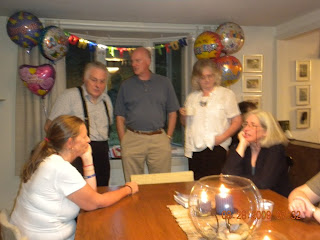


After the skit, I gave a bit of a speech, some of which Emma Simonetti captured on video:
(Okay, so I tried and tried to get the video to upload, but apparently am not geeky enough to figure it out.)
After the speech, Tamar said a few lovely things, and Matt and Mary Jane Odhner gave me a gift.....

A black sheep in a red stole!
How perfect.
No one from my family of origin came.
But 24 wonderful people filled the house and sang to me, with many more folks sending good wishes and regrets that they couldn't attend.
It was a lovely evening.
I've also got video of the ordination itself, which some people watched at the party. I'm trying to figue out how to upload it so more folks can see it.
Bryn Athyn Celebration of Ordination, Part 1
We started the party with a skit:
(In case you're not sure, this is satire.)
General Church member: Hey, Hi! Good to see you! (Hug) I hear you are a minister now. Congratulations!
Alison: Thanks! I feel great. I’m very happy.
General Church member: So, they finally let women into the Bryn Athyn theological school....and they ordained you. Wonders never cease.
Alison: Well, no. I’m ordained into the Swedenborgian Church of North America - the "Convention" Church.
GC member: Ohhhhhh! Well then.... So you’re not a real minister.
Alison: No. I guess I’m not a real minister.
GC member: So, where did you study to get your degree?
Alison: I did the bulk of my studies at a wonderful Lutheran seminary in Ontario, and got all my Swedenborgian credits through the Convention seminary in California by distance learning.
GC member: I see. So, not at a real seminary.
Alison: No. I couldn’t study at a real seminary. But I made wonderful friends at my seminary!
GC member: Oh! Are they in the General Church?
Alison: Well, no, it was a Lutheran seminary....
GC member: So, they aren’t real friends.
Alison: No. I guess you’re right. They aren’t real friends....
GC member: Mmm-hmmm.... So, where do you work?
Alison: I work at the Church of the Good Shepherd, in Kitchener.
GC member: Ohhhhhh! Well then.... (relieved) So at least you are working in Caryndale.
Alison: No. That’s the General Church congregation. I work at the Convention Church in Kitchener.
GC member: Ohhh. So, you don’t work at a real church.
Alison: No. You’re right. I guess I don’t work at a real church....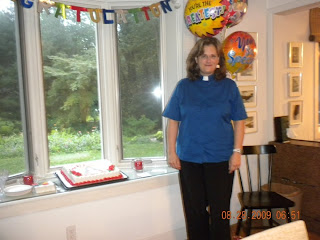
GC member: And how is your husband with all this?
Alison: He’s been wonderful, really supportive.
GC member: But, you’re not a member of the General Church any more?
Alison: That’s right. I resigned almost two years ago.
GC member: So, you don’t even have a real marriage.
Alison: I guess not, not a real marriage.... (Sighs)
GC member: (Pause. Brightens) Well, your children! How are they doing?
Alison: Both of my daughters have wonderful, adorable boyfriends, who are really good to them.
GC member: That’s wonderful! Who are they?
Alison: You wouldn’t know them. They aren’t in the General Church.
GC member: So, they don’t have real boyfriends.
Alison: No. Not real boyfriends.
GC member: But they are both at The Academy?
Alison: No. None of my children are.
GC member: So, you don’t even have real children.
Alison: No, I don’t even have real children. (Sighs)
GC member: (Long, awkward pause.) Well! This has been interesting.
Alison: Indeed! But don’t worry. Talking to me wasn’t even a real experience, so you’ll be okay.
GC member: (Laughs with relief.) You’re right! Well that’s all right then! Good bye!
Alison: It has been quite interesting talking to you. (Then, under her breath) Unreal....
(In case you're not sure, this is satire.)
General Church member: Hey, Hi! Good to see you! (Hug) I hear you are a minister now. Congratulations!

Alison: Thanks! I feel great. I’m very happy.
General Church member: So, they finally let women into the Bryn Athyn theological school....and they ordained you. Wonders never cease.
Alison: Well, no. I’m ordained into the Swedenborgian Church of North America - the "Convention" Church.
GC member: Ohhhhhh! Well then.... So you’re not a real minister.
Alison: No. I guess I’m not a real minister.
GC member: So, where did you study to get your degree?
Alison: I did the bulk of my studies at a wonderful Lutheran seminary in Ontario, and got all my Swedenborgian credits through the Convention seminary in California by distance learning.
GC member: I see. So, not at a real seminary.
Alison: No. I couldn’t study at a real seminary. But I made wonderful friends at my seminary!
GC member: Oh! Are they in the General Church?
Alison: Well, no, it was a Lutheran seminary....
GC member: So, they aren’t real friends.
Alison: No. I guess you’re right.
 They aren’t real friends....
GC member: Mmm-hmmm.... So, where do you work?
Alison: I work at the Church of the Good Shepherd, in Kitchener.
GC member: Ohhhhhh! Well then.... (relieved) So at least you are working in Caryndale.
Alison: No. That’s the General Church congregation. I work at the Convention Church in Kitchener.
GC member: Ohhh. So, you don’t work at a real church.
Alison: No. You’re right. I guess I don’t work at a real church....

GC member: And how is your husband with all this?
Alison: He’s been wonderful, really supportive.
GC member: But, you’re not a member of the General Church any more?
Alison: That’s right. I resigned almost two years ago.
GC member: So, you don’t even have a real marriage.
Alison: I guess not, not a real marriage.... (Sighs)
GC member: (Pause. Brightens) Well, your children! How are they doing?
Alison: Both of my daughters have wonderful, adorable boyfriends, who are really good to them.
GC member: That’s wonderful! Who are they?
Alison: You wouldn’t know them. They aren’t in the General Church.
GC member: So, they don’t have real boyfriends.
Alison: No. Not real boyfriends.
GC member: But they are both at The Academy?
Alison: No. None of my children are.
GC member: So, you don’t even
 have real children.
Alison: No, I don’t even have real children. (Sighs)
GC member: (Long, awkward pause.) Well! This has been interesting.
Alison: Indeed! But don’t worry. Talking to me wasn’t even a real experience, so you’ll be okay.
GC member: (Laughs with relief.) You’re right! Well that’s all right then! Good bye!
Alison: It has been quite interesting talking to you. (Then, under her breath) Unreal....
Tuesday, June 30, 2009
My ordination talk

Welcoming the Stranger
Alison Longstaff, June 26 2009
Ordination talk, University of Washington
Matt 25: 34-40 Then the Sovereign One will say to those on the right hand, 'Come, you blessed of Abba God, inherit the kingdom prepared for you from the foundation of the world: for I was hungry and you gave Me food; I was thirsty and you gave Me drink; I was a stranger and you took Me in; I was naked and you clothed Me; I was sick and you took care of Me; I was in prison and you visited Me.
Then those honorable ones will answer, saying, “Teacher, when did we see You hungry and feed You, or thirsty and give You drink? When did we see You a stranger and take You in, or naked and clothe You? Or when did we see You sick, or in prison, and come to You?" And the Sovereign One will answer and say to them, "Truly, I say to you, every time you did it for one of the least of my sisters or brothers, you did it for Me."
 In ancient Rome and Greece, newborn baby girls were regularly abandoned by the roadside and left to die. Girls were considered a liability. They cost money to marry off, and they couldn’t carry on the family name. By the time of the Lord’s birth on earth Roman society was experiencing a severe shortage of women because of the neglect and abandonment of baby girls. But it didn’t stop the practice.
There are parts of the world where girls are still treated this way. Indeed, the practice of subjugating and devaluing women continues in many subtle ways in every corner of our world. Our culture has come a long way, but we’ve still got a long way to go.
“for I was hungry and you gave Me food; I was thirsty and you gave Me drink; I was a stranger and you took Me in; I was naked and you clothed Me; I was sick and you took care of Me; I was in prison and you visited Me."

 You, all of you, whether you know it or not, cared for me, wounded and broken though I was, and nursed me back to health. Though I’m not perfect, you welcomed me with kindness and love.
  Do you have any idea what that has meant to me?
But maybe we need to reframe our mission on this world. We keep thinking that it is our job to grow the New Church for the Lord, and that that “New Church” is going to look like lots of new members in this denomination.
But look around you. The New Church is popping up in voices and hearts in all sorts of unexpected places. It lives in that Rabbi and in that Sheikh that spoke so eloquently to us Wednesday night. You saw it and felt it. It lives in the heart and mind of Reverend Jeff, even if he uses different words and has some different ideas. It is showing up everywhere, if we can but realize what we are seeing. It lives in more and more hearts and minds every day, and God is doing it all by ... Herself. God is bringing about the Holy City, and a person doesn’t necessarily have to have heard of Swedenborg to be part of it.
Have we failed because we are still so small and so few people have heard of Swedenborg? Not on your life. Every moment that we live our love and our calling, we are doing just what God asks of us. Because it is always and ever about living our love, and not about our status, or glossy brochures, or fancy programming, or packed stadiums and praise bands.
 Anyway, let’s not worry about the future. It will worry about itself. Please, just for tonight, celebrate with me that one little girl who was dead is alive again. And God willing, thanks to you, I am going to be one mighty power for good in the world. Tonight, celebrate with me the miracle of the newest good news: the absolute trustworthy power of God’s love. Of course we will work with all our might for this church because we love it so much. But we don’t have to worry. All will be well with the church because it is not really up to us; it’s in God’s hands … and with God, all things, ALL THINGS, are possible.
Alison Longstaff, June 26 2009
Ordination talk, University of Washington
Matt 25: 34-40 Then the Sovereign One will say to those on the right hand, 'Come, you blessed of Abba God, inherit the kingdom prepared for you from the foundation of the world: for I was hungry and you gave Me food; I was thirsty and you gave Me drink; I was a stranger and you took Me in; I was naked and you clothed Me; I was sick and you took care of Me; I was in prison and you visited Me.
Then those honorable ones will answer, saying, “Teacher, when did we see You hungry and feed You, or thirsty and give You drink? When did we see You a stranger and take You in, or naked and clothe You? Or when did we see You sick, or in prison, and come to You?" And the Sovereign One will answer and say to them, "Truly, I say to you, every time you did it for one of the least of my sisters or brothers, you did it for Me."
 In ancient Rome and Greece, newborn baby girls were regularly abandoned by the roadside and left to die. Girls were considered a liability. They cost money to marry off, and they couldn’t carry on the family name. By the time of the Lord’s birth on earth Roman society was experiencing a severe shortage of women because of the neglect and abandonment of baby girls. But it didn’t stop the practice.
There are parts of the world where girls are still treated this way. Indeed, the practice of subjugating and devaluing women continues in many subtle ways in every corner of our world. Our culture has come a long way, but we’ve still got a long way to go.
However, this isn’t meant to be a “women’s lib” talk. It is a cry against discrimination in every form. We all know injustice, not just women, not just blacks not just immigrants.  Every one of us in this room, at one time or another in our lives has felt marginalized, singled out, or picked on. From playground bullying, to being the last one picked for basketball, to being refused service or support because our income is too low, we have all experienced that feeling of the door slamming in our face---of being deemed unworthy. We all know the emotional experience of having the pack withdraw from us and look at us with dislike. It feels rotten.
 Every one of us in this room, at one time or another in our lives has felt marginalized, singled out, or picked on. From playground bullying, to being the last one picked for basketball, to being refused service or support because our income is too low, we have all experienced that feeling of the door slamming in our face---of being deemed unworthy. We all know the emotional experience of having the pack withdraw from us and look at us with dislike. It feels rotten.
If an infant experiences the withdrawal of the pack, it faces certain death. Such abandonment communicates profound dehumanization. That child is considered a waste of time and resources. How can the most helpless and innocent of all human beings comprehend such a rejection?  Perhaps that is why all forms of rejection cut so deep. It communicates to our “lizard brain” that we are singled out to die. Though you and I may be relatively mature, and know in our heads that we will survive rejection just fine, experiences of rejection and abandonment can still throw us into a profoundly vulnerable emotional place. Our lizard brain sees the complete withdrawal of our support, resources, and foundation, and it believes we are going to die.
 Perhaps that is why all forms of rejection cut so deep. It communicates to our “lizard brain” that we are singled out to die. Though you and I may be relatively mature, and know in our heads that we will survive rejection just fine, experiences of rejection and abandonment can still throw us into a profoundly vulnerable emotional place. Our lizard brain sees the complete withdrawal of our support, resources, and foundation, and it believes we are going to die.
That was essentially what my emotional state was when I knocked  on the door of this denomination. I had been cut out of my pack. My spiritual family had left me by the road to die, without a backward glance. I was devastated, kicked out of the only spiritual home I had ever known. After all, the Bishop’s Decree had come down from the top: “God says women can’t be ministers, so shut up and stop your whining.” (I think those were the bishop’s exact words...)
 on the door of this denomination. I had been cut out of my pack. My spiritual family had left me by the road to die, without a backward glance. I was devastated, kicked out of the only spiritual home I had ever known. After all, the Bishop’s Decree had come down from the top: “God says women can’t be ministers, so shut up and stop your whining.” (I think those were the bishop’s exact words...)
Oh, I was welcome back, if I kept my mouth shut about the injustice and the sexism I was witnessing. I was welcome back if I gave up my call to ministry and suppressed it as unnatural and unfeminine. I was welcome back if I stopped being me. They wanted my body in the pews, but not my heart, not my intelligence, and certainly not my longing to be a minister.
So I stumbled up to your doors, “bleeding from every orifice” as one friend described me. I was an orphan. I was an unwanted child.
 was witnessing. I was welcome back if I gave up my call to ministry and suppressed it as unnatural and unfeminine. I was welcome back if I stopped being me. They wanted my body in the pews, but not my heart, not my intelligence, and certainly not my longing to be a minister.
So I stumbled up to your doors, “bleeding from every orifice” as one friend described me. I was an orphan. I was an unwanted child.
“for I was hungry and you gave Me food; I was thirsty and you gave Me drink; I was a stranger and you took Me in; I was naked and you clothed Me; I was sick and you took care of Me; I was in prison and you visited Me."

I began to inquire at SHS, and was astonished to receive heartfelt congratulations and excitement over my call to ministry. Then the local congregation in Kitchener, Ontario, Canada adopted me with unbounded warmth, kindness, and enthusiasm, welcoming me as if I was someone worth loving.
I was a stranger and you took Me in; I was naked and you clothed Me; I was sick and you took care of Me....
 You, all of you, whether you know it or not, cared for me, wounded and broken though I was, and nursed me back to health. Though I’m not perfect, you welcomed me with kindness and love.
  Do you have any idea what that has meant to me?
And now, now that I am strong and well again, and equipped for service, it is my turn to give back to you, with my whole heart and devotion. I bring playfulness and music, a voice of hope and compassion, and a heart full of delight in the new incarnation of God’s love that is this second coming. I wish to be an encourager, a teacher, and perhaps even a pioneer into new spiritual territories, discovering and mapping where this church might go in the future.
I have sat in these meetings and I have heard the concerns for our future. I see the frustration and the discouragement over the declining membership.
I have sat in these meetings and I have heard the concerns for our future. I see the frustration and the discouragement over the declining membership.

But maybe we need to reframe our mission on this world. We keep thinking that it is our job to grow the New Church for the Lord, and that that “New Church” is going to look like lots of new members in this denomination.
But look around you. The New Church is popping up in voices and hearts in all sorts of
 unexpected places. It lives in that Rabbi and in that Sheikh that spoke so eloquently to us Wednesday night. You saw it and felt it. It lives in the heart and mind of Reverend Jeff, even if he uses different words and has some different ideas. It is showing up everywhere, if we can but realize what we are seeing. It lives in more and more hearts and minds every day, and God is doing it all by ... Herself. God is bringing about the Holy City, and a person doesn’t necessarily have to have heard of Swedenborg to be part of it.
I don’t think we have to worry. We don’t own the New Church. We never did. It is God’s church, not ours, and comes to each person in its right time. We don’t “have it” to give to another. We h ave it to live, day by day in community with the whole world.
 ave it to live, day by day in community with the whole world.
 You and you and you and I, simply by loving these ideas and struggling to live them into our ordinary lives, are very much contributing to the descent of the Holy City. We bear witness to it with our lips, yes, but more importantly, we bear witness to it with our quality of being on this planet.
 So, we might need to reframe our understanding of our job as a church. It may not be our destiny to grow huge in numbers. It might just be our job to hold the space for love, to keep the flame of the spirit of truth alive while God does the work of birthing the New Church on earth. This tiny denomination has been the mother and the midwife of this new birth for years already. Well done, good and faithful servants. The baby is crowning, and all we have to do is breathe, and relax, and try not to strain. This birth is in the Lord’s h
 ands, and therefore, all is well.
 So, we might need to reframe our understanding of our job as a church. It may not be our destiny to grow huge in numbers. It might just be our job to hold the space for love, to keep the flame of the spirit of truth alive while God does the work of birthing the New Church on earth. This tiny denomination has been the mother and the midwife of this new birth for years already. Well done, good and faithful servants. The baby is crowning, and all we have to do is breathe, and relax, and try not to strain. This birth is in the Lord’s h
 ands, and therefore, all is well.
 I say again: “the new church” may never be one unified natural organization called “The New Church.” I think we get stuck on that expectation. The New Church may be just what we are already seeing: Rabbis and Sheikhs, Imams and Pagan priestesses, Lutherans and Presbyterians and agnostics who see that the one God is for everyone. Allah is Yahweh is the Goddess is Jesus is: “Goodness embodied in kindness and art and compassion and service” no matter what our holy book or skin colour or country of origin or gender.
Have we failed because we are still so small and so few people have heard of Swedenborg? Not on your life. Every moment that we live our love and our calling, we are doing just what God asks of us.
 Because it is always and ever about living our love, and not about our status, or glossy brochures, or fancy programming, or packed stadiums and praise bands.
How do I know this? Well, remember those baby girls who were abandoned in Rome to die? Some were found and adopted by a tiny and persecuted group whose mandate was simply to serve the world with kindness and compassion---to feed the hungry and visit those in prison and to tend the sick. Those girls were adopted and raised within the fragile struggling group, learning also to serve the poor and reach out in love to the marginalized. That tiny band was heaven-bent on obeying their radical rabbi’s command to remember the widows and the orphans, to welcome the stranger, and to become the least and the servant of all.
Whatever happened to that tiny, poor, struggling group? You can bet they wondered and worried about their future. What were they called anyway? Something like … Christians? What did ever happen to them?
Whatever happened to that tiny, poor, struggling group? You can bet they wondered and worried about their future. What were they called anyway? Something like … Christians? What did ever happen to them?
 Anyway, let’s not worry about the future. It will worry about itself. Please, just for tonight, celebrate with me that one little girl who was dead is alive again. And God willing, thanks to you, I am going to be one mighty power for good in the world. Tonight, celebrate with me the miracle of the newest good news: the absolute trustworthy power of God’s love. Of course we will work with all our might for this church because we love it so much. But we don’t have to worry. All will be well with the church because it is not really up to us; it’s in God’s hands … and with God, all things, ALL THINGS, are possible.
Subscribe to:
Posts (Atom)