“Tearing Down the Walls”
Supply preached
by Kippy Rudy, November 9, 2014
Bath Church of the New Jerusalem
Joshua
5:13-14, Joshua 6: 1-5, 10-11, 12b, 15-16, 20-25, HS 8815
“The walls of Jericho” mean the falsities that defend
evils. Secrets
of Heaven (AC) 8815

I'd like you all to relax, open your minds, and imagine something
with me for a moment. Now, this may be a stretch, but I want us to imagine that
we are all part of a small, no scratch that, very small—all right let's be honest,
compared to everyone else we're minuscule—I want us to try and imagine that we
are all part of a teeny, tiny, and yet vibrant, extremely vibrant, spiritual
community. Do you think you can do that with me? Good, then let's continue.A community with its own unique language and rituals and understanding of God, a community with a long and venerable history, a
community with so much to offer the world, and yet a community that could
easily disappear into the annals of history if we can't somehow find a way to
hold it together and face the seemingly insurmountable challenges ahead of us
with absolute courage and unwavering faith—you got it? Are you with me here?
Do you feel it? Good.

Then you know exactly how the Israelites felt as they entered the
Promised Land. After years of wandering, this tiny little band of chosen
people has finally crossed the river Jordan and entered the land of Canaan. And
they are ready—ready and willing to receive their divine inheritance and take
possession of the land that was promised to their forefather Abraham. Only,
there's a slight problem. People already live there: namely the Canaan-ites,
the Hittites, the Hivites, the Perizzites, the Girgashites, the Amorites, and
please don't forget the Jebusites, and, well, these people haven't gotten the
divine eminent domain memo.
So if the Israelites want this land, they're going to have to take
it, and
under the leadership of Joshua, this is precisely
what they set out to do. They may be small and scrappy, they may have their own
peculiar way of doing things and their own peculiar way of talking about the
things that they do, but with God on their side there is no battle they cannot
win, no people they cannot conquer, no city they cannot take.

And so the Israelites march right up to the first city, the city
of Jericho, the gateway city that stands at the base of the Promised Land, and
set up camp around the great wall. In accordance with the Lord's instruction,
they do not attack, but rather they march.
They march around the city every day for six days. The priests
carry their trumpets, the soldiers carry their swords, but no one says a word
or makes a sound. Then on the seventh day, the Israelites march around the city
seven times, and at the very last moment the priests blow their horns, and the
people shout with all their might; the walls of the city come crashing down and
Jericho is given like a gift into the hands of the Israelites is a complete
and utter triumph.

But then something happens, something absolutely, unspeakably
horrible. The people rush forward and put every living being—all the kings
soldiers and all the kings men, yes, but also all of the civilians, the men,
the women, the little children, and the tiny babies, all of the animals, the
oxen and the sheep and the donkeys, the horses, the cats, and the dogs, (people,
if there was so much as a hamster in Jericho that day . . .)—every living
being, except for one woman and her household, are put to death by the sword.
It is a heartbreaking story, absolutely horrible, and I wish I
could say it was an isolated incident within scripture, a bizarre little
aberration in an otherwise unsullied narrative of divine love and mercy, but
it's not. There are several such stories in the Bible, not just stories of
war, but stories of war wherein God commands the complete and utter
destruction of every living being in an enemy's territory, no matter how young
or weak or vulnerable those beings might be.

But do you want to know what is unusual, what the really crazy
thing is about this story in particular? People love it. Pastors lift the
Battle of Jericho up in their sermons as a story of God's favor and awesome
power. Congregations and choirs sing some great songs about it. (Thank you
very much by the way. Can we have a hand for the Convention Choir?) And as if that weren't strange enough, we read
it to our kids in Sunday School, in much the same way we read the story of
Noah's ark, as if genocide was the most natural thing in the world.
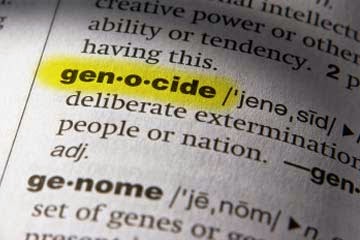
Yeah. It's all a little strange when you really start to think
about it, isn't it? Wipe life as we know it off the planet and you have the
makings of an epic tragedy, but save just two of every animal and you've got
all the material you need for the most popular children's play set of all time.
Who knew? But seriously, once you start to look at the finer details of a story
like this, it really is disturbing. Scholars and theologians have labored
long and hard to try and make sense of this one, and I could tell you a bit
about what they say, only I have the strange suspicion that you would all promptly
tune out.
We're Swedenborgians after all, and we already know that there's a
spiritual sense imbued within these letters full of a higher, more personal,
and surely more useful meaning. Why slum about in the historical realm when you
can soar and play in the celestial one? Why torment one's self trying to make
sense of the literal when one can revel in the spiritual?

Why? Because real people died that day in Jericho. Real mothers
lost real babies, real husbands lost real wives, real people lost their homes,
their livelihoods, their very lives in the face of an army that thought it
was carrying out God's will. And if we dismiss those people as no more than a
means to an end, the literal fodder for a great spiritual interpretation, the
only difference between us and Joshua's soldiers is not one of kind but of
degree.
That is, if we look at this story and somehow convince ourselves
that our ability to draw a spiritual meaning from this literal historical event
somehow makes the event itself okay, then what we are effectively doing is
justifying the slaughter. Furthermore, when we jump right to the
correspondences and begin playing with spiritual interpretations, we miss the
opportunity to question the event itself, to question what it says about God,
and what it says about us, to question whether or not Joshua was even right,
whether or not the slaughter was necessary.
And I'm afraid that if we miss that opportunity, then our
understanding of Swedenborg's correspondences, however interesting they might
be, is bound to become corrupted in the process.

Because, you see, if Joshua was actually wrong on the literal
level to cause such destruction, then simply transferring his methodology up
the correspondential ladder, if you will, probably won't yield better or more
lasting results for any of us. So let's take a closer look, first, at how this
story is traditionally understood on the literal level, and see how a few well-placed
questions on that end can add nuance to our standard spiritual understanding of
this most troubling text. Are you with me? Wonderful. A little nervous? Me too,
but here we go.
Traditionally, on the literal level, the genocide that takes
place during the Battle of Jericho is understood as an unfortunate but necessary
means to an end. When you are as small and as unique as the Israelites were,
when you have so much to protect and so little to work with, then when you
strike you must strike hard.

They couldn't afford to fail, nor could they afford to be
compromised, so when they conquered a people they showed no mercy. They wiped
out every last person they could find, every last trace of culture or religion
that could possibly lead their people astray. Only then, in their minds, could
they truly be safe and prosper in the promised land.
And you know, on the one hand I can see their logic; however,
there are still some pretty strange inconsistencies in this story that I'd like
to point out to you, the first having to do with the promise itself. You'll
remember that a big part of the promise given to Abraham back in Genesis
involved the Israelites not just inheriting the land of Canaan but being
a—what to the nations? A blessing.

Now, I don't know about you, but I can't quite see how killing
first and blessing later is a really good strategy for fulfilling this promise.
Does that seem a little off to you? Me too. And speaking of killing—and
this is my second problem with the story—it's one thing to kill those who have
the potential to kill you—I mean even the poor, little, innocent babies could
theoretically grow up to exact revenge someday—but killing all the animals
seems like a needless waste to me. How could the animals have corrupted the
Israelites I wonder?
Likewise, destroying the city itself with all its temples and art
and literature seems a good plan if you don't want the people to get seduced
or tainted by falsities, but it's exceedingly ironic, in my humble opinion,
that in their mad dash to purge the city of all corrupting influences, be they
animal, vegetable, or mineral, that the one person they do save is—anyone
remember her name?—Rahab, yes. And what did Rahab do for a living? She was a
harlot. Rahab and all the members of her "household" were spared
because she had helped the Israelite spies escape, a household that included
her father and mother and brothers, I'm sure, but a household that in all
likelihood probably included an unusually large number of "sisters"
as well, if you catch my drift.

And finally, there is the issue of God's part in this whole
debacle, our God who we understand to be all loving and all wise. I have a
really hard time understanding how our God could ever approve of genocide, and,
truth be told, I see a number of little signs that indicate that, at least in
this story, the all-out slaughter wasn't really God's idea at all. For one
thing, when God says he will give the city to Joshua, he does so, but he
brings down the walls with music rather than warfare. Victory is achieved
without one drop of blood being spilt.
For another, although God does command the Israelites in other
parts of the Bible to wipe out entire cities, in this particular passage, if
you read it closely, he never once tells Joshua to kill all of the living
creatures inside of Jericho. God says, "See, I have given Jericho into
your hand, with its king and valiant warriors," but it is not God who
commands that the Israelites put all of Jericho to death, it is Joshua.

All of which sends me back to reconsider that strange little
exchange Joshua engages in with an angel days before the battle even begins.
Joshua asks the angel, "Are you for us or for our adversaries?" And
the angel says, "No," which is kind of a strange answer to an
"either/or" question. "Rather, I indeed come now as captain of
the host of the Lord," says the angel. That is, "I'm on God's side,
human, not theirs, but not yours either." Joshua wanted to know if God was
on their side, but what he should have been asking each step of the way is not
whether God was on their side, but whether or not they were on God's.
Now, I bring all of these little quirks to your attention because
I think it is extremely important for us to question scripture, to have enough
respect for the literal sense of the word to wrestle with it and not accept it
as simply a text for imitation or as a spring board we can utilize uncritically
to reach a more interesting spiritual interpretation.
The Bible isn't always showing us who we ought to be. Sometimes it
is only showing us who we already are. And in those instances, our job is not
to meekly accept the charge, but to wrestle with the image before us and, God willing,
strain for something higher.
Unfortunately, most of the Swedenborgian literature that deals
with this passage in particular fails to question whether or not Joshua was
even right. It plows right ahead and concludes that if Joshua dealt with the
evils of Jericho in this way, then we ought to deal with the evils in our own
lives this way as well. But what if Joshua went overboard?

Now please understand, I'm not calling the correspondences
themselves into question, but I'm questioning what we ultimately do with them.
I think the correspondences Swedenborg outlines actually stand up very well.
In Secrets of Heaven (8815) he explains that the walls of Jericho represent
the lies, half truths, and rationalizations we use to justify our own evil
actions, and it is clear that those walls really do need to come down if we are
going to live our lives to the fullest as God intended.
If we truly want to overcome our evils, then we must, with the
help of God, examine the defensive strategies we have built up around them to
keep them safe, just as the spies appraised the defenses of Jericho. We need to
be patient and obedient to what we know is good even when it doesn't feel right
yet, just as the Israelites did when they walked about the city each day for
six days wondering what the heck they were doing. And finally, we need to trust
not in our own power, but in the power of God to bring the walls down on our
behalf.
These correspondences are powerful and exceedingly useful. Indeed
Swedenborgians, and Grant Schnarr in particular in his very helpful little
book, Return to the Promised Land, have put them to good use, especially
around issues of addiction and spiritual recovery. How many of you have
benefited from his work? I'm not surprised.

if you're caught up in a web of sin or
addiction, the only way to break the chains that bind you to destructive behaviors
is with the truth. With the help of God you can tear down the walls of lies
that keep you going back to the bottle for solace or drugs for happiness or
pornography for love, just to name a few examples.
But I think we get into trouble when we follow Joshua down the
road of believing we can not only rid ourselves of all the lies that give evil
power over us, but succumb to the belief that with enough determination we can
actually rid ourselves of evil itself once and for all. It would be nice if we
could, but I don't think evil works that way anymore than God does.

At the end of Grant Schnarr's chapter on Jericho he writes:
After
the walls fell down Israel wiped out the enemy so as not to be perverted by
their immoral spiritual practices. Spiritually, the lesson is one that cannot
be overstated: we must wipe out that hideous evil completely. Once we expose
the defect, we must show no leniency. When the walls of illusion crumble, it's
time to destroy those defects before they can re-arm and destroy us. Knock them
out with the sword of truth and annihilate them. Not until then will there be
peace,
(pp. 165-166)
Well, that sounds really good, and I can see a lot of usefulness
in what Rev. Schnarr is saying, except for one small but pesky detail: war
never leads to peace, at least not the true, just, lasting peace that we all
long for.

In my experience you can make war on drugs, you can make war on
terror, you can make war on poverty, you can make war on most anything that is
harmful, but war is, at best, only a temporary solution. Peace is not what you
get when you finally destroy everything or everyone who could potentially harm
you because that battle never ends. Peace only comes from the hard work of
making peace.
Add to this the fact that, as it says in Divine Providence, the
Lord does not annihilate the evils in our lives when we repent of them, but
simply removes them to a place where they have no power over us, and you start
to wonder, "Hey, if God doesn't destroy evil, who are we to think that we
should or even could, if we wanted to?”

So perhaps the story of Jericho is here to tell us that ultimately
Joshua was wrong, as are we if we think that the best way to combat evil is to
obliterate it rather than neutralize it. War did not eternally secure the
Promised Land for the Israelites back then, anymore than war is securing it for
them right now. Maybe the most powerful spiritual lesson to be found in this
passage is the knowledge that our job is not to wipe out evil, because evil
doesn't work that way, and when we go after evil, too often what we really end
up going after is each other. No, our job is not to fight evil with force but
to join with God in peacefully dismantling the lies that give evil power over
us and over others. "Peace," in the words of Frederich Beuchner,
"is not the absence of conflict, but the presence of love."
And believe it or not, there is actually a little bit of love in
this story, a modicum of mercy, if you will, an exception made in the midst of
Joshua's headlong rush to obliterate a people he feared would corrupt his own,
and it is in her that we find redemption, not just for Joshua but for all the
world. Remember Rahab, who we mentioned before, Rahab the harlot?
If there was a top ten list of people most likely to corrupt the
purity of the Israelites, Rahab and her "household" would have been
in the top five. But Joshua made a curious exception for Rahab and showed her
mercy. He compromised to save a person of dubious character, and it was this
very compromise that ultimately led to the greatest in-breaking of the divine
upon our world.

For you see, Rahab was taken in by the Israelites, and, in time,
she had a son named Boaz who grew up and married another compromised gentile
girl by the name of Ruth, whose great grandson was none other than King David,
whose line eventually culminated in the birth of a tiny baby boy in a little
town called Bethlehem by the name of Jesus. Because Rahab the prostitute was
allowed to live, Jesus the messiah was able to be born.
Coincidence?
I think not.
Providence?
You better believe it.
So maybe the battle of Jericho is not a story that glorifies war
after all, but a story that lifts up the true blessing that comes from showing
mercy and making peace.
My friends, preserving one's identity as a small people and
protecting one's integrity as a people set apart for God is a high calling. As
such we are called to dismantle the walls of lies that protect and nurture all
that is evil and corrupt in this world. But when we do so at the expense of
one another, when, in our headlong rush to destroy evil we destroy one another,
then we have lost our way.

For our highest calling is not the tearing down but the building
up of a new city. Not a new Jericho, but a new Jerusalem, a city built not with
bricks and mortar, but with hands reaching out to one another, especially those
who are other, hands that build up with love and reach out with mercy, and
hands that make room, no matter what the cost, for God's love and God's light
to break in upon our world. This is our calling. Amen and Amen.
Originally preached at the 184th Annual Convention, Saturday morning, July 5, 2008 at Bridgewater New Jerusalem Church, in Bridgewater, Massachusetts.
As published in “The Messenger,” by the Swedenborgian Church of North
America; Volume 230 • Number 7 • September 2008
At the
time of this writing, Rev. Sarah Buteux was pastor of the First Congregational
Church of Hadley, Massachusetts.
If you would like to comment on this or any other posting without signing into Blogger, you may post a comment on the Facebook page: https://www.facebook.com/InThisMomentBlog?ref=br_tf
The Readings
Joshua 5:13-14, Joshua 6: 1-5,
10-11, 12b, 15-16, 20-25
13 And it
came to pass, when Joshua was by Jericho, that he lifted his eyes and looked,
and behold, a Man stood opposite him with His sword drawn in His hand. And
Joshua went to Him and said to Him, “Are You for us or for our adversaries?”
14 So He
said, “No, but as Commander of the army of the Lord I have now come.”
Now Jericho was shut up inside and out because of the
Israelites; no one came out and no one went in. 2 The Lord said to Joshua, “See, I have handed
Jericho over to you, along with its king and soldiers. 3 You shall
march around the city, all the warriors circling the city once. Thus you shall
do for six days, 4 with seven priests bearing seven trumpets of rams’ horns
before the ark. On the seventh day you shall march around the city seven times,
the priests blowing the trumpets. 5 When they
make a long blast with the ram’s horn, as soon as you hear the sound of the
trumpet, then all the people shall shout with a great shout; and the wall of
the city will fall down flat, and all the people shall charge straight ahead.”
10 To the
people Joshua gave this command: “You shall not shout or let your voice be
heard, nor shall you utter a word, until the day I tell you to shout. Then you
shall shout.” 11 So the ark of the Lord went around the city, circling it once;
and they came into the camp, and spent the night in the camp.
14 b They did this
for six days.
15 On the
seventh day they rose early, at dawn, and marched around the city in the same
manner seven times. It was only on that day that they marched around the city
seven times. 16 And at the seventh time, when the priests had blown the
trumpets, Joshua said to the people, “Shout! For the Lord has given you the city. 20 So the
people shouted, and the trumpets were blown. As soon as the people heard the
sound of the trumpets, they raised a great shout, and the wall fell down flat;
so the people charged straight ahead into the city and captured it. 21 Then
they put to the sword all in the city, both men and women, young and old, oxen,
sheep, and donkeys.
22 Joshua
said to the two men who had spied out the land, “Go into the prostitute’s
house, and bring the woman out of it and all who belong to her, as you swore to
her.” 23 So the
young men who had been spies went in and brought Rahab out, along with her
father, her mother, her brothers, and all who belonged to her—they brought all
her kindred out—and set them outside the camp of Israel. 24 They
burned down the city, and everything in it; only the silver and gold, and the
vessels of bronze and iron, they put into the treasury of the house of the Lord. 25 But
Rahab the prostitute, with her family and all who belonged to her, Joshua
spared. Her family has lived in Israel ever since. For she hid the messengers
whom Joshua sent to spy out Jericho.
Secrets of Heaven (AC) 8815
“The walls
of Jericho” mean the falsities that defend evils.


