“Earthquakes”

Rev. Alison
Longstaff, May 17, 2015
Bath Church
of the New Jerusalem
Psalm 104: 1-9,
31-35; Revelation 11: 13-14, 19; DLW 47
From Emanuel Swedenborg, "The Apocalypse Explained" # 400
“The earth tottered and quaked; the
foundations of the mountains trembled.” (Ps. 18:7) This does not mean that it
was the actual earth and its foundations that tottered and quaked, but that the
spiritual church and the truths upon which it was founded tottered and quaked.
“Earth” signifies the church as a spiritual collective, and the “foundations of
the mountains” signifies the church’s foundational beliefs, which ought to be
true ideas that lead to a good life.
Raise your hand if
you have ever been in an earthquake. How
close was it? What magnitude was
it?
The only one I have ever experienced was when I was in Toronto in 1986, and it was so small that at first I simply thought an extra big truck had driven by.

One friend I know
lived through the 1994 6.7 magnitude “North Ridge” quake near Los Angeles in
1994. He had recently moved there from a
region that has no quakes, and he said, “Reality is never supposed to behave
that way.” It was one of the most
profoundly disorienting and disturbing experiences he had ever had. No one he knew was hurt or killed, yet it
“shook” him to his core emotionally as well as physically.
But then again,
another friend who has lived in Los Angeles for years told me with a laugh what
to do if there was a quake. “Just stand
in a doorway or get under the table. Or
you can go out on the porch and watch the road do this,” and she moved her arm
like waves in the water. She had
experienced so many earthquakes without major catastrophe that they had become
simply a matter of course. (She does
live in a sturdy house that has survived many quakes already.)

Scientists no
longer use “the Richter scale” when they describe earthquakes because they
measure many more aspects of their movement than they used to: direction, style,
and the depth, for example. But for the purposes of us peasants, the old and
new scales look pretty much the same. Each
increase of one up the scale still means “1000 times stronger.” So the April 25, 7.8 Nepal earthquake was over
1000 times stronger than the 6.7 “North Ridge” quake in California. I simply can’t imagine what that must be like. The Nepal quake lasted not quite two minutes—shall
we sit here for two minutes in silence and see just how long two minutes can
be? Actually, we would run outside away
from all the buildings and wait. Think
of the ground moving like a washing machine on agitate or a plane in turbulence
for those almost two minutes. Think of
buildings around here cracking and falling and the dust rising up. Think of not being able to go back into your
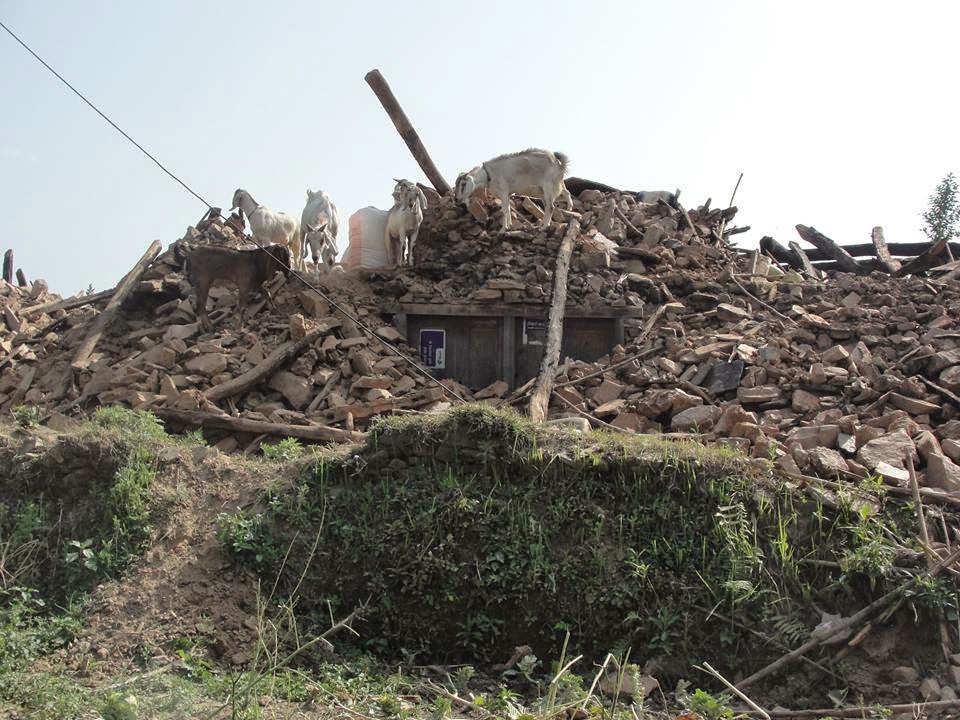
house because it has pancaked down to a pile of rubble.

The Nepal quake killed
more than 8000 people. Wikipedia gives the population of Bath, Maine as 8,357
in 2013. So more or less most of the entire
population of Bath was killed in Nepal in the first quake. I cannot comprehend it. My brain and emotions
shut down.
Yet I think it is
important that we sit with these details. I think it is important to feel the meaning of
earthquakes physically and spiritually.
Quakes that are between 7 and 8 on the scale cause “strong shaking” which clearly can last for several minutes,
and can cause major damage up to 155 miles away. 155 miles of strong shaking. That would mean
strong shaking and extensive damage as far from here as Killington VT, or Sherbrook
QB, Providence RI, or north along the coast of Maine all the way to the border
of Canada. That is how big the area of severe damage would be. The quake would be “felt” much farther away
than that.

Thinking about
this helps us understand how there could be many hundreds of outlying villages all
over Nepal, all needing aid. Most of the houses have been destroyed or rendered
unsafe in all these villages. The mountainous terrain also means that the roads that are barely
accessible at the best of times have often been blocked by landslides.
I cannot
imagine. I cannot imagine.

The Swedenborgian orphanage
in Kathmandu survived the earthquake and everyone is safe. Kent Rogers and his wife Shovha oversee its
running. Since the quake their home has
been a safe place for their thirteen children as well as many neighbors and
friends too whose homes were destroyed.
They have all been sleeping (cheek by jowl) on the floor of the main
room since that first quake. This is
because they must be able to get outside away from buildings as quickly as
possible no matter the time of day or night if there is another big shaking.

But so far, the
Loving Arms Mission is blessed to have a strong house and good resources, therefore
from this house and resources, they are delivering as much aid as they possibly
can to their neighbors.
Kent and his wife
Shovha, and many others at the mission have been doing everything in their
power to give aid to those in need. They
have especially been trying to get aid to many of the outlying villages, some
of which had seen no help at all until their mission van arrived. They are using every bit of donated money to
buy up sacks of food as well as tarps and other necessities and then take them
out to people in need day after day.

This is from Kent
on May 1, six days after the first quake, “Today, we went to Rajendra, Sunita and Sharmila's
village, Bansbari in Sindhupalchowk. All the houses were destroyed and we were
the first to offer aid. They were so happy to see us. Tomorrow, we go to Suman,
Mina and Bina's village which is in similar condition. If anyone reading this
is willing to lend or rent a four-wheel vehicle, we will take it. We very much
need it. We are going where no van has gone before---and I'm not sure how much
more the van can go.”

He also wrote: “Today
we brought 924 pounds of rice, 132 pounds of lentils, 198 pounds of soy protein
(cooked in curry and actually tasty), 300 packets of instant noodles and 300 small packets of crackers/cookies. It was all for
about 300 dollars. In addition to food needs, there are shelter needs and
rebuilding needs. Thank you so much to all who have donated--you are giving
food to people who need it. One old man told us today he hadn't eaten in seven
days.”
Kathmandu is built
on a sedimentary basin. That makes it
like the sugar bin I used in the children’s talk. When the earth shakes, the soil near the
surface goes every which way ripping apart the very foundations of the
homes. There is no stability at
all. Many of the homes in Los Angeles
that have survived quake after quake are built on granite—not just on the granite but drilled into the granite, so that when the earth moves, the rock
moves as one. The foundation is not ripped apart, and most
houses will survive the shaking.

In any case, the
spiritual metaphors are hard to miss.
When the foundation of our whole outlook on life is “solid,” we will
have a better chance of coming though life’s “earth-shattering” experiences
relatively unmarked. Unfortunately, we often
don’t realize that our foundation isn't solid until it is ripped apart.
Houses are our
thought structures. Houses are the
comforting and sheltering views of the world which we build on whatever
foundation we have. Sometimes we have
come from a spiritually impoverished background and we build where we are with
what we have. We don’t have the time or
ability to think about deep foundational meanings and what might later bring
our house down around us. We don’t have
the support or the resources.
We humans cling to
our political and religious beliefs with such vehemence precisely because they
shelter us and make us feel safe. They
are connected to and spring from our most foundational understandings of how
the universe works. Such spiritual
shelter is a basic need like spiritual food and spiritual water.
If someone else’s
perspective threatens to blow our spiritual house down, we will likely feel
upset. Even worse, if our own party or
denomination behaves in a way completely other than what we believe it should, it
can be devastating. In fact, we often will dismiss it or deny it, because truly
seeing it forces us to question the very foundations of the things we have
trusted in. “But if this isn't really
true, then maybe this other thing isn't either….” Our
spiritual ground starts moving every which way.
It can be deeply disturbing.

No one likes it
when our very ground of being stops behaving in a trustworthy fashion. What have been your spiritual or intellectual
earthquakes? Have they been minor,
significant, or even catastrophic? How
did you recover? What is your foundation
now?
It is NOT
comfortable to have “the earth move under your feet.” Sometimes we don’t even
realize where we have placed our trust until it lets us down. I have trusted in denominations, in certain
people, in food, in coffee, in chocolate, in marriage, in the United States, in
Canada, (and every once in a while in God.)
A lot of my life I have believed I was trusting in God, but now I am not
sure I truly was. I certainly liked to believe I was.
When we become mad
at God for not behaving the way we think God should, were we trusting in God or
in an idea of God that wasn't deep
enough?

Regardless, a true
personal spiritual earthquake can be devastating. It can involve tremendous loss. Whatever it is that we have relied on is
destroyed beyond repair. We cannot even
pretend to rebuild what was. It is a
form of death and birth. There is no
going back, no matter how much one might miss the old reality. God only allows such spiritual earthquakes as a necessary part of our spiritual
growth. Sometimes there are certain
sheltering thoughts and beliefs we would never
leave behind if we were not forced to.
My seminary told
me they would “challenge my truth-claims.”
I somehow had expected they would try to teach me “The Truth,” so I
could teach it to others. But no. Their job was to make my faith and thought
structures living, strong, and flexible.
They pushed against my beliefs and invited me to question them again and
again, not because they wanted to replace them with their own, but to enable
mine to grow strong and mature, living and well-rooted. This
produced a kind of foundational examination and re-examination of why I thought or felt what I did which
compelled me to throw out some old perspectives while deepening and strengthening
some others. It was an invitation to “build
a better designed spiritual house” founded on a deeper rock than I knew was possible. It also showed me that even spiritual houses
and foundations need constant maintenance, re-examination, and care just like
natural ones. We can all do this. You don’t need to go to seminary to work on
your spiritual house.

And so, though we often
cannot choose where we “live” spiritually;
and we cannot choose what disasters will come our way, we can work on
being ready for them. We even may not
truly know whether our spiritual foundation is strong enough. Most of us are too busy just trying to
survive to worry about such things, like so many of the people in Nepal.
But if you are
inclined and have the resources, there is a way to dig deep and find your best foundation. There is a deep peace that lives within each
of us, which is “God With Us.” We can
learn to ground ourselves in that awareness and deep peace.
We can drill down into that rock.
If we can do that, we will not be shaken though the earth be moved. It takes attention and intention, but it can
be done.

And if we are
blessed enough to have a solid spiritual home when disaster strikes, may we
become a blessing to those less fortunate, the way the Loving Arms Mission in Nepal is managing to do.
In gratitude to
those who are funding that brave little mission in Nepal; in gratitude to Kent
and Shovha and Nadine and all those who work with and for the Loving Arms Mission;
and with ongoing prayers for Nepal. Amen.
The following was the interlude, with the images projected onto a screen. It is of show the people connected with LAM and of some of the children as they are growing up well cared for. https://www.youtube.com/watch?v=Wz4EG2rXooo
The following was the interlude, with the images projected onto a screen. It is of show the people connected with LAM and of some of the children as they are growing up well cared for. https://www.youtube.com/watch?v=Wz4EG2rXooo

May
3, Kent Rogers. I'd like to thank the Asplundh Foundation. Their grants provided our
first home, our second home, and then our vehicles. The homes are very strong
and kept us alive. They have saved us hundreds of thousands of dollars for
rent. The van is unbelievable. It is a veritable tank! I can't believe some of
the places it has forged through, and we've been able to reach so many people
with aid due to that vehicle. Our organization wouldn't be half of what it is,
were it not for your support. In addition, I want to thank all the individuals
associated with the foundation who have offered personal support and
encouragement.
THANK YOU ASPLUNDH FOUNDATION!
THANK YOU ASPLUNDH FOUNDATION!

May
13, after the second quake. Kent Rogers.
I stayed home at the request of Shovha
with the significant danger of post quake landslides. With the down time, the
reality of what has happened has begun to set in in an emotional way. We had
all begun to believe it was over. The tremors were getting less and less often
as well as weaker and weaker. The feelings of terror and powerlessness are
probably greater now than after the first quake even though the destruction and
death are less.
Thank you all for your outpouring of
support. It is a privilege and pleasure to be a conduit of your support to
those in need. This is a time I will never forget. Such sorrow and joy mixed
together.
Mental health is now a growing concern as the giant aftershock had a reinforcing effect on the first trauma, shredding morale and stripping even some of the most resilient of their hope and courage. Once the physical needs are addressed, LAM will begin the work of helping rebuild spirits too.

TO DONATE:
Go to LAMCHILDREN.ORG and
click “donate”
Or
send a check marked "earthquake relief" to
Loving
Arms Mission
Po
Box 213
Bryn
Athyn, PA 19009
The Readings
Psalm 104:1-9, 31-35
Bless the Lord, O my soul! O Lord my God, you are very great!
You are clothed with splendor and majesty, covering yourself with light as with a garment, stretching out the heavens like a tent.
He lays the beams of his chambers on the waters; he makes the clouds his chariot; he rides on the wings of the wind; he makes his messengers winds, his ministers a flaming fire.
He set the earth on its foundations, so that it should never be moved.
You covered it with the deep as with a garment; the waters stood above the mountains.
At your rebuke they fled; at the sound of your thunder they took to flight.
The mountains rose, the valleys sank down to the place that you appointed for them.
You set a boundary that they may not pass, so that they might not again cover the earth.
May the glory of the Lord endure forever; may the Lord rejoice in his works, who looks on the earth and it trembles, who touches the mountains and they smoke!
I will sing to the Lord as long as I live; I will sing praise to my God while I have being.
May my meditation be pleasing to him, for I rejoice in the Lord.
Let sinners be consumed from the earth, and let the wicked be no more!
Bless the Lord, O my soul! Praise the Lord!
Rev 11:13-14, 19
At that very hour there was a severe earthquake and a tenth of the city collapsed. Seven thousand people were killed in the earthquake, and the survivors were terrified and gave homage to the God of heaven.
14 The second woe has passed; the third woe is coming soon.
19 Then God’s temple in heaven was opened, and within his temple was seen the ark of his covenant. And there came flashes of lightning, rumblings, peals of thunder, an earthquake and a severe hailstorm.
Hymns:“Oh Lord Our Help in Ages Past;” “The Summons;” “A Mighty Fortress Is Our God”


