Showing posts with label trauma. Show all posts

Sunday, May 17, 2015

Earthquakes-a sermon in solidarity with Nepal


 “Earthquakes”

Rev. Alison Longstaff, May 17, 2015
Bath Church of the New Jerusalem
Psalm 104: 1-9, 31-35; Revelation 11: 13-14, 19; DLW 47

From Emanuel Swedenborg,  "The Apocalypse Explained" # 400 
“The earth tottered and quaked; the foundations of the mountains trembled.” (Ps. 18:7) This does not mean that it was the actual earth and its foundations that tottered and quaked, but that the spiritual church and the truths upon which it was founded tottered and quaked. “Earth” signifies the church as a spiritual collective, and the “foundations of the mountains” signifies the church’s foundational beliefs, which ought to be true ideas that lead to a good life.
Raise your hand if you have ever been in an earthquake.  How close was it?  What magnitude was it? 

The only one I have ever experienced was when I was in Toronto in 1986, and it was so small that at first I simply thought an extra big truck had driven by.  

One friend I know lived through the 1994 6.7 magnitude “North Ridge” quake near Los Angeles in 1994.  He had recently moved there from a region that has no quakes, and he said, “Reality is never supposed to behave that way.”  It was one of the most profoundly disorienting and disturbing experiences he had ever had.  No one he knew was hurt or killed, yet it “shook” him to his core emotionally as well as physically.

But then again, another friend who has lived in Los Angeles for years told me with a laugh what to do if there was a quake.  “Just stand in a doorway or get under the table.  Or you can go out on the porch and watch the road do this,” and she moved her arm like waves in the water.  She had experienced so many earthquakes without major catastrophe that they had become simply a matter of course.  (She does live in a sturdy house that has survived many quakes already.)

Scientists no longer use “the Richter scale” when they describe earthquakes because they measure many more aspects of their movement than they used to: direction, style, and the depth, for example. But for the purposes of us peasants, the old and new scales look pretty much the same.  Each increase of one up the scale still means “1000 times stronger.”  So the April 25, 7.8 Nepal earthquake was over 1000 times stronger than the 6.7 “North Ridge” quake in California.  I simply can’t imagine what that must be like.  The Nepal quake lasted not quite two minutes—shall we sit here for two minutes in silence and see just how long two minutes can be?  Actually, we would run outside away from all the buildings and wait.  Think of the ground moving like a washing machine on agitate or a plane in turbulence for those almost two minutes.  Think of buildings around here cracking and falling and the dust rising up.  Think of not being able to go back into your house because it has pancaked down to a pile of rubble.

The Nepal quake killed more than 8000 people. Wikipedia gives the population of Bath, Maine as 8,357 in 2013.  So more or less most of the entire population of Bath was killed in Nepal in the first quake.  I cannot comprehend it. My brain and emotions shut down.
 
Yet I think it is important that we sit with these details.  I think it is important to feel the meaning of earthquakes physically and spiritually.  Quakes that are between 7 and 8 on the scale cause “strong shaking”  which clearly can last for several minutes, and can cause major damage up to 155 miles away.  155 miles of strong shaking. That would mean strong shaking and extensive damage as far from here as Killington VT, or Sherbrook QB, Providence RI, or north along the coast of Maine all the way to the border of Canada.  That is how big the area of severe damage would be.  The quake would be “felt” much farther away than that.

Thinking about this helps us understand how there could be many hundreds of outlying villages all over Nepal, all needing aid. Most of the houses have been destroyed or rendered unsafe in all these villages.  The mountainous terrain also means that the roads that are barely accessible at the best of times have often been blocked by landslides.

I cannot imagine.  I cannot imagine.

The Swedenborgian orphanage in Kathmandu survived the earthquake and everyone is safe.  Kent Rogers and his wife Shovha oversee its running.  Since the quake their home has been a safe place for their thirteen children as well as many neighbors and friends too whose homes were destroyed.  They have all been sleeping (cheek by jowl) on the floor of the main room since that first quake.  This is because they must be able to get outside away from buildings as quickly as possible no matter the time of day or night if there is another big shaking. 

But so far, the Loving Arms Mission is blessed to have a strong house and good resources, therefore from this house and resources, they are delivering as much aid as they possibly can to their neighbors.

Kent and his wife Shovha, and many others at the mission have been doing everything in their power to give aid to those in need.  They have especially been trying to get aid to many of the outlying villages, some of which had seen no help at all until their mission van arrived.  They are using every bit of donated money to buy up sacks of food as well as tarps and other necessities and then take them out to people in need day after day.

This is from Kent on May 1, six days after the first quake, Today, we went to Rajendra, Sunita and Sharmila's village, Bansbari in Sindhupalchowk. All the houses were destroyed and we were the first to offer aid. They were so happy to see us. Tomorrow, we go to Suman, Mina and Bina's village which is in similar condition. If anyone reading this is willing to lend or rent a four-wheel vehicle, we will take it. We very much need it. We are going where no van has gone before---and I'm not sure how much more the van can go.”

He also wrote: “Today we brought 924 pounds of rice, 132 pounds of lentils, 198 pounds of soy protein (cooked in curry and actually tasty), 300 packets of instant noodles and 300 small packets of crackers/cookies. It was all for about 300 dollars. In addition to food needs, there are shelter needs and rebuilding needs. Thank you so much to all who have donated--you are giving food to people who need it. One old man told us today he hadn't eaten in seven days.”

Kathmandu is built on a sedimentary basin.  That makes it like the sugar bin I used in the children’s talk.  When the earth shakes, the soil near the surface goes every which way ripping apart the very foundations of the homes.  There is no stability at all.  Many of the homes in Los Angeles that have survived quake after quake are built on granite—not just on the granite but drilled into the granite, so that when the earth moves, the rock moves as one.  The foundation is not ripped apart, and most houses will survive the shaking. 

In any case, the spiritual metaphors are hard to miss.  When the foundation of our whole outlook on life is “solid,” we will have a better chance of coming though life’s “earth-shattering” experiences relatively unmarked.  Unfortunately, we often don’t realize that our foundation isn't solid until it is ripped apart.

Houses are our thought structures.  Houses are the comforting and sheltering views of the world which we build on whatever foundation we have.  Sometimes we have come from a spiritually impoverished background and we build where we are with what we have.  We don’t have the time or ability to think about deep foundational meanings and what might later bring our house down around us.  We don’t have the support or the resources.
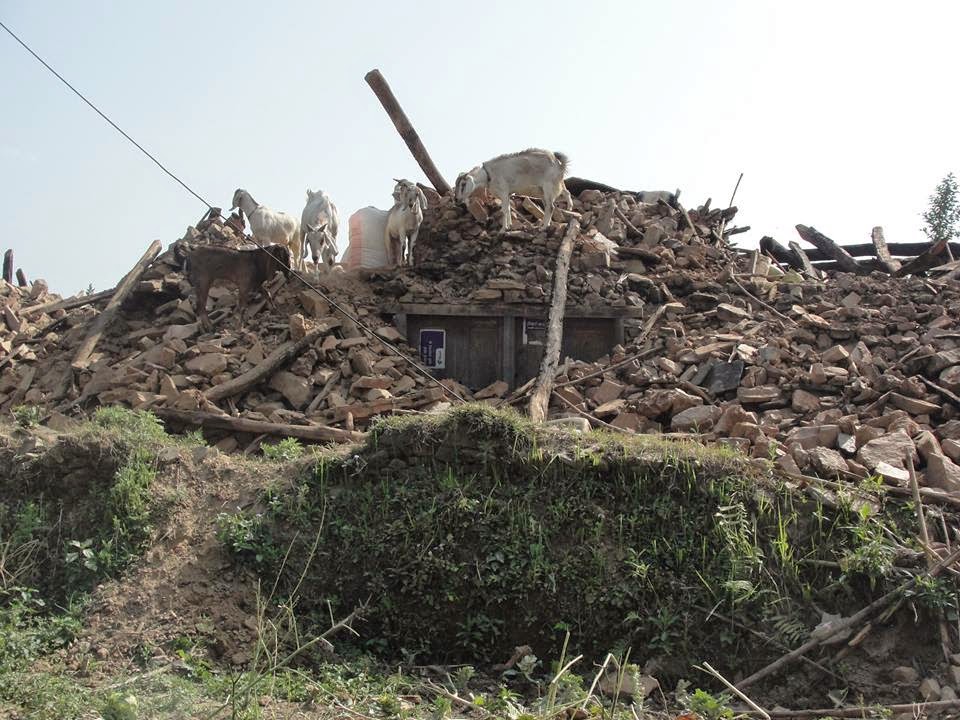
We humans cling to our political and religious beliefs with such vehemence precisely because they shelter us and make us feel safe.  They are connected to and spring from our most foundational understandings of how the universe works.  Such spiritual shelter is a basic need like spiritual food and spiritual water. 
 
If someone else’s perspective threatens to blow our spiritual house down, we will likely feel upset.  Even worse, if our own party or denomination behaves in a way completely other than what we believe it should, it can be devastating. In fact, we often will dismiss it or deny it, because truly seeing it forces us to question the very foundations of the things we have trusted in.  “But if this isn't really true, then maybe this other thing isn't either….”  Our spiritual ground starts moving every which way.  It can be deeply disturbing.

No one likes it when our very ground of being stops behaving in a trustworthy fashion.  What have been your spiritual or intellectual earthquakes?  Have they been minor, significant, or even catastrophic?  How did you recover?  What is your foundation now?

It is NOT comfortable to have “the earth move under your feet.” Sometimes we don’t even realize where we have placed our trust until it lets us down.  I have trusted in denominations, in certain people, in food, in coffee, in chocolate, in marriage, in the United States, in Canada, (and every once in a while in God.)  A lot of my life I have believed I was trusting in God, but now I am not sure I truly was.  I certainly liked to believe I was.

When we become mad at God for not behaving the way we think God should, were we trusting in God or in an idea of God that wasn't deep enough? 

Regardless, a true personal spiritual earthquake can be devastating.  It can involve tremendous loss.   Whatever it is that we have relied on is destroyed beyond repair.  We cannot even pretend to rebuild what was.  It is a form of death and birth.  There is no going back, no matter how much one might miss the old reality.  God only allows such spiritual earthquakes as a necessary part of our spiritual growth.  Sometimes there are certain sheltering thoughts and beliefs we would never leave behind if we were not forced to. 

My seminary told me they would “challenge my truth-claims.”  I somehow had expected they would try to teach me “The Truth,” so I could teach it to others.  But no.  Their job was to make my faith and thought structures living, strong, and flexible.  They pushed against my beliefs and invited me to question them again and again, not because they wanted to replace them with their own, but to enable mine to grow strong and mature, living and well-rooted.  This produced a kind of foundational examination and re-examination of why I thought or felt what I did which compelled me to throw out some old perspectives while deepening and strengthening some others.  It was an invitation to “build a better designed spiritual house” founded on a deeper rock than I knew was possible.  It also showed me that even spiritual houses and foundations need constant maintenance, re-examination, and care just like natural ones.  We can all do this.  You don’t need to go to seminary to work on your spiritual house.

And so, though we often cannot choose where we “live” spiritually;  and we cannot choose what disasters will come our way, we can work on being ready for them.  We even may not truly know whether our spiritual foundation is strong enough.  Most of us are too busy just trying to survive to worry about such things, like so many of the people in Nepal.  

But if you are inclined and have the resources, there is a way to dig deep and find your best foundation.  There is a deep peace that lives within each of us, which is “God With Us.”  We can learn to ground ourselves in that awareness and deep peace.  We can drill down into that rock.  If we can do that, we will not be shaken though the earth be moved.  It takes attention and intention, but it can be done.

And if we are blessed enough to have a solid spiritual home when disaster strikes, may we become a blessing to those less fortunate, the way the Loving Arms Mission in Nepal is managing to do.

In gratitude to those who are funding that brave little mission in Nepal; in gratitude to Kent and Shovha and Nadine and all those who work with and for the Loving Arms Mission; and with ongoing prayers for Nepal.  Amen.

The following was the interlude, with the images projected onto a screen.  It is of show the people connected with LAM and of some of the children as they are growing up well cared for. https://www.youtube.com/watch?v=Wz4EG2rXooo

Further Notes:  These are Facebook entries from Kent Rogers, from whom come many of the pictures.

May 3, Kent Rogers.  I'd like to thank the Asplundh Foundation. Their grants provided our first home, our second home, and then our vehicles. The homes are very strong and kept us alive. They have saved us hundreds of thousands of dollars for rent. The van is unbelievable. It is a veritable tank! I can't believe some of the places it has forged through, and we've been able to reach so many people with aid due to that vehicle. Our organization wouldn't be half of what it is, were it not for your support. In addition, I want to thank all the individuals associated with the foundation who have offered personal support and encouragement.
THANK YOU ASPLUNDH FOUNDATION!

May 13, after the second quake. Kent Rogers.
I stayed home at the request of Shovha with the significant danger of post quake landslides. With the down time, the reality of what has happened has begun to set in in an emotional way. We had all begun to believe it was over. The tremors were getting less and less often as well as weaker and weaker. The feelings of terror and powerlessness are probably greater now than after the first quake even though the destruction and death are less.
Thank you all for your outpouring of support. It is a privilege and pleasure to be a conduit of your support to those in need. This is a time I will never forget. Such sorrow and joy mixed together.

Mental health is now a growing concern as the giant aftershock had a reinforcing effect on the first trauma, shredding morale and stripping even some of the most resilient of their hope and courage. Once the physical needs are addressed, LAM will begin the work of helping rebuild spirits too.


TO DONATE:

Go to LAMCHILDREN.ORG  and click “donate”

Or send a check marked "earthquake relief" to

Loving Arms Mission
Po Box 213
Bryn Athyn, PA 19009


The Readings
Psalm 104:1-9, 31-35
Bless the Lord, O my soul!  O Lord my God, you are very great!
You are clothed with splendor and majesty, covering yourself with light as with a garment, stretching out the heavens like a tent.
He lays the beams of his chambers on the waters; he makes the clouds his chariot; he rides on the wings of the wind; he makes his messengers winds, his ministers a flaming fire.
He set the earth on its foundations, so that it should never be moved.
You covered it with the deep as with a garment; the waters stood above the mountains.
At your rebuke they fled; at the sound of your thunder they took to flight.
The mountains rose, the valleys sank down to the place that you appointed for them.
You set a boundary that they may not pass, so that they might not again cover the earth.

May the glory of the Lord endure forever; may the Lord rejoice in his works, who looks on the earth and it trembles, who touches the mountains and they smoke!
I will sing to the Lord as long as I live; I will sing praise to my God while I have being.
May my meditation be pleasing to him, for I rejoice in the Lord.
Let sinners be consumed from the earth, and let the wicked be no more!
Bless the Lord, O my soul! Praise the Lord!

Rev 11:13-14, 19
 At that very hour there was a severe earthquake and a tenth of the city collapsed. Seven thousand people were killed in the earthquake, and the survivors were terrified and gave homage to the God of heaven.
14 The second woe has passed; the third woe is coming soon.
19 Then God’s temple in heaven was opened, and within his temple was seen the ark of his covenant. And there came flashes of lightning, rumblings, peals of thunder, an earthquake and a severe hailstorm.

Hymns:Oh Lord Our Help in Ages Past;” The Summons;” A Mighty Fortress Is Our God 

Wednesday, November 21, 2012

Can There Be Peace In Palestine?


This was written in response to a trip I was lucky to be part of in 2007.  I thought I would repost it as we witness renewed violence in in the Holy Land.  Regardless of what one thinks of the theology, the details remain true.

"Can There Be Peace in Palestine?
- reflections on my trip to Israel"
Alison Longstaff, August 26th, 2007
Church of the Good Shepherd
Psalm 122: 1-9; Matthew 24:1-13
                                                                                                     
            As many of you know, I went on a pilgrimage to the Holy Land this past Spring.   Because the Holy Land is not the most stable of regions, preparation for the trip included a day-long session on culture shock, cultural sensitivity and diversity, and post-traumatic-stress disorder, among other things.  In our information packets we found articles on how to recognize post-traumatic-stress disorder, both in ourselves and in our fellow travellers.  We learned that we could be affected by the general atmosphere of trauma-survival among the peoples we would be visiting.  We discussed how we should care for ourselves and each other should violence occur.  It was sobering.
            Above all, we were taught, "The situation in Palestine is complicated."  We must try to withhold judgment.  We must avoid taking sides, and instead, simply keep our eyes and ears open. Apparently, westerners characteristically assume that the problems over there could be easily fixed if someone just said the right thing or took charge the right way.   It is not so.
            I was immediately struck by the warmth with which the Israelis in the airport greeted us.  They welcome all visitors.  The arrival of tourists helps them not feel so isolated nor so judged and feared and cut-off from the rest of the world.  We also met our tour guide at the airport, a Palestinian Arab Christian Israeli.
(picture: The Lion's Gate in Jerusalem. Notice how bullet-riddled it is.)
            His name was Husam, not Hussein  but Husam.  He advised us to call him "Who? Sam?" to remember the correct pronunciation.  His name was as unfamiliar in my mouth as his identity was to grasp in my brain.  An Arab Christian Palestinian Israeli. He was an Arab, which is a blood-line or ethnicity, but he was not Muslim, like many Arabs are.  He was a Christian.  There are many Christians in the Holy land still, Christians descended from the Christians who have been there since the time of Jesus.  He is Palestinian, which means his family has lived in the Palestinian territories for centuries, but he is not a terrorist.  It is terribly unfortunate that the western media has somehow gotten many of us in the Western world to equate "Palestinian" with "terrorist." It is an emotional and fearful association and entirely uneducated.  There are so many good and peaceful Palestinians. To think every Palestinian is a terrorist is as accurate as thinking that, because I am a woman and a seminarian, all women are seminarians.  (Picture: Husam [white hat] talks to some of us on the school steps. See the clear, brilliant blue of the sky.)
            And, Husam was an Israeli.  Both a Palestinian and an Israeli?  At the same time?  Yes.  He was born to a Palestinian family in Palestinian territory, but he is one of the lucky few to have an Israeli passport.  He is recognized as a citizen of Israel.  Many Palestinians are not, for all sorts of reasons, which is a huge part of the problem over there.  But he is.  So He is an Arab Israeli Palestinian Christian.  Even he doesn't know where he fits.
            There are so many ways I could describe our travels over there.  I could speak of the land, the light, and the locations.  I could describe all the many churches vying to be sitting on the "original spot where" something religious maybe happened.  I could describe the crazy mix of old and new, and the march of time in a place nearly older than time.
            But I choose to describe my observations of the people of the land, the desperate religious sincerity, and the age-old battles for dominance and control.  I choose to describe both the beauty and courage, the resilience and hope in the face of the repeated failures of the peace efforts.  And the heart-breaking violence that seems to have a life of its own.  
(Next two pictures: school children, Christian and Muslim, playing soccer together in Ramallah. Will they also grow up to kill or be killed?) 
            At no time did we witness open violence.  We were never exposed to any real danger, ever.  But we witnessed evidence of the tension everywhere we looked.  From the thick razor-wire topped walls that Israel is unremittingly erecting around section after section of Palestinian territory, to the machine gun toting soldiers, to the bullet holes riddling the walls of Jerusalem, we could not help but be aware of the tension.
            These people have lived through things I can't even imagine.  We had to pass through heavily guarded check points.  We had our bus driver yelled at by an angry Israeli guard at one check point.  We had soldiers barely out of their teens march through our bus, examining our passports, machine guns slung on their hips.  One pulled off his sunglasses, and looked just like our neighbour's son, except he had darker hair. 
            Israel is a military state, and every young person must spend two years in the army.   Imagine if we lived there.  That would be every young person you know, taught to handle guns. To shoot to kill.  To obey orders.  To see violence as a common occurrence.  Jake and Sam, Stephanie, and Megan and Kate, Heather and Joshua. . . .  Both my girls, and eventually, Jordan.  And this, not in Canada, but in a country born in the holocaust, and shaped by a lifetime of hatred and oppression.  I simply can't comprehend it.
(picture: overlooking the school's playground in Ramallah) 
            We stayed in Bethlehem first, beyond the wall.  The Palestinians nearest Jerusalem live in some of the worst conditions.  Though our hostel was spacious, clean, and quiet, we saw the rubble and neglect in the streets.  The severe water restrictions were evident in the bathrooms though never shoved in our faces.  Some of us blithely and ignorantly took our long western showers, not realizing the desperate need for every drop behind the walls.  You see,  Bethlehem, a scarce five miles from Jerusalem, is Palestinian.  It is the distance of about eight kilometres from here to the St Jacobs farmers market or from here to Sports World.  For that matter, from here to the Carmel Church, our Swedenborgian cousins.  By now, development is as continuous between Jerusalem and Bethlehem as it is between Good Shepherd and St Jacobs.  It could be one big city except the Israelis have been and still are erecting a wall all around Bethlehem, and all around Ramallah, and around many other places.  Imagine having friends who lived near the St. Jacob's farmer's market who were walled in, and never allowed to leave.  Imagine them cut off from their jobs, their doctors, their families.  Imagine trying to invite them to a wedding or a funeral, and them being refused permission to come.  This is the reality of many Palestinians in Israel.  No wonder many have resorted to violence.  Some are cut off from their family vineyards which have been their livelihood for centuries.  It is arbitrary, cruel, and they are completely powerless.  There is 70% unemployment within these walled areas.
            Seeing the conditions behind the wall and hearing the stories, it was hard not to take sides against the Israelis.  On the first day, a group of us went to visit a Christian school in Ramallah.  Because our bus and tour company had all the right passes and papers, and because tourists bring welcome dollars to Israel, our bus was allowed to traverse the two heavily guarded check points in order to make this trip.  Ramallah, yes, the Ramallah in the news, is another stone's throw out the other side of Jerusalem.  We travelled from the dusty, broken, and run-down Palestinian streets of Bethlehem into the clean, new, well watered and beautifully landscaped Israeli neighbourhoods on the right side of the wall, and then back into the pock-marked, rubble-strewn, and neglected streets of Ramallah.
            We met some of the most courageous and called teachers and volunteers at this school, as in the many other Christian centres we visited.  The school in Ramallah has several hundred pupils from Kindergarten to about grade eight.  They are Muslim and Christian.  Yes, this school welcomes Muslim children, and educates them as Muslims.  The Muslims have separate religion classes from the Christians, but also, all the children have religion together once a week, where they learn about each other's religions as well as the many other religions of the world.  The Christian and Muslim families in these Palestinian territories are bound together by their shared hardship.  They want only peace, and for their suffering to end.
(Picture: Children cluster around Debbie Lou and others of us, including our tall photographer)
            Everything looked normal.  The children's happy voices rang out from the recess yard as we sat and spoke with the head teachers.  Debbie Lou, one of our group who is a music instructor at Wilfrid Laurier, went out to mingle with the children.  When the children learned that she loved music, they wanted to sing her their songs.  One little boy sang her "his song."  The interpreter described the story to Debbie Lou as the little boy happily performed his long composition.  It was a song about his grandfather, who was taken in the night from their home, by soldiers with guns.  It was about how he would never see his grandfather again, and it went on and on.
(Picture: in the crowd is the little boy singing to Debbie Lou.)

            The teachers told us that this type of song is a form of trauma therapy for the children.  That the primary task the teachers face, daily, is helping the children deal with the precariousness of their lives.  Almost nightly, Israeli soldiers come into some part of Ramallah and arrest someone or shoot up a home, occasionally just because they can.  It is a form of intimidation.  It is meant to keep the Palestinians off balance.
            The children come to school chattering about the soldiers being on their street in the night, much the way our kids might chatter about an extra violent thunderstorm or a tornado scare.  This is normal for them.  The safest place these children have is the school.  The teachers do everything they can to help the children, Christian and Muslim together, to feel safe and loved and cared for by God.  Even so, in 2002, the soldiers came to the school during the day. They blasted open the doors and shot up the walls.  When the teachers complained to Isreali officials afterwards they were told, "No one was hurt."
            "No one was hurt."  Imagine if a huge explosion rocketed those doors off their hinges and a mass of armed soldiers stormed in screaming and ordering everyone onto the floor, and then proceeded to shoot up our walls and windows.  Then after yelling at us all and calling us names like filthy terrorists, vile English, dirty Canadians, and threatening to kill us and our families, for several hours, they left. ? !  "No one was hurt," simply doesn't adequately describe the shock we all would have sustained
(picture: One of our Canadian peace-workers, one of the seminary professors, and the brave head teacher of the school.)
            Just looking at the blast-blackened and twisted front doors would be enough to bring all of the emotional trauma back.  And we would be left to pick up the shattered glass, and see our dear sanctuary all bullet-riddled, and try to decide how to go on.
            This is one tiny piece of one tiny reality in all of the stories and sights we heard.  I haven't even told you about the three empty dialysis chairs awaiting children who would never show up that day at the hospital.  The guards at the check-points refused three children permission to come get their dialysis treatments at the hospital.  It makes no sense.  Three children, who would be dead in two days if they are not allowed through the wall to the hospital for their treatments.  That was four months ago.  Are any of them still alive?
            If I think too much about it all, I get choked up.
(picture: The head teacher and some students.)
            The same day that we visited that hospital, we went to the holocaust museum.  We only had a half-hour for the museum, which needed at least three.  I could barely take it in.  I sat and wept and wept.  That night, tempers erupted in our group.  There was shouting and accusations resulting in withdrawal and tears.  We were all dealing with more than we could handle.  The scope of the human on human abuse and horror was more than we were capable of comprehending.  We were shattered.
(Picture:The school pastor looks on and our Canadian tour director talks to the head teacher.)
            We are very sheltered here in Canada.  And we kid ourselves if we think we are incapable of the behaviours we heard of and saw in Israel.  Everyone of us, under the same conditions, would exhibit much the same behaviours.  Just witness the small violence of barking, hurtful accusations that arose in our tiny, peaceful, Canadian group after the one day of witnessing the hospital and the holocaust museum.  We were overwhelmed.  The helplessness and grief had to pour out somehow.  We were able to apologize and heal within 24 hours.  These people are dealing with a legacy of trauma and violence that spans generations, crosses cultures, and touches every one of us.  It's not going to be a simple fix.
            Though it is understandable, the fact of the holocaust does not give Israel a right to bully and oppress the Palestinians.  A battered wife will take a long time, a LONG time before she will trust a man to treat her kindly.  How much more is Israel a battered wife?  The horror of the generations of abuse must work its way out somehow, and it will take time.
            "O Jerusalem, Jerusalem. . . .  How often I wanted to gather your children together, as a hen gathers her chicks under her wings, but you were not ready." (Matt 23:27)
            Before we become too depressed by the stories we've explored together today, before we decide that it is all hopeless and horrible, let's remember that God was born into this very place.  He did not and will not give up on us, though He himself, his beauty and love and truth was spoken into this darkness and treated much the same way.  Standing with and bearing the horror, and still staying open to love is the way out.  And I need not go to Israel to do this work.  I can find it readily in my own family and neighbourhood, and yes, even in our church.
            When you and I work to face and, without passing on the harm, express and release the hurts and little traumas and small betrayals we face within our lives here and now, we are helping to strengthen the great global consciousness of peace and forgiveness.  It has long been known that abuse will be passed on and on until someone is strong enough to stop the transmission.  The abuse will stop when the human race is ready and strong enough and conscious enough to stop it.  AND, what you and I do in our hearts, here and now, today, makes a difference.  Forgiving my brother, my sister, my father, for abuses and hurts in my family, is the way I help the world move toward forgiveness. (picture: watching the children at play)

            Yes, there are many active and hands-on ways we can try to help in Israel.  They need help.  They particularly need volunteers who speak Arabic.  I can put you in touch with any number of ways to provide support and caring if you feel called.
            But more than that, you and I can stand, hand in hand, and believe in peace and forgiveness.  You and I can look fearlessly into the horror and hopelessness and speak love into the darkness.  We are not alone in the desire for peace.  We have God on our side.  And God is infinitely patient and infinitely healing.  If our hearts break at the sights and stories, God's heart breaks a thousand times more.  But while we become weighed down by hopelessness, God has never given up and never will give up.  He knows what He's doing.  Nothing, absolutely nothing is hopeless in God's care.
            As we read in Jeremiah:
For surely I know the plans I have for you, says the Lord,
plans for your welfare and not for harm,
to give you a future with hope. (Jeremiah 29:11)
            Thank you for listening.  Amen.
Special music  Calling All Angels    by Jane Siberry

Sunday, October 7, 2012

Holidays After Trauma

First let me say that trauma is a continuum.  Part of me doesn't feel legitimate naming myself as someone recovering from trauma, but enough friends and therapists have independently named me so, that I am accepting that.

Today is the Sunday of Canadian Thanksgiving weekend.  In the past I would have been planning or deep in the middle of cooking a big family dinner, complete with gorgeous autumn decorations and turkey.  I would have enjoyed finding as many chairs as possible and getting creative with table arranging so everyone had a place.  The older I get, the more this sort of ritual is meaningful to me it seems, and the more precious my family is to me.

My "broken" family.

Today I slept in and awoke with a headache (no, not an "Oktoberfest headache," the regular kind) and perimenopausal hot flashes, and discouragement.  I thought I would be content this weekend because my girls all have their partners' family meals to go to, and my son seems just content to be home and spending time with me, and later his dad.  I have plenty to keep me busy, including a backlog of graduate school reading, cleaning, and ironing.

Duh.  I'm still a classic codependent, eh?  "So long as everyone else is happy, I am happy."  I didn't have a sweet clue as to what *I* actually wanted or needed.  It didn't even occur to me that I might not be okay.

So, today I am inordinately sad (who gets to say what "ordinately" sad is?) that I am not doing a traditional  meal with my kids, going on a walk in the autumn colours, and generally enjoying my family.  Today looks like it will be a day of releasing more pent up sadness and loss and grief.

Yay.

It's okay.  There is no statue of limitations on grief, no matter how much our culture (including me!) is uncomfortable with prolonged sadness.  If "just being with and accepting" the sadness is what needs to happen today, so be it.
God knows, I am not alone.
 
It's NORMAL to feel more deeply during holidays.  It is NORMAL for the contrast between what is and "what should have been" to ache most intensely right now.

So I will cry some, write some, pray some, and be very gentle with myself today, and this too, shall pass.

In solidarity with everyone for whom holidays, for now, seem to be more painful than joyful:
You are not wrong.
You are not alone.
You can make it through.

Alison