Showing posts with label immediate. Show all posts

Tuesday, February 18, 2014

Reflections on Communion

Reflections on Communion


In lieu of a sermon last Sunday, (because of the projected storm) we held a "Bible study" around a table of goodies and hot beverages.  It was an experiment, but seemed to go extremely well, and those who gave me feedback appreciated the experience.

I believe strongly in opportunities for us to hear each other as members of one community, and this sort of event gives us that chance.  I get to know my dear congregants better, and they get to know each other better too.  We laugh together, and we become re-humanized in each other's eyes, dispelling any false perceptions or thin layers of fear or judgment that may have settled over some relationships.  It makes things "shiny" again.


So I opened the topic of the meaning of communion. I particularly encouraged any questions, problems, or difficulties anyone might have.  This was the time to air them.  I started by describing my own experience of being taunted for being a "cannibal" by a former Christian.  I had myself always had a bit of discomfort with the "eat my flesh", "drink my blood" language, and this mockery brought that discomfort to the surface for me.  I could explain that I saw it as a metaphor, and that I believe Jesus and the disciples also understood it that way, but if someone wanted to mock, there was only so much defense, because the language is undeniably there.

Besides, if she needed to mock, that was not my problem so much as my own inner discomfort was, and my need was to come to some peace and resolution inside myself.  Her journey is and remains her journey.

"What has your journey with communion been like?"  "How do you understand it?" Were the questions I asked those gathered around the table.  We then went around the table giving each person a chance to respond.

I would like to share some of the observations and insights that came up, in case they add to or inform your own relationship with communion.

No one else had ever considered or been challenged by the "flesh and blood" language nor the idea of cannibalism.  All of the other eight participants, three of whom had not been raised Swedenborgian, had considered the language metaphorical.  One described it as meaning that we must "walk the walk" and "live the life."  Many nodded their heads in agreement with this comment.

One woman (from a minister's family!) said with breathtaking honesty that she had never understood what the communion was about and had a hard time finding meaning in it.  This lightened the room immediately, as it gave everyone permission to admit not understanding, if that was their experience.

One observation that I shared that seemed as helpful to the listeners as it had been to me, when I encountered it (and which came to me from Rev George F. Dole, my predecessor), was this:  That when Jesus commanded that we "do this in remembrance of him.," He was eating a meal with his friends.  He was not kneeling in a special spot in a special place at a special time with a special little piece of bread and little sip of wine.  He was sharing a meal with His friends.  He was communing with them socially and spiritually.

Rev George had observed that the two elements that we consider sacraments---communion and baptism--- are also two essential daily acts necessary for our physical well-being---eating and washing.  Perhaps it is more the remembrance of Him in the most every day and mundane acts that is where the sacredness lies, not in specialized little rituals in specialized little sacred moments.  This has tremendous resonance with me, and seemed to feed many around the table on Sunday as well.

Another person observed that she felt spiritually fed by sitting and conversing over a "meal" such as we were doing almost more than attending church feeds her.  I had to point out that enjoying a meal together is what communion is.  That the preciousness of the bonds built during this sort of "communion" between and among us is what makes it meaningful.  This is what we treasure, and this is why it is sacred.  For me, it illustrates how the sacred has always been "right here, right now" in every day moments.  It is always present, and not meant to be kept in a "sacred" box and brought out only on Sundays.

I know I appreciated this change in our ritual.  It will not happen often.  But I suspect I will do this again. Perhaps once a year I will invite a "communal" gathering with discussion over a meal rather than formal worship.  I like the idea.

What has your journey with communion been like?  How do you understand it?

May you find peace and growing wisdom as you journey forward this week.

Pastor Alison


Friday, April 28, 2006

Low Christology


Low Christology does not exalt the Divinity of Jesus over his humanity. It opens itself to the reality of Jesus' human experience. His immediacy and connection with our experience is reflected in architecture and art.
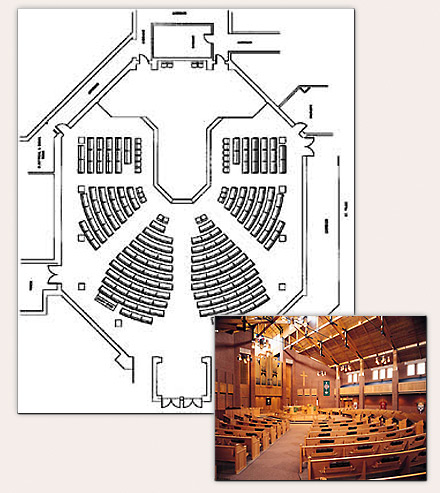
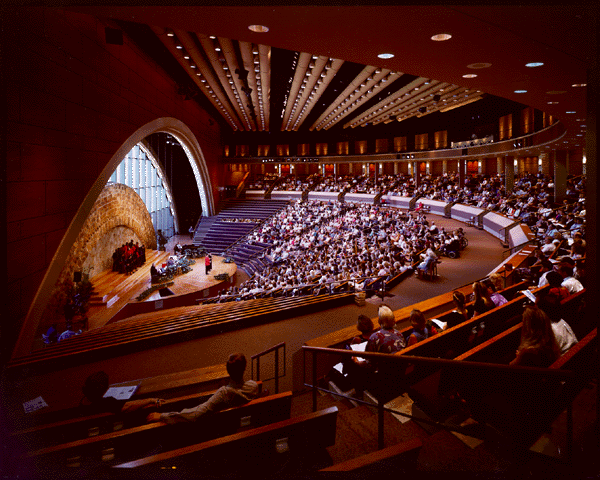
We see Low Christology reflected in the church architectures which bring the altar down toward the people and even into their center, as it were. It tends to have a more semi-circular design with the activities around the altar being brought physically and psychologically closer to the people. The circular-style seating also promotes much more of a feeling of community and connection with fellow worshippers. The warmth of this sort of arrangement contrasts the austerity of the high cathedrals of Europe.

In art, we find depictions of the temptations and suffering of Christ looking like suffering. No longer does the art look like mild discomfort or a slightly bad afternoon, but the agony described in the gospels.

I recently watched the 6-hour Jesus of Nazareth movie from the 1970s, and was blown away by how the actor's facial expressions are almost robotic or trancelike. This represents the ideology of the directors or producers - Jesus could barely crack a smile. He was remote and disconnected from his disciples. He was blank or sober in expression much of the time. I guess he was busy being Divine.

Contrast this with the made-for-TV movie entitled "Jesus" released in 2000. Jesus smiles, dances, laughs, is shown chanting in the temple with the "law" on his forehead according to tradition, teases his cousin John, feels insecure, loves and goofs around with his disciples, and plays with the children.
In Gethsemane He claws at the grass, and some the temptation is depicted as a struggle to stand strong in his path as Satan offers ways out of the coming torture and assures Jesus that His efforts will be in vain. I really cared about this Jesus and felt conflicted and torn by "Satan's" arguments.

The production sought to bring us into Jesus' experience, and Him into ours.

I didn't cry when the 1970's movie Jesus was crucified. It was an awful intellectual exercise to watch, but I had no personal attachment to the figure. But in the 2000 movie, I bawled my eyes out. I had LOVED this Jesus. I was devastated. A precious, beloved mentor was being unjustly tortured and killed before our eyes. It seems to me that this emotional response to Jesus' crucifixion is far more appropriate than a merely intellectual dismay and distaste.

While the Gibson movie certainly didn't shy from showing incredibly hideous torture in all it's physicality, it failed to generate in me a feeling of connection to the figure on the screen before the torture started. Again, I spent most of the movie in a state of horrified fascination---in an intellectual and analytical response---critiquing the scholarship and almost finding a morbid humour in how "horrible" advanced to insufferably hideous, to ridiculously horrendous. The only times I wept were when humanity, in efforts to support and comfort Jesus, broke through the relentless torture. Otherwise, it didn't bring me into my heart at all. I stayed in my head, just to survive.

So, what is the thing about High Christology and Low Christology? Is Low Christology "better" than high Christology?
I don't think so. I think separation of Human and Divine is harmful, either way you slice it.
If we make Jesus too human, he becomes our buddy, our yes-man, or our "sweet" friend who is essentially a powerless wuss.
We need to really get it in our very blood that Christ is Divine and human, Human and divine. They don't cancel each other out. They aren't mutually exclusive.
I think this is hard for us. I think we tend to be out of balance with it, and it takes a lifetime to "get-it-together" or see that they are One.
God with us.
GOD with us.
God WITH us.
God with us.