Showing posts with label Divine Providence. Show all posts

Sunday, June 14, 2015

Fear Not - sermon for June 14

Today we welcomed new members, celebrated communion, celebrated "New Church" day, and celebrated the end of the Sunday School year with a pageant.  It took a few minutes extra, but we managed it!
This comes to you with blessings and love.

“Fear Not”

Rev. Alison Longstaff, June 14, 2015
Bath Church of the New Jerusalem
Psalm 27:1-5; Revelation 1:12-19; Apocalypse Explained 431:6


Apocalypse Explained 431:6

“The New Jerusalem” does not mean a new earthly city called “Jerusalem,” nor does its “wall and gates” mean a physical wall and gates, nor do “the twelve tribes and apostles” mean the actual original twelve tribes and apostles. Something completely different is meant by each one of these things. “The New Jerusalem” means a new spirituality with a new understanding; “angels,” “tribes,” and “apostles” mean all the ways humanity will increase in benevolence and mutual understanding, and live from principles that are both deeply wise and deeply compassionate.

Today we will be welcoming two new people into this congregation—two terrific people who are choosing to walk beside us and with us here at Bath Church of the New Jerusalem. Robin and Rick are honoring us by making this commitment.

One reason so many people no longer attend any church is because they have been hurt or disappointed by a religious community in the past. To choose to try again when one has been hurt in the past takes courage, and I stand in honor of anyone who makes such a choice.

Robin and Rick, I cannot promise you that you will never feel hurt or disappointed at some point as you walk with us here. I can only pray that we as a community can walk with courage and compassion through the hurts together, so that we may keep healing and growing as a spiritual family.

To quote (the fictional) Father Timothy Cavanaugh (from At Home in Mitford by Jan Karon), “My friend, if you keep your eyes on Christians, you will be disappointed every day of your life. Your hope is to keep your eyes on Christ.”

We sometimes mistakenly expect perfection from each other just because we are a church. At such times I implore us all to remember that we are a community bounded by our need for God in our lives, not because in any way we have already arrived at some kind of special status.

It takes courage to break into a long-standing tradition such as this congregation represents.  And it takes courage on the part of those who have been running things for many years to step aside and allow new energies in, because new energies mean change.  So I commend all of us for not allowing fear to run the show.
           
Today we are also celebrating “June 19th” or “The New Church’s birthday.”  We typically have a pageant featuring some story from the Book of Revelation, because Swedenborgians see the book of Revelation as a metaphor about the spiritual temptations that we go through on the way to heaven. A whole lot of people find the Book of Revelation scary. So today, I am going to talk about fear. I am especially going to talk about fear in relation to religion and God.

Looking in the Hebrew and Greek Bibles, one important thing to notice is that every time an angel of the Lord shows up with a message for someone, the very, very first thing he or she says is . . .

“Fear Not.”

The first thing said is: “Fear Not.” Sometimes it is worded “Do Not be Afraid,” but the message is the same. “Fear Not.” The angel brings these opening words of comfort to Hagar, to Isaac, to Rachel, to Jacob, to the People of Israel, to Moses, to Joshua, to Gideon, to Daniel, to Joseph, to Mary, to Zacharias, to the women at the tomb, and last but not least, to John on the isle of Patmos. As well as these 14 direct words of comfort, the followers of the Lord frequently say it to each other; Moses, Joshua, and the prophets say it to the children of Israel; and Jesus speaks these words of reassurance to the disciples and to the man whose daughter was dying.

In the Word, the first thing said is pivotal. It sets the tone. It shapes the entire rest of the message. Maybe we should pay attention to this, “Fear not.”

Why would “Fear not” be the first thing God would communicate to us? After all, won’t we all become lazy, selfish lumps if we’re not afraid? If we get too relaxed about our salvation, isn’t it possible we might miss the boat? Didn’t God also say in Psalm 111, “The fear of the Lord is the beginning of wisdom”? ( vs.10).

Well, yes and no.

You see, the fear of the Lord, spoken of in the Psalms is not the anxious, grovelling uneasiness we often think of when we hear the word, “fear.” The “fear” in the Psalms isn’t fear at all in that sense of the word. The “fear of the Lord” spoken of in Psalm 111 is a deep respect and reverence for the Lord born of deep love. And that sort of “fear” we do indeed want.

When the Word says, “Fear not,” it is calling us to release any grovelling, cowering, “please don’t hit me!” kind of fear. The Lord is not the angry, judgmental God we “fear” He is. He doesn’t want us to be cowering and grovelling and afraid of the Divine. He says, “Fear Not!” And, coming from the Lord, these words say a thousand more things too.

God speaks to us the words, “Fear Not,” but knows that we will often still feel afraid anyway, or at least mildly uneasy. We can’t change our feelings on demand simply by force of will. We might change feelings over time by changing our perspective, but mostly, feelings just are. Therefore, maybe these words from the Lord are not a command, “Thou shalt not fear! (and if you do, I will judge you)” but a reminder. God is reminding us that, though we may still experience fear, we do well to remember that the omnipotent, omniscient, benevolent God of the whole universe has things well in hand, all the way down to the hairs of our head.

It is a reminder to hold before our eyes: “Fear Not,” because God is in charge!

“Fear Not” can also be a promise. When God says, “Fear Not,” He is giving us a promise that some day, if we persevere along the path of spiritual growth, we will stop being afraid. Eventually, when we reach the spiritual state described as the Holy City, we will never truly fear anything again. We will know all is well, and feel only immense love.

So then the words “Fear Not” are a reminder and a promise. And there’s more.
           
The dragon and the harlot of Babylon in Revelation symbolize two unhealthy ways of doing religion. We all tend toward one or the other by nature, and these show what they can do to our lives if we let them get out of hand. These two unhealthy ways are the “Ideas Alone” approach (dragon) and the “sheer self-determination, I’ll just try hard enough” approach (works).  It is no coincidence that the tower of Babel (Babylon) is a story about humans trying to climb up to heaven by their own power.

These two unbalanced approaches are actually two sides of the same coin found within each of us. Where you find one, the other is not far away. They don’t actually compete with each other, they mirror and balance each other in a dysfunctional sort of way. In fact, in Rev. 19, the harlot of Babylon is seen riding the dragon. But the answer is not to find a middle ground between them, we need a shift to a higher order of unity in ourselves. We don’t want a dragon and whore married inside us (arrogance and control)—we want a bridegroom and bride (wisdom and love.)

A recent poll discerned whether people in any given congregation believed salvation was due more to our personal effort (works-based) or due to believing the right stuff regardless of effort (belief-based). What they discovered was that in any given congregation, no matter what denomination, the people tended to fall along a 50/50 or 60/40 split in their view of salvation. This study did not ask people directly what they thought they believed about salvation.  Instead it asked people to judge and assign responsibility or merit given certain hypothetical scenarios—a much more accurate way to measure what they actually believed. 

It looks as though all of us have a tendency to lean one way or the other in our approach to religion no matter what our denomination may teach.  We worry a lot and can’t do enough and feel a lot of guilt OR we live in our heads and rationalize everything and hold an aloofness from the feeling and doing side (response-ability) of life. (They sound a bit like Virginia Satir's coping mechanisms.)

This also reminds me that just because Swedenborg said the “new church” will have a perfect balance (represented by the Holy City), people who like to call themselves “New Church” (lots of Swedenborgians identify this way) are mistaken to think they automatically have that internal marriage by virtue of joining the external club. Every one of us on this planet has the same path to walk, and the Lord doesn’t play favorites. No one is a Navy Seal by virtue of calling themselves “a Navy Seal.” And no one is “New Church” just because they might call themselves “New Church.” You have to let yourself be changed.  You have to wake up and “do the work” which involves learning and humility and honesty.  It involves letting God work in your spirit while letting go—which often feels like hard work and sometimes feels too easy.

Now, having said that we all lean toward one spiritual imbalance or another, should it worry us that we tend subconsciously to lean more towards “ideas will get me there” or towards “sheer determination will get me there”? Not at all. In fact, the process described in Revelation through all the scary imagery is the process of how this imbalance gets corrected for us (and how apocalyptic this process can sometimes look and feel). The things that die or are cast down in the story aren’t you and me or anyone we love, they are broken and dysfunctional parts of us. Those things will be cast down as we are ready to be lifted up.

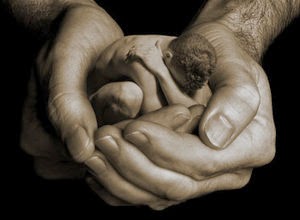
The Lord can and does and always will do everything He can to help you and me and every one of us rise up from our divided internal state into the heavenly marriage. He knows how we are made! He formed each one of us in the womb. He doesn’t expect perfection today or even any time soon. He doesn’t judge us for being tiny, imperfect, stumbling newbies at this whole regeneration thing. In fact, in His eyes, we are precious beyond compare. And He knows just how to lead each one of us. We need to be open to Him.

The Book of Revelation is written the way it is, not as a warning, but as a reassuring description of what the final stages of personal regeneration can look like. Yes, this process can look and feel like the stars are falling and everything we rely on and trust in are in flaming ruins. But God says, “Fear Not.” Perhaps this is why the birth process for our race looks so messy, dramatic, and well, frightening to the uninitiated. If you ask a new father, he might talk of blood and screaming, and the woman in labor might talk of pain and even sometimes wanting to die. But if you ask a midwife, she will tell you that the birth of a child is the most beautiful thing on the whole earth.

So, which one is telling the truth about the birth of a new human being?

The Book of Revelation describes the last final push—the moment of transition from a previous, incomplete spiritual state to a whole new, triumphant reality. And just about anyone associated with the human birth process will tell you that the phase called “transition” is the hardest and most apparently “out of control” or “chaotic” phase there is. The Last Judgement in the Word is describing a final transition in our spiritual rebirth.

And any spiritual midwife worth his or her salt will tell you, “Fear Not,” no matter how melodramatic the process feels to us. The spiritual soul in labor might not feel so sure at that moment, but that’s okay. All of it, ALL OF IT, is okay. This is simply what the process looks like for us messy beings—cataclysmic, earth-shattering, and beautiful beyond our wildest dreams.

So, “Fear Not.”

After all, we were born to become angels, so what have we to fear? And if you think about it, fear is the actual opposite of love. It isn’t hatred, it is fear that closes us off from loving others. “Hate” is simply one face of fear—fear of pain, fear of lost love, fear of all things that have hurt us in the past. So “Fear Not” is another way of saying “remember love.”

“Fear not,” says God. “Trust me.” “Choose love,” says God. “I’ve got you.” “Fear Not.”

“Are not five sparrows sold for two pennies? Yet not one of them is forgotten by God. Indeed, the very hairs of your head are all numbered. Don't be afraid; you are worth more than many sparrows.” (Luke 12:6-7)  Amen

Revised from a sermon originally preached November 4th, 2007 Pretty Prairie Kansas

Readings:
Psalm 27: 1-5
The Lord is my light and my salvation; Whom shall I fear?
The Lord is the strength of my life; Of whom shall I be afraid?
When the wicked came against me To eat up my flesh, My enemies and foes,
They stumbled and fell.
Though an army may encamp against me, My heart shall not fear;
Though war may rise against me, I will be confident.
One thing I have desired of the Lord,
That will I seek: That I may dwell in the house of the Lord All the days of my life,
To behold the beauty of the Lord, And to inquire in His temple.
For in the time of trouble He shall hide me in His pavilion;
In the secret place of His tabernacle He shall hide me;
He shall set me high upon a rock.

Revelation 1:12-18
Then I turned to see the voice that spoke with me. And having turned I saw seven golden lampstands, and in the midst of the seven lampstands One like the Son of Man, clothed with a garment down to the feet and girded about the chest with a golden band. His head and hair were white like wool, as white as snow, and His eyes like a flame of fire; His feet were like fine brass, as if refined in a furnace, and His voice as the sound of many waters; He had in His right hand seven stars, out of His mouth went a sharp two-edged sword, and His countenance was like the sun shining in its strength. And when I saw Him, I fell at His feet as dead. But He laid His right hand on me, saying to me, “Do not be afraid; I am the First and the Last. I am He who lives, and was dead, and behold, I am alive forevermore. Amen.

Sunday, March 15, 2015

Dealing With Despair - sermon March 15

“Why Is My Pain Unceasing?” - Dealing With Despair
Rev. Alison Longstaff, March 15, 2015
Bath Church of the New Jerusalem
Jeremiah 15:15–21, Matthew 16:21–28, DP 214


Why is my pain unceasing, my wound incurable, refusing to be healed?

One nice thing about pain is that it feels so good when it stops.

In our Scripture readings, we heard a lot about suffering.  We heard a pain-filled cry to God to end the suffering in Jeremiah.  In the gospel reading, Jesus is warning the disciples about the terrible suffering he will endure.  Peter objects, and Jesus shouts at Peter, “Get behind me, you Satan!” in a shocking, very un-Jesus like moment.  He says, “You are a stumbling block to me; for you are setting your mind not on divine things but on human things.”

Peter was the voice of the tempter when he declared that such suffering and death should never happen to Jesus.  Jesus knew it was imperative to focus on the spiritual work about to be accomplished and not on the suffering.  He had to focus on His Divine mission and not be distracted.  Perhaps Peter was the voice of the demon attacking Jesus, trying to convince Jesus to opt out of the suffering.  This would explain the intensity of the rebuke.

Jesus had to keep his eyes set on the Divine, to accomplish his mission.

Life on this earth includes suffering.  Even here in North America, with our insurance policies, relative wealth, and myriad safety measures, we can’t seem to escape suffering.  We often think we shouldn't have to suffer.  We keep creating more ways to protect ourselves, as if constant comfort and total security were the answer to all our problems.

So why are we still so restless and unhappy?  Some of the countries that rank highest for overall national happiness are places like Nigeria and Bhutan.  What’s that about?  Nigeria suffers from extreme poverty, and many people live in mud huts.  How can they possibly be happier than us?  Well, it seems they have a deep reliance on God.  They are a very Christian country, and they live their faith in every way they can.  They are desperately poor, yet they sing and pray and share the little they have with each other, and they are happy.

Toronto journalist Jonathan Power interviewed Olusegun Obasanjo, a Nigerian who became a Christian and a preacher after being unjustly imprisoned.  In his three years of captivity, Obusanjo became a sort of chaplain to his fellow prisoners. He says, “The time I had real joy in my life was when I was in prison.  I felt then that there was just God and me, and my fellow prisoners whom I must try and help." (Power, 2003)  Extreme hardship robs us of everything … but God.  Perhaps this is why some of the most loving and deeply spiritual people are also people who have suffered great hardship.

In the midst of the deepest suffering God becomes all we have left, and this breaks ground for a deep and rich faith to grow.  I’m not saying we should all discard our current lives and go live in a third-world country so as to really suffer so we can experience God. Suffering will find us, no matter where we live, nor how much money we have.  I am saying that it is good to remember that suffering can be our greatest teacher.  God wouldn't allow anything to happen if it didn't serve some purpose for good.  So even the painful times in life—perhaps especially the painful times—are carefully overseen by God to deepen us and eventually bring us joy.

My one objection to books and philosophies like The Secret is the way they can promote the idea that we are solely responsible for what happens to us in our lives.  The idea is that if we cultivate a good attitude, we invite good things into our lives, and conversely that we invite misfortune by having a bad attitude.  The logical conclusion to this is that if we just work hard enough to have a great attitude, nothing bad will happen to us.  But if that were true, those Indonesians and Japanese must have had terrible attitudes to invite such massive tsunamis onto themselves.  The Hebrew nation must have somehow invited the Holocaust. Every victim of every tragedy could be blamed for their misfortune.  Such a belief might give the rest of us some sort of security, but I can’t believe in a God or universe that works so simplistically (and harshly).  We mortals are simply not that powerful.
 
“It must be their fault.  If only they were positive like me, they’d be okay,” is the underlying thinking  when we judge victims of hardship and illness.  This thinking is problematic, in that it promotes a strong reliance on our own efforts for “salvation”, and there's no mention of reliance on God (or Spirit or Higher Power or anything outside of oneself).  I understand the appeal of this idea.  But it falls flat whenever we come up against anything more powerful than our own positive thinking.

My mother lived in chronic physical pain for many years of her life.  She had fibromyalgia and rheumatoid arthritis and depression, which meant that everything hurt, inside and out.  She was on all sorts of pain medicines, which only helped a little, had their own strange side-effects, and caused other problems.  I don’t know how she managed.  I can’t handle chronic pain for even a day.  I get grumpy and whiny and can be very impatient when waiting for my next dose of pain reliever.  She had chronic pain for over twenty years!  Did I mention that she also got regular migraines?  She tried every treatment in the world, from steroids to vitamins to acupuncture to moose meat, and nothing helped.  She was told again and again that it was all in her head and that she “should” be happy.

She died in 2008, in terrible pain to the bitter end.

I loved her.  It was terrible to watch her suffer.  I admit that sometimes I got impatient with her.  I thought, “Surely she can do something differently!”  I judged her for not trying hard enough, and for not trying the right things long enough.  My judging came from how hard it was to see her in such pain. 

But my judging never helped her. My impatience never helped her.  No one’s judgment or “should”s helped her.

Again and again, the best and only thing I could do for her was to love her to bits, and spend time with her, and believe with my whole heart that God had a plan.  Period.

Have you ever heard someone say, in the midst of some awful situation, “I suppose God has a lesson for me,” as if he or she could stop the suffering if they could simply figure out what the lesson was and learn it?  I don’t think God works that way.  I don’t think God ever sends suffering to teach us a lesson.  I think God allows it sometimes, only when He can also bring some long term good out of it for everyone involved.

Did my mom suffer for over twenty years because there was some lesson she was refusing to learn or because she didn't have the right attitude?  I can't believe that.  I know she did the best she could.  She got dealt a rotten hand.  She didn't invite her pain onto herself any more than she invited the childhood abuse she suffered at the hands of her father—any more than my classmate’s two-year-old son invited death from liver cancer onto himself either. 

Sometimes terrible stuff just happens.

Yes, a positive attitude can greatly improve certain aspects of our lives; it can improve our coping, and can spin off some terrific side effects.  Optimism and hope are our wings, and when we have them, they lift us up and over a multitude of life’s hurdles.  But sometimes, through no fault of our own, our wings get plucked or broken.  Sometimes a hoard of locusts swoops down on our rich and thick harvest of positive thinking and in a heart-beat, strips it to dead stalks.  Sometimes we are left walking or crawling down life’s muddy road, not flying, experiencing every bump and ditch and thorn and mud puddle.  “The rain falls on the just and on the unjust,” says God in the Gospels.  Or, to quote contemporary wisdom, “Shit happens.”

So we must set our minds on divine things, and not on human things.

There is so much in this life over which we have no control.  There are all sorts of forces at work around us, and we are far less powerful than we think. Our thoughts are not God’s thoughts.

We want a happy, comfy life now.  God wants us to have a happy, comfy life for eternity

From The Divine Providence by Emanuel Swedenborg, passage number 214:
The Lord’s Divine Providence pays attention to things that matter forever, and pays attention to short-term things only so far as they work in unison with the things that matter forever.  Short term or temporal matters usually have to do with earthly wealth and status, which is fame and fortune in the world. But what matters forever is our spiritual well-being and our spiritual character, which have to do with our becoming ever more loving and spiritually wise—these impact our eternal happiness.  We mortals see the worldly values of wealth and social standing as disconnected from our eternal happiness, but the Lord sees that they are connected.  And so the Lord’s Providence must give our eternal well-being priority over our earthly fame and fortune, until they work in unison.

We are part of a great tapestry.  Stuff that looks bad to our eyes now is allowed to happen because God sees a bigger picture.  But don’t forget, God isn't some cold, distant artist.  When we suffer, God suffers along with us.  S/He knows what it is like to be a mortal.  He was one, in Jesus.  Jesus suffered to bring a much better outcome for every one of us down the road.   And in the very same way the disciples couldn't see why Jesus allowed Himself to suffer, we often can’t see why we or our loved ones are allowed to suffer.  We can’t see God’s plan, but it is there.

Bad things happen, and not all the positive thinking in the world can save us from it.  No one is that powerful, no matter what we'd like to think.  All twelve steppers can tell you that powerlessness is the first and most important thing to learn.  We have to embrace and face life on life's terms, not ours.  Facing our powerlessness throws us finally and completely into God’s arms.

“Why is my pain unceasing, my wound incurable, refusing to be healed?”  Set your mind on divine things, and not on human things.  Spiritual growth or personal growth involves finding our relationship with suffering, not avoiding it.  Why else would God invite us to take up the cross to follow Him?  Jesus fought through temptation after temptation on his journey to the cross.  He showed us the way.  AND He showed us that it will come out all right, no matter how hopeless it looks along the way. 

God loves us desperately.  S/He doesn't want us to suffer.  But sometimes the most loving thing He can do for us is to let us have our experiences, good and bad.  Eliminating the struggle for us eliminates the joy and triumph we will feel when we finally arrive at the finish line.  Suffering calls forth qualities in us like endurance, stamina, and patience. It frequently teaches us compassion and opens us up to the Holy Spirit.  It is like spiritual roto-tilling, breaking up old and set things inside us, turning us upside down, and making room for new and wonderful things to grow.

Suffering helps us to appreciate more fully the truly good things in life.  It also teaches us how precious are the times of peace and good fortune.  We no longer take them so much for granted.  Suffering deepens us, whether we like it or not.  And it reminds us who’s really in charge of the universe, and that it is not us.  It teaches us to trust in God; and to set our sights on divine goals and not on human ones.

For those of you who are in the midst of suffering, take heart.  Every single thing in life is in God’s hands.  Not one hair of your head falls without notice.  No matter how long the night may seem, the spiritual morning always brings comfort and joy.  You are intimately loved and cared for, and every single detail of your life is being woven for your eternal blessedness.  Even if you cannot see it; even if you rail against God for your suffering, it is all covered.  Your spiritual insurance policy is in God’s Divine Providence, which is wise beyond all human wisdom and compassionate beyond all human understanding.

All manner of things WILL be well.
           
 Why is my pain unceasing, my wound incurable, refusing to be healed?

“…They shall not prevail over you, for I am with you to save you and deliver you, says the LORD.
 I will deliver you out of the hand of the wicked, and redeem you from the grasp of the ruthless.” (Jeremiah 15:20-21)
“Be of good courage, and He shall strengthen your heart, all you who trust in the Lord.” (Psalm 31:24)
Then surely goodness and mercy will follow you all the days of your life;
And you will dwell in the house of the Lord forever. (Psalm 23)
Amen

Revised from a sermon preached August 2008
Reference: Nigeria: Happiest Nation on Earth?
by Jonathan Power, Published on Monday, December 29, 2003 by the Toronto Star

The Readings
Jeremiah 15:15-21
O LORD, you know; remember me and visit me, and take vengeance for me on my persecutors.
In your forbearance take me not away; know that for your sake I bear reproach.
Your words were found, and I ate them, and your words became to me a joy
and the delight of my heart, for I am called by your name, O LORD, God of hosts.
I did not sit in the company of revelers, nor did I rejoice;
I sat alone, because your hand was upon me, for you had filled me with indignation.
Why is my pain unceasing, my wound incurable, refusing to be healed?
Will you be to me like a deceitful brook, like waters that fail?
Therefore thus says the LORD: “If you return, I will restore you, and you shall stand before me.
If you utter what is precious, and not what is worthless, you shall be as my mouth.
They shall turn to you, but you shall not turn to them.
And I will make you to this people a fortified wall of bronze;
they will fight against you, but they shall not prevail over you,
for I am with you to save you and deliver you, declares the LORD.
I will deliver you out of the hand of the wicked, and redeem you from the grasp of the ruthless.”

Matthew 16:21-28
From that time Jesus began to show to His disciples that He must go to Jerusalem, and suffer many things from the elders and chief priests and scribes, and be killed, and be raised the third day.
Then Peter took Him aside and began to rebuke Him, saying, “Far be it from You, Lord; this shall not happen to You!”
But He turned and said to Peter, “Get behind Me, Satan! You are an offense to Me, for you are not mindful of the things of God, but the things of men.”
Then Jesus said to His disciples, “If anyone desires to come after Me, let him deny himself, and take up his cross, and follow Me. For whoever desires to save his life will lose it, but whoever loses his life for My sake will find it. For what profit is it to a man if he gains the whole world, and loses his own soul? Or what will a man give in exchange for his soul? For the Son of Man will come in the glory of His Father with His angels, and then He will reward each according to his works. “Assuredly, I say to you, there are some standing here who shall not taste death till they see the Son of Man coming in His kingdom.”

The Divine Providence 214
The Lord’s Divine Providence pays attention to things that matter forever, and pays attention to short-term things only so far as they work in unison with the things that matter forever.  Short term or temporal matters usually have to do with earthly wealth and status, which is fame and fortune in the world. But what matters forever is our spiritual well-being and our spiritual character, which have to do with our becoming ever more loving and spiritually wise—these impact our eternal happiness.  We mortals see the worldly values of wealth and social standing as disconnected from our eternal happiness, but the Lord sees that they are connected.  And so the Lord’s Providence must give our eternal well-being priority over our earthly fame and fortune, until they work in unison.

Monday, August 11, 2014

“Why have you deceived me?” - When God Lets Us Down - a sermon

Why have you deceived me?” - When God Lets Us Down
Rev. Alison Longstaff, Aug 10, 2014
Fryeburg Church of the New Jerusalem
Genesis 29:14-30, and Luke 11: 5-13; DP 221

‘So Jacob said to Laban, "What is this you have done to me? I served you for Rachel, didn't I? Why have you deceived me?"’
Who can hear the story of Jacob and Rachel and not feel indignant on Jacob’s behalf?  Jacob worked seven years for Rachel, the beautiful woman whom he loved, and yet the morning after the wedding, he discovers that it is Rachel’s older, less attractive sister Leah in his marriage bed and not Rachel.

(Okay, let’s not get into how Rachel felt about this arrangement, or the little cultural detail of women being property that can be promised, earned, swapped, and/or given away. Or how Jacob didn't even notice the little switcheroo until the next morning—how drunk was he?  Let alone how Leah felt about the whole thing!  Stinks to be Leah!  BUT, setting aside all that, and identifying with Jacob as we are intended to do…)  

Who can hear this and not feel indignant on Jacob’s behalf?

Jacob did everything he was supposed to do, and yet didn't get the reward promised to him. It was a bait and switch.  Yes, he got Rachel in the end, but this whole story just leaves a bad taste in the mouth.  Why is it in the Bible?  What lesson are we supposed to learn from this story?

Are we to learn that we can do everything right and still not have our prayers answered? Are we to believe that God is fickle and arbitrary and we are simply at the Divine whim and mercy?—that God can pull a bait and switch on us, and that is just the way God is? 

No.  That is not what we are to learn.  This story is about persistence in the spiritual journey. This story is teaching us that sometimes we shoot for a goal and fall short, and that we are to keep trying until we hit the mark.  This story is about God’s mercy and loving kindness in not granting us something we desire until we, not God, are absolutely ready for it.

Take a look at this law of Divine Providence:

“The means by which a person is led by the Lord are what are called the laws of the Divine Providence; and among these is this, that a person is admitted interiorly into the truths of wisdom and into the goods of love only so far as he or she can be kept in them right on to the end of life.”  (DP §221)
Note: it says a person is granted these good things “only so far as he or she can be kept in them right on to the end of life.”  That means that God won’t allow us to achieve any spiritual milestone or earn any spiritual truth or goodness until we can hold on to it without backsliding—until we are spiritually mature enough to maintain it from that moment on to eternity.    That is a key thing to remember when studying our text for today.  In the spiritual sense of the Bible, this story is about how God does grant us our dream come true, in its right time, and what that process looks like.

The Bible is always about the spiritual journey—yours, mine, and that of the whole human race.  So though the stories are cloaked in physical/natural images and sometimes include some unpleasant content, the inner story is always about spiritual and eternal values and point to our greatest happiness.

The story of Jacob, Leah, and Rachel, highlights the value of our own persistence, and the necessity of absolute trust in the Lord’s leading.  We don’t know when we are spiritually ready for something, no matter how we may feel personally, and it is a kindness, not an insult that God allows us to achieve new spiritual states only when we are completely ready.

God’s perspective always includes details that we cannot see.  God ALWAYS says yes to every prayer, if it is regarding our own or anyone else’s spiritual well-being.  We often cannot see how God has said yes to our prayer until much later.  And in the mean time, it often looks like God has said “no” and even sometimes puts massive setbacks in our path as well. 

Things can and do go wrong from our perspective, so much so sometimes that we find ourselves looking at God, as Jacob looked at Laban, and saying, ‘“What is this you have done to me?”’

So let’s look at the Jacob story a little more closely.

Swedenborg takes the Jacob and Laban story sentence by sentence, and sometimes word by word explaining the internal meaning in his book Arcana Caelestia (or Secrets of Heaven). Just this one story goes on for pages and PAGES!  Today I will give us all a very condensed summary, in as plain speech as I am able.  Swedenborg’s abstract way of talking can be pretty heady, but I’ll do my best.  So…..

“Laban” is the part of us that parents our various levels of spiritual love.

'And Leah's eyes were weak' means that our first capacity to see and respond to the Lord’s truth is relatively short-sighted.  It is not a very beautiful form of spirituality, but it is a necessary step in our journey and cannot be bypassed. 

'And Rachel was beautiful in form and beautiful in appearance' is saying that the more developed spirituality (in which we have a deep love for the Lord and therefore a much deeper understanding of life and truth) is a much more desirable spirituality. Rachel is where we all want to end up.  She is beautiful for good reason.

However, our first understanding of truth and what living a truly good life means is fairly shallow.  It tends to be simplistic and more about rules.  That’s Leah.  Leah comes first because that is what we do first as spiritual beings—we can’t help it.  Beginner violinists sound like beginner violinists and every one of us starts out spiritual life relatively short-sighted and spiritually dense.  However, every aspect of what we learn in our “Leah” state of spirituality provides an essential foundation upon which God can build in us the more beautiful and mature “Rachel” spirituality.  It is Rachel that we long for, and Rachel that God intends us to have.

There are so many great gems of wisdom in this story. I am skipping over so much so that we can get out of here before 10:00, but I want you to know how much there is I’m not even telling you!  For example, Swedenborg has a whole section on the difference between Leah and Rachel as they manifest in our lives, basically illustrating the difference between a “spiritual life” as guided by poor judgment vs. one guided by a much deeper wisdom and understanding.

Then there is a very beautiful section about the love Jacob has for Rachel.  This is the strong desire God implants in each of us to seek an ever more wise understanding of God because of the tremendous comfort and beauty this wisdom brings to our lives. 

Then we come to the discussion of finding Leah in the marriage bed instead of Rachel.  Here Swedenborg tells us that to the extent that we continue to be attached to and care about materialistic and earth-bound values, to that extent the Lord will not allow us to attach to deeper, spiritual values, even though we want to.  This is not a judgment on us but a protection.  We don’t allow small children to play with the fine art and breakables, nor have access to the sharp knives, etc. because little children are not mature enough to use them properly.  They could do great harm out of ignorance and clumsiness.  It is the same with us and the great spiritual tools and treasures that God so desperately wishes us to have.  God is wise enough to keep us and them safely apart until we are ready.

And so periodically we, too, wake up to ourselves and realize that we are nowhere near where we wish to be spiritually.  This is a deeply disappointing discovery and is represented by Jacob’s indignation.

So we come to the key lines that inspired me to dig into this subject matter: 'And he said to Laban, “What is this you have done to me? And why have you cheated me?”'

This whole story seemed so unfair that I had to know what was going on in the internal sense. It fascinated me to realize that the angels also feel similar feelings when they hear this story, though they understand it on a much deeper level.

We read in Swedenborg:

“There are two parts to the internal sense of the Word—affections and subject-matter. The affections lying within expressions of the Word are not visible to humans but are hidden away deep within. Nor can they be visible since a person during life on the earth is governed by earthly and bodily concerns, which have nothing in common with the affections present in the internal sense of the Word. That sense contains a flow of feelings which belong to spiritual love and to the most heavenly love—feelings which people are scarcely able to imagine because they are so rare on earth. These affections that belong to spiritual love and to the most heavenly love manifest themselves in loving-kindness towards the neighbor and in love to God. These are the tender feelings which, in great variety have been stored away in the internal sense of the Word, residing not only in every sentence but also in every expression, indeed in every detail. And they reveal themselves to angels when the Word is read by humans from a state of simple goodness and innocence.”  Heavenly Secrets 3839

When we read the Word, the angels read it too, but hear it on an entirely different level.  Perhaps that is why we can feel so comforted by it, even when we don’t understand it.  The angels who are with us when we read the Word do understand it and are filled with delight, for the spiritual meaning is always full of hope and promise.  We may not understand it, but simply reading the Word still does a great deal of good. Even reading stories as strange as this one about Jacob and Laban, Leah and Rachel.

So now when we read that Laban said, ‘It is not done that way in our place,’ can you understand the meaning in a whole new way?  This isn’t about an ancient custom of not allowing a younger sister to be married before an older one, nor is it sanctioning polygamy, nor is it sanctioning betrayal and dishonesty.  In the inner meaning it is simply saying, “On the spiritual journey, you must pass through all the preparatory stages of spiritual growth before you achieve the highest and most blessed spiritual states.”

Well that seems fair and sensible.

In the natural story it is neither fair nor sensible, especially to our modern ears.  But the inner meaning is telling an entirely different tale.  It is the tale of God’s very wise and careful preparation of us for heaven.

So Laban commands Jacob, 'Complete this week' which represents God urging us to continue in our diligent pursuit of a truly spiritual and heavenly life.  Yes, we wake up to our failings, and project our failings onto God, while God encourages us to keep trying.

This is where I must mention our quirky New Testament parable.  It is a parable that basically says, “If you are irritating enough, God will answer your prayers.”  A man has come late at night and is bothering his friend for help, knocking and knocking on the door until the homeowner gets up.  Picture the homeowner opening his upstairs window and yelling at the man to go away in not so very gentle language.  But the man just keeps bugging the homeowner until he gets what he needs.  The quote from Luke is this: (11: 8) “yet because of the man's shameless audacity he [the homeowner] will get up and give him as much as he needs.” The word “shameless audacity” in the Greek is “Anaideia” which could also be translated impudence, persistence, or insolence. Essentially the quote says, “Yet because of the man's impudence, persistence, and insolence, the homeowner will get up and give him as much as he needs.”

What a funny parable!  It implies that God is overwhelmingly busy and tired, and if we want to get our needs met, we must make pests of ourselves!  What this text is really about is the necessity of our own persistence in the spiritual quest.  WE are served by our own persistence.  Our diligent labour towards something we desire teaches us on a cellular level how valuable is the goal.  The harder won any prize is, the more cherished it will be, yes?  God knows this and uses this for our benefit.  And so, despite disappointments, we must persist.

'And he gave him Rachel his daughter for his wife' means the joining of the goodness achieved (so far) with the affection for deep, inner truth. We read in Swedenborg:

“The reason these shallow affections (Leah) are the means by which truth is joined to good is that not one single truth of doctrine, nor indeed any item of knowledge, can find a home in anyone except by means of affection or feeling. For affections hold life within themselves, but truths which belong to doctrine and knowledge cannot hold any life within themselves apart from those affections.”  

Haven’t we all experienced this?  We simply cannot learn or retain any knowledge unless there is some motivation or passion driving us to learn.  So God makes sure that these deep inner truths will be joined up with good affections, and that takes time.

Genuine deep affections do arrive in the process of time, but not until a person is ready.

'And he came [in] also to Rachel' means finally we come into a genuine affection for deep inner truth. 'And he loved Rachel also, more than Leah' means we love that deep inner truth much more than the shallow, more external truth. And we are told, this love for genuine, inner truth is “holiness itself.”

What I’d like to leave you with is this: God never lets us down. Life throws a lot of stuff at us that looks pretty rotten, but God has a bigger picture in mind: God makes sure we are fully ready for our own intoxicatingly beautiful “Rachel”-spirituality before “she” is granted. God asks us only to persist, and reminds us that there are no short-cuts, no matter how impatient we may be.
God’s plan is always bigger than we think.  God has plans for a future more beautiful than we dare dream. Our part is to persist in the journey and insist on God’s help.  Life does let us down sometimes.  People and circumstances can seem to be radically unfair sometimes.  So trust in God’s plan, for God will never let you down.  Amen.
Originally preached Aug 1, 2010: Church of the Good Shepherd, Kitchener, Ontario


The Readings
Genesis 29: 14-30 After Jacob had stayed with him for a whole month, 15 Laban said to him, “Just because you are a relative of mine, should you work for me for nothing? Tell me what your wages should be.”
16 Now Laban had two daughters; the name of the older was Leah, and the name of the younger was Rachel. 17 Leah had weak[a] eyes, but Rachel had a lovely figure and was beautiful. 18 Jacob was in love with Rachel and said, “I’ll work for you seven years in return for your younger daughter Rachel.”
19 Laban said, “It’s better that I give her to you than to some other man. Stay here with me.” 20 So Jacob served seven years to get Rachel, but they seemed like only a few days to him because of his love for her.
21 Then Jacob said to Laban, “Give me my wife. My time is completed, and I want to make love to her.”
22 So Laban brought together all the people of the place and gave a feast. 23 But when evening came, he took his daughter Leah and brought her to Jacob, and Jacob made love to her. 24 And Laban gave his servant Zilpah to his daughter as her attendant.
25 When morning came, there was Leah! So Jacob said to Laban, “What is this you have done to me? I served you for Rachel, didn’t I? Why have you deceived me?”
26 Laban replied, “It is not our custom here to give the younger daughter in marriage before the older one. 27 Finish this daughter’s bridal week; then we will give you the younger one also, in return for another seven years of work.”
28 And Jacob did so. He finished the week with Leah, and then Laban gave him his daughter Rachel to be his wife. 29 Laban gave his servant Bilhah to his daughter Rachel as her attendant. 30 Jacob made love to Rachel also, and his love for Rachel was greater than his love for Leah. And he worked for Laban another seven years.

Luke 11: 5-13  Then Jesus said to them, “Suppose you have a friend, and you go to him at midnight and say, ‘Friend, lend me three loaves of bread; a friend of mine on a journey has come to me, and I have no food to offer him.’ And suppose the one inside answers, ‘Don’t bother me. The door is already locked, and my children and I are in bed. I can’t get up and give you anything.’ I tell you, even though he will not get up and give you the bread because of friendship, yet because of your shameless audacity he will surely get up and give you as much as you need.
“So I say to you: Ask and it will be given to you; seek and you will find; knock and the door will be opened to you. 10 For everyone who asks receives; the one who seeks finds; and to the one who knocks, the door will be opened.
11 “Which of you fathers, if your son asks for a fish, will give him a snake instead?12  Or if he asks for an egg, will give him a scorpion? 13 If you then, though you are evil, know how to give good gifts to your children, how much more will your Father in heaven give the Holy Spirit to those who ask him!”


Divine Providence 221. The means by which a person is led by the Lord are what are called the laws of the Divine Providence; and among these is this, that a person is admitted interiorly into the truths of wisdom and into the goods of love only so far as he or she can be kept in them right on to the end of life.