Showing posts with label Swedenborg. Show all posts

Wednesday, September 2, 2020

Cain and Abel and the Stages of Spirituality


So, I’m a student of the Psychology of Religion.

Scholars have done studies on the developmental stages of faith—meaning there ARE stages of faith from less mature to more mature. Early stages rely on an external authority. They are very rules-based and about doing things “right” according to the authority and the rules. There is usually an innocence or naïveté because folks don’t know better, they can’t be more progressive yet, and they absolutely want to be “saved".


The hardest shift is between level 3 and level 4 spirituality (according to James Fowler) when a person shifts from an external authority to an internal authority, and from a head-based religion to a heart-based religion.
(Richard Rohr simplifies it as early life—stages 1, 2, 3—and later life—stages 4 and up.) The people around them who are still in a rules- and authority-based religion are particularly threatened by their shift and do not understand it. I liken it to learning to swim. People who have not learned to swim cling to the side of the pool and call out in fear at their loved ones who are starting to let go and swim in the water.

(Does this information help in understanding the ways people do religion that can be so different?)

If you are raised by people who are in stage 4 or higher level of spiritual development, you still have to go through your own stages, but everything about the way they live encourages you to move into a thoughtful, heart-based approach to life. But if you are raised by people who are “clinging to the side of the pool” in an authoritative “you will only be safe if you stick with us” religion, it is much much harder to take the next developmental step into heart-wisdom, because most of the people around you are screaming that you are going to “die”. They don't want you to notice all the people that you’re finding who are living from their hearts and yet are not "dead".

This theory has helped me a lot in understanding why people do religion the way they do. Levels five and higher in spiritual development don’t even look like “religion”, because they are so respectful of the individual spiritual journey. They tend to be empowering, not controlling.

How is this connected to Cain and Abel? (Genesis 4)

My childhood tradition's teachings say that Cain represents “the need to be right” and Abel represents “being loving from deep wisdom.” They are brothers because they are ways of doing religion. Cain is born first (early spirituality) and Abel second (later life spirituality). Cain resents and does not understand why God favors Abel (the more mature and genuine spirituality). Cain is threatened by Abel and wants God's favor too, not understanding the shifts he still has to make in his motivations and perspective. And threatened, Cain “kills” Abel thinking that that is the way to win God's attention and favor (someone clearly isn't reading the manual). Cain-energy in life will always kill Abel-energy. Judgy, controlling, need-to-be-perfect-and-right ways of doing religion (or politics) will always attack and criticize and invalidate loving, inclusive, service-focused ways of doing religion (and politics). It’s just the way people are. There's a foundational shift that needs to happen from "I've got mine, screw you" to "We are all in this together; if you are suffering, we are all suffering".


We all have a tendency to be drawn into the need to be right and "win" arguments. We value a sense of cognitive security and don't like perspectives that threaten our foundational narrative of how life (God, "salvation") works. Arguing with someone about how they are wrong is rarely effective because they are so emotionally invested in "staying alive" (maintaining the reality they have known and trusted until this point).

If you don't know how to swim, moving into deep water means death.

Questioning religious dogma is moving into deep water. It is essential that we learn to swim so as to be much freer and to realize how life-giving swimming can be. But everything in Cain-level development screams "death!" unless you are surrounded by loving swimmers encouraging you to try swimming.

The same way you can't teach a child to read until they have reached reading readiness, you can't force a lower level spiritual seeker to be ready to think for themselves until they are ready AND feel safe enough to try. Some birds are pushed from the nest, some fly with sufficient encouragement, but some have parents telling them that flying equals death.

So just love everybody to bits.

Try not to judge because people are (possibly stuck) where they are for good reason.

Learn to draw firm boundaries with those who want to push their beliefs on you (spiritual violation) even as you stop trying to push your beliefs onto others (still a spiritual violation, no matter how "right" you are).

This is my distillation of theology and psychology. It is not to be used as a club to force others to agree. Just a balm and guide for those who need a helpful perspective.

For more scholarship on the stages of faith you might start here:

For counseling and empowerment on your spiritual journey, you may contact me here:
I do talk therapy as well as weddings.

Thursday, April 27, 2017

"Blessed Are the Virgins..." The Unpublished Beatitude

“Blessed are the virgins, for they will not be called whores and stoned to death.”

heavily adapted from 
Spiritual Reflection #1
For TH680 A
October 13, 2012

Warning: the following post challenges traditional religious values around female sexuality.

Most of the couples that come to me to be married have already been living together for some time.  I was raised to believe that any sex outside of marriage was evil.  How do I resolve this childhood teaching with today's western culture statistics?

In particular, the female participant in "fornication" was defined as being, "of loose morals," or a "fallen woman."  (The male was just acting like a male.)
Raised to be “pure” before marriage, and to pray to be blessed with that sacred union, I went so far as not to engage in anything sexual before I was engaged just to be absolutely sure.  (Shut up!)  
My marriage failed.  (I said shut up.)
Paradoxically, despite what I was taught, I never felt judgment toward those I knew who had had sex before marriage. What matters still to me is who they are in the present moment, not their sexual history.  Neither does their sexual history seem to affect the quality of their marriage relationships.  Many friends who were sexually active before marriage are still married, for example. I, who did it perfectly, got divorced. In fact, very little of what I was taught about sexual morality in my childhood seems true in life.  At best, it is profoundly simplistic.

But look at these quotes, used in my upbringing:


"After her maidenhead has been breached and her virginity tasted, a maiden becomes a wife, and if not a wife, a whore." (from my childhood tradition)

"But if … evidence of virginity was not found in the young woman, then … the men of her city shall stone her to death with stones. . . . So you shall purge the evil from your midst." (Deuteronomy 22:20-21)

I have to admit, simply seeing such material gives me a chill.  I shudder, knowing how the uneducated and ignorant use these texts without understanding their culture or context.

Either today's young people are sinning, or there is another way to understand their choices around sexual activity that fit my gut sense that they are in no spiritual danger.  Everything I know from psychology says that our self-knowledge and emotional intelligence---our ability to take healthy responsibility for our lives and live in respect of ourselves and others, indeed our psychological or spiritual hygiene---is what matters, not the state of our sexual experience. 


While I was taught to believe that there was something innately sacred about intercourse and female virginity, I no longer believe that something terrible happens to a girl’s character if she crosses this threshold before she is in a traditional marriage. 


There are many Biblical quotes that counter the fearful ones above, if Biblical quotes are needed.  We are advised not to be too judgmental (Matthew 7:1) That the ones who are without sin are the only ones who can cast a stone (John 8:7) And then there are the Beatitudes (Matt. 5:1-11). Nowhere do we read among the Beatitudes, “Blessed are the virgins, for they will not be called whores and stoned to death.”

My understanding is that a prohibition of sex outside of marriage makes a great deal of sense in an honour/shame culture, when women were more property than people, and where a pregnancy out of wedlock greatly jeopardized a woman's worth and therefore her chances of survival.  In ancient times, to impregnate a girl and leave her without support would be essentially to create a whore and bastard. That was the sin. The prohibition was realistic and pragmatic in its day. It was to prevent victimizing the vulnerable population, not control the sex-act itself. In many cultures even today, single mothers remain profoundly socially and financially disadvantaged, including in much of North America, and it is STILL women who bear the brunt of this reality. rarely do the fathers experience any consequence.

Based on these realizations, I no longer believe that something terrible happens to a girl’s character if she crosses this threshold before she is in a traditional marriage.  That is NOT what these prohibitions are about.

       Until the extremely recent introduction of birth control, combined with the increasing ability of women to support themselves financially, the harsh reality for women much of the world over was shame, loss of all community or family support, and all too often descent into sex work as the only remaining way to support themselves.

So, if the key issue for our historic prohibition of sexual activity outside of marriage is that it once put a girl at tremendous risk, then the moral issue is about protecting a vulnerable population (women and infants) from greater poverty; it is not about the status of a woman's hymen.  

The moral codes in so many religious teachings are about the moral obligation of the community and those in power NOT to victimize those who are vulnerable.  This social code is found in many ancient traditions, springing from times in which women could not engage in sexual activity without a very high risk of impregnation. It was about protecting women from having to carry, deliver, and raise a child without any means of support. But we turned it into the opposite---shaming and shunning women who were discovered to have been "violated" whether voluntarily or involuntarily, requiring them to do the very things from which the moral code was designed to protect them.  We even shamed the "bastards" as if they too, were somehow deserving of being born into a reality that judged them based on something over which they had no control.  What a mess we have made of things!

If God is love, then the Divine Being is concerned about healthy interpersonal dynamics, mutual caring and support, and about NOT harming the vulnerable. God is concerned with the wellbeing of a person’s soul, not the sexual history of their body.

          If we could understand these things, perhaps we would ease up on our fearful desire to control each other's sexuality and spend more time on WHY such laws were created.  If the laws were created to help us not treat each other badly, maybe we could see that treating each other badly should never be the outcome of following such laws.

         That makes sense.  Stay safe, respect yourself and all others, and be at peace.

Sunday, June 14, 2015

Fear Not - sermon for June 14

Today we welcomed new members, celebrated communion, celebrated "New Church" day, and celebrated the end of the Sunday School year with a pageant.  It took a few minutes extra, but we managed it!
This comes to you with blessings and love.

“Fear Not”

Rev. Alison Longstaff, June 14, 2015
Bath Church of the New Jerusalem
Psalm 27:1-5; Revelation 1:12-19; Apocalypse Explained 431:6


Apocalypse Explained 431:6

“The New Jerusalem” does not mean a new earthly city called “Jerusalem,” nor does its “wall and gates” mean a physical wall and gates, nor do “the twelve tribes and apostles” mean the actual original twelve tribes and apostles. Something completely different is meant by each one of these things. “The New Jerusalem” means a new spirituality with a new understanding; “angels,” “tribes,” and “apostles” mean all the ways humanity will increase in benevolence and mutual understanding, and live from principles that are both deeply wise and deeply compassionate.

Today we will be welcoming two new people into this congregation—two terrific people who are choosing to walk beside us and with us here at Bath Church of the New Jerusalem. Robin and Rick are honoring us by making this commitment.

One reason so many people no longer attend any church is because they have been hurt or disappointed by a religious community in the past. To choose to try again when one has been hurt in the past takes courage, and I stand in honor of anyone who makes such a choice.

Robin and Rick, I cannot promise you that you will never feel hurt or disappointed at some point as you walk with us here. I can only pray that we as a community can walk with courage and compassion through the hurts together, so that we may keep healing and growing as a spiritual family.

To quote (the fictional) Father Timothy Cavanaugh (from At Home in Mitford by Jan Karon), “My friend, if you keep your eyes on Christians, you will be disappointed every day of your life. Your hope is to keep your eyes on Christ.”

We sometimes mistakenly expect perfection from each other just because we are a church. At such times I implore us all to remember that we are a community bounded by our need for God in our lives, not because in any way we have already arrived at some kind of special status.

It takes courage to break into a long-standing tradition such as this congregation represents.  And it takes courage on the part of those who have been running things for many years to step aside and allow new energies in, because new energies mean change.  So I commend all of us for not allowing fear to run the show.
           
Today we are also celebrating “June 19th” or “The New Church’s birthday.”  We typically have a pageant featuring some story from the Book of Revelation, because Swedenborgians see the book of Revelation as a metaphor about the spiritual temptations that we go through on the way to heaven. A whole lot of people find the Book of Revelation scary. So today, I am going to talk about fear. I am especially going to talk about fear in relation to religion and God.

Looking in the Hebrew and Greek Bibles, one important thing to notice is that every time an angel of the Lord shows up with a message for someone, the very, very first thing he or she says is . . .

“Fear Not.”

The first thing said is: “Fear Not.” Sometimes it is worded “Do Not be Afraid,” but the message is the same. “Fear Not.” The angel brings these opening words of comfort to Hagar, to Isaac, to Rachel, to Jacob, to the People of Israel, to Moses, to Joshua, to Gideon, to Daniel, to Joseph, to Mary, to Zacharias, to the women at the tomb, and last but not least, to John on the isle of Patmos. As well as these 14 direct words of comfort, the followers of the Lord frequently say it to each other; Moses, Joshua, and the prophets say it to the children of Israel; and Jesus speaks these words of reassurance to the disciples and to the man whose daughter was dying.

In the Word, the first thing said is pivotal. It sets the tone. It shapes the entire rest of the message. Maybe we should pay attention to this, “Fear not.”

Why would “Fear not” be the first thing God would communicate to us? After all, won’t we all become lazy, selfish lumps if we’re not afraid? If we get too relaxed about our salvation, isn’t it possible we might miss the boat? Didn’t God also say in Psalm 111, “The fear of the Lord is the beginning of wisdom”? ( vs.10).

Well, yes and no.

You see, the fear of the Lord, spoken of in the Psalms is not the anxious, grovelling uneasiness we often think of when we hear the word, “fear.” The “fear” in the Psalms isn’t fear at all in that sense of the word. The “fear of the Lord” spoken of in Psalm 111 is a deep respect and reverence for the Lord born of deep love. And that sort of “fear” we do indeed want.

When the Word says, “Fear not,” it is calling us to release any grovelling, cowering, “please don’t hit me!” kind of fear. The Lord is not the angry, judgmental God we “fear” He is. He doesn’t want us to be cowering and grovelling and afraid of the Divine. He says, “Fear Not!” And, coming from the Lord, these words say a thousand more things too.

God speaks to us the words, “Fear Not,” but knows that we will often still feel afraid anyway, or at least mildly uneasy. We can’t change our feelings on demand simply by force of will. We might change feelings over time by changing our perspective, but mostly, feelings just are. Therefore, maybe these words from the Lord are not a command, “Thou shalt not fear! (and if you do, I will judge you)” but a reminder. God is reminding us that, though we may still experience fear, we do well to remember that the omnipotent, omniscient, benevolent God of the whole universe has things well in hand, all the way down to the hairs of our head.

It is a reminder to hold before our eyes: “Fear Not,” because God is in charge!

“Fear Not” can also be a promise. When God says, “Fear Not,” He is giving us a promise that some day, if we persevere along the path of spiritual growth, we will stop being afraid. Eventually, when we reach the spiritual state described as the Holy City, we will never truly fear anything again. We will know all is well, and feel only immense love.

So then the words “Fear Not” are a reminder and a promise. And there’s more.
           
The dragon and the harlot of Babylon in Revelation symbolize two unhealthy ways of doing religion. We all tend toward one or the other by nature, and these show what they can do to our lives if we let them get out of hand. These two unhealthy ways are the “Ideas Alone” approach (dragon) and the “sheer self-determination, I’ll just try hard enough” approach (works).  It is no coincidence that the tower of Babel (Babylon) is a story about humans trying to climb up to heaven by their own power.

These two unbalanced approaches are actually two sides of the same coin found within each of us. Where you find one, the other is not far away. They don’t actually compete with each other, they mirror and balance each other in a dysfunctional sort of way. In fact, in Rev. 19, the harlot of Babylon is seen riding the dragon. But the answer is not to find a middle ground between them, we need a shift to a higher order of unity in ourselves. We don’t want a dragon and whore married inside us (arrogance and control)—we want a bridegroom and bride (wisdom and love.)

A recent poll discerned whether people in any given congregation believed salvation was due more to our personal effort (works-based) or due to believing the right stuff regardless of effort (belief-based). What they discovered was that in any given congregation, no matter what denomination, the people tended to fall along a 50/50 or 60/40 split in their view of salvation. This study did not ask people directly what they thought they believed about salvation.  Instead it asked people to judge and assign responsibility or merit given certain hypothetical scenarios—a much more accurate way to measure what they actually believed. 

It looks as though all of us have a tendency to lean one way or the other in our approach to religion no matter what our denomination may teach.  We worry a lot and can’t do enough and feel a lot of guilt OR we live in our heads and rationalize everything and hold an aloofness from the feeling and doing side (response-ability) of life. (They sound a bit like Virginia Satir's coping mechanisms.)

This also reminds me that just because Swedenborg said the “new church” will have a perfect balance (represented by the Holy City), people who like to call themselves “New Church” (lots of Swedenborgians identify this way) are mistaken to think they automatically have that internal marriage by virtue of joining the external club. Every one of us on this planet has the same path to walk, and the Lord doesn’t play favorites. No one is a Navy Seal by virtue of calling themselves “a Navy Seal.” And no one is “New Church” just because they might call themselves “New Church.” You have to let yourself be changed.  You have to wake up and “do the work” which involves learning and humility and honesty.  It involves letting God work in your spirit while letting go—which often feels like hard work and sometimes feels too easy.

Now, having said that we all lean toward one spiritual imbalance or another, should it worry us that we tend subconsciously to lean more towards “ideas will get me there” or towards “sheer determination will get me there”? Not at all. In fact, the process described in Revelation through all the scary imagery is the process of how this imbalance gets corrected for us (and how apocalyptic this process can sometimes look and feel). The things that die or are cast down in the story aren’t you and me or anyone we love, they are broken and dysfunctional parts of us. Those things will be cast down as we are ready to be lifted up.

The Lord can and does and always will do everything He can to help you and me and every one of us rise up from our divided internal state into the heavenly marriage. He knows how we are made! He formed each one of us in the womb. He doesn’t expect perfection today or even any time soon. He doesn’t judge us for being tiny, imperfect, stumbling newbies at this whole regeneration thing. In fact, in His eyes, we are precious beyond compare. And He knows just how to lead each one of us. We need to be open to Him.

The Book of Revelation is written the way it is, not as a warning, but as a reassuring description of what the final stages of personal regeneration can look like. Yes, this process can look and feel like the stars are falling and everything we rely on and trust in are in flaming ruins. But God says, “Fear Not.” Perhaps this is why the birth process for our race looks so messy, dramatic, and well, frightening to the uninitiated. If you ask a new father, he might talk of blood and screaming, and the woman in labor might talk of pain and even sometimes wanting to die. But if you ask a midwife, she will tell you that the birth of a child is the most beautiful thing on the whole earth.

So, which one is telling the truth about the birth of a new human being?

The Book of Revelation describes the last final push—the moment of transition from a previous, incomplete spiritual state to a whole new, triumphant reality. And just about anyone associated with the human birth process will tell you that the phase called “transition” is the hardest and most apparently “out of control” or “chaotic” phase there is. The Last Judgement in the Word is describing a final transition in our spiritual rebirth.

And any spiritual midwife worth his or her salt will tell you, “Fear Not,” no matter how melodramatic the process feels to us. The spiritual soul in labor might not feel so sure at that moment, but that’s okay. All of it, ALL OF IT, is okay. This is simply what the process looks like for us messy beings—cataclysmic, earth-shattering, and beautiful beyond our wildest dreams.

So, “Fear Not.”

After all, we were born to become angels, so what have we to fear? And if you think about it, fear is the actual opposite of love. It isn’t hatred, it is fear that closes us off from loving others. “Hate” is simply one face of fear—fear of pain, fear of lost love, fear of all things that have hurt us in the past. So “Fear Not” is another way of saying “remember love.”

“Fear not,” says God. “Trust me.” “Choose love,” says God. “I’ve got you.” “Fear Not.”

“Are not five sparrows sold for two pennies? Yet not one of them is forgotten by God. Indeed, the very hairs of your head are all numbered. Don't be afraid; you are worth more than many sparrows.” (Luke 12:6-7)  Amen

Revised from a sermon originally preached November 4th, 2007 Pretty Prairie Kansas

Readings:
Psalm 27: 1-5
The Lord is my light and my salvation; Whom shall I fear?
The Lord is the strength of my life; Of whom shall I be afraid?
When the wicked came against me To eat up my flesh, My enemies and foes,
They stumbled and fell.
Though an army may encamp against me, My heart shall not fear;
Though war may rise against me, I will be confident.
One thing I have desired of the Lord,
That will I seek: That I may dwell in the house of the Lord All the days of my life,
To behold the beauty of the Lord, And to inquire in His temple.
For in the time of trouble He shall hide me in His pavilion;
In the secret place of His tabernacle He shall hide me;
He shall set me high upon a rock.

Revelation 1:12-18
Then I turned to see the voice that spoke with me. And having turned I saw seven golden lampstands, and in the midst of the seven lampstands One like the Son of Man, clothed with a garment down to the feet and girded about the chest with a golden band. His head and hair were white like wool, as white as snow, and His eyes like a flame of fire; His feet were like fine brass, as if refined in a furnace, and His voice as the sound of many waters; He had in His right hand seven stars, out of His mouth went a sharp two-edged sword, and His countenance was like the sun shining in its strength. And when I saw Him, I fell at His feet as dead. But He laid His right hand on me, saying to me, “Do not be afraid; I am the First and the Last. I am He who lives, and was dead, and behold, I am alive forevermore. Amen.

Sunday, January 11, 2015

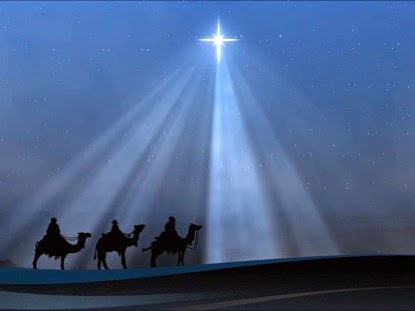
Follow That Star - sermon for Jan. 12, 2015

Follow That Star
Rev. Alison Longstaff, Jan 12, 2015
Bath Church of the New Jerusalem
Psalm 147:1-5; Matthew 2:1-12; Heavenly Secrets 9293:3; The Apocalypse Explained 695:20  

We all follow some star.  Which one leads to hope and peace and joy?

The story of “the wise men from the east” is a magical story, with interesting characters, a villain, and strange and wonderful gifts.  In it, some sages from a foreign culture see a star and “follow it.”  We don’t know how many sages there were.  We have decided there were three because three gifts are given.  But there could have been two or four or ten sages….  And they weren't kings.  It is okay that we represent them as kingly, covered in fine garments and jewels, because spiritual wisdom corresponds to spiritual riches.  They were spiritually very rich, but were probably not kings.  So, not three, and not kings—they also didn't come to the manger, but to a house—but other than that, we are right on the money.

When was the last time you tried to follow a star?  It sounds like something from a fairy tale or a fantasy story. It captures our imaginations.  The truth is, while we have pretty much lost the ability to follow stars in our modern cultures, thanks to GPS and other technologies, we all follow stars in our spiritual lives.  Those of us that are a little ADD may follow several different stars in one day—“Ooh! Shiny!” But the inner stars we follow are anything that we look toward or use to get us to a better place.  They are anything we are “trusting in” or “living by” to get us closer to the things we value most.  It is always good to reexamine just what it is we are trusting in, so as to  make sure we are going where we truly want to go.

And if you are anything like me, sometimes your eyes may waver, and you start following a different star than you intended without realizing it.  Or maybe you forget you were even following a star—rather the way we forget our New Year’s resolutions. Or perhaps you have been following diligently, and then the star disappears.  That is what happened in today’s story. 

Often, the stars we are following are not the best stars, like wealth, or power, or shopping, or even coffee.  Honestly, if I prayed or meditated as often as I drink coffee … I can’t even think how different my life would be.  But fortunately, God is patient and forgiving.  And in today’s story, only the sages from the east needed to follow the star, not the shepherds, not all of Israel, not the whole world, just this handful of foreigners—and there is a correspondence in that, too.

Today’s sermon is all about the small part of us that does manage to follow the star, THE Star, The Star of Bethlehem, even while other parts of us are wandering off after other stars.  And it is about the results that come from that small part of us successfully arriving at the cradle of God in our souls, and all the blessings that unfold from that. 

So let’s look at some of the details around this story.
  • The wise ones came from the east.
  • They went first to Jerusalem
  • Then the star led them to Bethlehem 
Swedenborg says the sages came from the east for two reasons.  First, it was in the east that there were still people who had a very ancient wisdom. Only these could “read the signs” of the Lord’s coming.   

Secondly, the east is the direction that symbolizes the greatest intimacy with God, because it is where the sun rises.  The most ancients knew that the sun represented God.  Only later did humans begin to confuse the sun with God and worship it.  Sun worship is a vestige of this ancient wisdom.  In any case, these wise ones coming from the east symbolize a part of our inner reality that lives closest to the divine or is the most spiritual, and it therefore holds the deepest wisdom, such that it recognizes God’s approach and responds.  That part of us is paying attention to signs of God’s leading, and following. The whole rest of our psyches, or “the world” may be going about life as usual, but this part of us is listening and waiting and then responding to God’s birth in our lives.  We don’t have to do much to make this happen.  It just happens.

An interesting and perhaps very telling detail is that the sages first went to Jerusalem.  This journey symbolizes that our first spiritual response to the Divine is to learn more.  We get curious.  We might go to the very center of a given religion (Jerusalem) to find the Divine. Whatever it looks like, we all start our spiritual journey with education—with learning in some form. We start by trying to learn “the rules.”  (Egypt also represents learning or education, so every time someone travels to Egypt or lives in Egypt in the Bible, the story is about a phase of education in the spiritual journey.) 

Notice that it doesn't say the star led them to Jerusalem.  It just says they went there. Did an expectation that they would find what they need in Jerusalem take over from their inner listening, and that is why they lost sight of the star?  Who knows?  In any case, it is clear that at some point they had to stop and ask for directions (wise men indeed!). Bethlehem is five miles beyond Jerusalem if we consider the most common route from the east to the west in this region.  Perhaps the story tells us that they went first to Jerusalem because this is what we all do in our spiritual journey.  We all start with education and must access education for us to advance in our spiritual growth. 
But we cannot stop there; we cannot think that we are getting closer to the Divine by piling on more and more spiritual education.  We have to “use it or lose it.” When we use spiritual education to try to bypass actual spiritual growth, it is a little like trying to get to heaven by building a tower. It is like mistaking the sun for God.  It is like mistaking the finger that points to the moon for the moon.  And it is why we all react with distaste to spiritual adherents whose lives show little transformation by the teachings and practices they supposedly espouse.  “Hypocrite” comes from Greek and means play-actor or faker.  Nobody likes a hypocrite.

All of us have encountered—or ourselves have been—the humans who mistake being right or having lots of doctrine for travelling the path to heaven.  It isn't what we have, it is what we do. The need to be right is from the ego.  But the light of the Star shines into our inner knowing, not our ego.  The more our ego takes over our spiritual journey, the harder it is for us to hear the inner wisdom—the “still, small voice.” When the ego takes over, the star disappears.

Jerusalem in the Word always represents our spirituality in regard to our ideas and rituals and “doctrine.”  Jerusalem is our “head” connection with religion.  It is the structure, the trappings, and the "bones” of religion.  It is a vital part of the religious landscape, but Jesus isn't born there for several reasons.
 
First, Herod is often ruling there, and he is threatened by Jesus.  Herod wants to kill Jesus.  Herod is our ego.  Herod is our fear and insecurity and need to control.  This part of us feels threatened by and wants to kill any gentle, intuitive calling to be open, vulnerable, non-dominant, and of service.  Our ego leads us to our ego.  It can’t lead us anywhere else.  It is a lousy leader of our spiritual life and wants to kill every single thing that threatens it, even the most tender and innocent.  It is also a fact of our existence.  We all have an ego and it always kills the innocent, and that is one reason we suffer so much.

So why did the wise men go to Jerusalem?  Why did they lose sight of the star? This has several meanings, but one simple one is that this story describes the way we learn how to move from a head-based spirituality to a heart-based one.  Every single one of us finds our way to a true and living spirituality through “Jerusalem.”  We think the Lord will be in “Jerusalem” which means we think our security and foundation will be in the doctrines or beliefs of a religion; and because we believe this, we are allowed to “go there,” which is the best way for us to realize that the Lord is not there.  The Divine is found through good religious instruction, but actually finds no room in a head-only, rules-based “I-have-arrived-because-I've-signed-up-with-the-right-club” way if doing religion. We must seek a living, inner connection to the Divine Love, and that is found elsewhere.

And so once we let go of “doctrine” and “religion” as the birthplace of the Divine in us, then we can be lead to where the Divine truly rests in us, in a humble manger, in Bethlehem.
 
Bethlehem means “House of Bread”.  A place of nourishment.  A place where we will be spiritually fed and cared for.  It is a place of hospitality, not worry about being perfect.  Jesus was born and laid in a manger, which is a place of nourishment of the most humble kind. When we are in a Jerusalem spirituality, we still judge worship and each other based on external features: Is the space perfect? Are the robes flawlessly clean?  Did the minister or organist make any mistakes?  Thinking these external trappings matter more than they do are often how we slide into in a “Jerusalem” spirituality.  Whereas a Bethlehem spirituality pays attention to the feeling of the space and the quality of the intention of the congregation even if the space is a little run down.  A “Bethlehem” church is one that is always welcoming, even if it is not ready to be showcased in a magazine, because appearances don’t matter as much as the love.

Bethlehem especially represents when the goodness in our hearts is finding expression in what we do.  It is when truths, such as that we should love our neighbor as our self are actually showing up in how we live.  Our spiritual life becomes complete only when we are living the truths we have learned simply because we love the Lord and the neighbor.  A stable is the birth-place.  It is humble.  The wise ones will find Jesus in a house, because by the time they arrive, Mary and Joseph have found a home.  Still, Bethlehem spirituality is about hospitality.  When our presence becomes soul-nourishing and sheltering and welcoming to all those around us, we are in a Bethlehem spirituality.

In our spiritual journey to the place where Jesus lives in us, we walk right by Herod (ego) metaphorically. We even ask him for help.  But it is not Herod that helps, it is the scholars attached to his palace that help us (ancient wisdom).  There is a resonant wisdom in Jerusalem that points our wandering sages to Bethlehem.  Then, instead of leading the ego straight to Jesus, there is a part of us that listens to the whispers in our dreams (our intuitive knowing).  This steers us away from any alliance with Herod, keeping Jesus safe.  The sages go home by another way. 
Phew!  The thing about a Swedenborgian study of the Bible, is that there are so many riches within even the shortest story, it is hard to keep the sermon short!  I want to share all of it.

And so, let us tackle Gold, Frankincense, and Myrrh which are the riches we reap when this part of our souls finally connects with the cradle of the Divine in us.  Remember, the entire rest of the world is going about its business, not paying much attention to this visit.  This means that the Lord is doing this work inside our souls even while we are trying to deal with paying the bills and getting our kids to do their homework and figure out how warm to keep our homes in the dead of winter when heat costs so much.  So long as we are doing our best and setting our intention repeatedly back to a life of integrity and selflessness and service according to our conscience, God takes care of the rest of it.  This is happening in the spiritual realm even while the bulk of our attention must go elsewhere.

Gold is a gift we give and receive from our love or motivational side.  In this story it is the rich and pure love from God which we offer back to God when we have done the work of the spiritual journey.  This giving and receiving happens over and over again, not just once, rather the way we read this story year after year, because the spiritual journey is both a process and an event.  Frankincense is a gift we give and receive from our intellect or thinking side.  It is the way our spiritual intelligence is enriched and seasoned by all the learning along the way, and how we serve others from this wisdom.  Myrrh symbolizes all the ways this deepened love and deepened wisdom become part of everything we do.  Once we find and “arrive” in a Bethlehem spirituality, we find our way straight to the Lord, and cannot help but offer up from our lives, acts of love and service shaped and informed by deep love and wisdom.

There is a star lighting your path.  You can see it when you go within yourself to commune with God.  This takes learning and discipline, education and practice, but God is patient and understands. Your Star of Bethlehem speaks into your heart; into what you love best.  When you cannot find it, perhaps you are near Jerusalem and Herod, thinking your ideas will save you, or that belonging to the right spiritual club will save you, or that learning more truth will save you, or that serving more from an empty place will save you.  But the answer lies in our hearts and in who we were created to be, which is always with us.  The Star speaks to a part of us we barely notice, but that is very wise.  When we remember that the spiritual path lies in love and in inner listening; when we remember that it is always headed toward compassion and service for all, we will find our way again.  When we fill with joy and hope, even if there is spiritual work ahead, we have found our star.

This is the hope and peace and joy awaiting us all (along the way and) at the end of this spiritual journey.  It is the hope of all humankind, for when we follow this star, we will find peace on earth, and life will be a joy. 

May you have good success on your journey toward your Star of Bethlehem this year.
Amen

The Readings
Psalm 147: 1-5  Praise the Lord! For it is good to sing praises to our God; for it is pleasant, and a song of praise is fitting.  The Lord builds up Jerusalem; he gathers the outcasts of Israel.
He heals the brokenhearted and binds up their wounds.  He determines the number of the stars; he gives to each one a name.

Matthew 2:1-12
In the time of King Herod, after Jesus was born in Bethlehem of Judea, wise men from the East came to Jerusalem, asking, "Where is the child who has been born king of the Jews? For we observed his star at its rising, and have come to pay him homage." When King Herod heard this, he was frightened, and all Jerusalem with him; and calling together all the chief priests and scribes of the people, he inquired of them where the Messiah was to be born. They told him, "In Bethlehem of Judea; for so it has been written by the prophet:
`And you, Bethlehem, in the land of Judah, are by no means least among the rulers of Judah; for from you shall come a ruler who is to shepherd my people Israel.'"
Then Herod secretly called for the wise men and learned from them the exact time when the star had appeared. Then he sent them to Bethlehem, saying, "Go and search diligently for the child; and when you have found him, bring me word so that I may also go and pay him homage." When they had heard the king, they set out; and there, ahead of them, went the star that they had seen at its rising, until it stopped over the place where the child was. When they saw that the star had stopped, they were overwhelmed with joy. On entering the house, they saw the child with Mary his mother; and they knelt down and paid him homage. Then, opening their treasure chests, they offered him gifts of gold, frankincense, and myrrh. And having been warned in a dream not to return to Herod, they left for their own country by another road.
The Apocalypse Explained 695:20   The sages from the east were the ones paying attention regarding the Lord's coming because of correspondences within their ancient beliefs.  That is why the star appeared them and lead them.  Being “from the east” also symbolizes a very close connection with the Divine. The star went before them, first to Jerusalem, which always represents “the church” in respect to doctrine and in respect to the Word.  From there it went before them to the place where the infant Lord lay. 
Heavenly Secrets 9293:3
‘Gold, frankincense, and myrrh’ symbolize all the different ways our lives are transformed by love and by a living faith.  We offer these back to God when we live more wisely and compassionately in the world. ‘Gold” is all the ways we are changed by becoming more loving; ‘frankincense’ is all the ways we are changed by becoming more wise and trusting in Providence; and ‘myrrh’ is all the ways those inner changes show up in everything we do.  The people of old, from ancient times, understood and saw such heavenly and divine realities shining from within all things in the world and on earth.  It was well known to these ancients that all things had a correspondence and were representative, and therefore had a spiritual meaning.  This was how they knew that gold, frankincense, and myrrh symbolize the forms of love that should be offered to God. They knew also from their prophecies that the Lord would come into the world, at which time a star would appear to them. ‘A star’ symbolizes an inner knowing of what is truly good, which come from connection with the Lord.