Showing posts with label abundance. Show all posts

Tuesday, May 16, 2017

Why Does God Speak in Parables? -sermon


Why Does God Speak In Parables?
Rev. Alison Longstaff, July 19, 2015
Bath Church of the New Jerusalem
Isaiah 6:6-10; Matthew 13:10-15; Sacred Scripture 97

You will indeed listen, but never understand, and you will indeed look, but never perceive.  For this people’s heart has grown dull, and their ears are hard of hearing, and they have shut their eyes; so that they might not look with their eyes, and listen with their ears, and understand with their heart and turn—and I would heal them.’ (Matthew 13:10-15 NRS)

At first glance, today’s Bible passages imply that God stops some people from understanding the Word. They imply that those who do somehow understand the inner message within the Word are given to understand and receive more and more wisdom, while those who don’t understand not only miss out on the inner meaning, but will be stripped of what understanding they do have.  Jesus says: “The reason I speak to them in parables is so that ‘seeing they do not perceive, and hearing they do not listen, nor do they understand.’  He then quotes a passage from Isaiah to emphasize his point.  In it the wording is even more harsh:

Go and say to this people: “Keep listening, but do not comprehend; keep looking, but do not understand.” Make the mind of this people dull, and stop their ears, and shut their eyes, so that they may not look with their eyes, and listen with their ears, and comprehend with their minds, and turn and be healed.  (Isaiah 6:9-10)

Today’s passages say that if the people understood, they would turn and be healed. Does this mean that God prevents some people from hearing and seeing?

These passages imply that to “be healed,” we must first manage to figure out the secret inner message to the “parables” and then we get the “abundance.”  But what if I’m not smart enough?  If my spiritual IQ is less than stellar, am I doomed to be stripped of my little rather than granted abundance?  Am I doomed to miss out on the “healing?”  Why would God prevent some of us from seeing and hearing the truths of the Word?

This picture of God isn’t fitting with a God who loved us so much that He came to earth and suffered and died for our eternal salvation.  So let’s look in deeper.

It always helps to look at the context of a saying.  The setting for our main quote is the gospel of Matthew.  Matthew begins with the promise of “God with us” (1:23) and ends with “I am with you always.” (28:20) The middle of Matthew is chock full of parables, one after another, many of them about the kingdom of heaven as something to be sought.  So this gospel’s overarching message is “God is with us,” and with us always, as well as the strong implication that we must seek the kingdom of heaven if we want to find it.  We need to want the kingdom of heaven to find it.  Today’s story is found within this bigger message: “God desires to be with us forever, but there is a process involved for us to achieve this.”

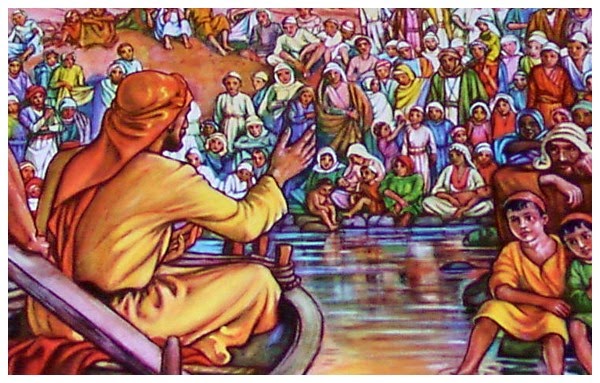
Matthew thirteen in particular opens with, “That same day Jesus went out of the house and sat beside the sea.  Such great crowds gathered around him that he got into a boat and sat there, while the whole crowd stood on the beach.” (1-2)

There is a wealth of meaning in these few lines. When it says Jesus went out of the house and entered a boat, it is preparing us for a paradigm shift. A boat is a structure that enables us to maneuver safely over great depths of water, to stay dry, to access the resources of the deep without drowning, and (especially in the days before cars and trains and planes) to travel long distances more quickly and efficiently than we could over land.

Emanuel Swedenborg tells us that boats have relation to the way our mind is structured by ideas.  Jesus sat in the boat to teach, implying a bending down or accommodation of His understanding to ours.  In this case, Jesus is established in His own Divine understanding of the Word, and then bending Himself in order to accommodate His understanding to our limited and mortal minds.

The crowd is standing on the beach. They have followed Jesus as far as they can, and cannot follow him farther.  They have hit a barrier—the sea.  They stand on the beach, at the very edge of the sea—where the land ends and past which these mortals could not travel and survive very long without specialized equipment and/or extensive swimming lessons.

Swedenborg tells us that water means knowledge, and that seas represent a large body of knowledge (a gathering together of many waters). This means that a sea illustrates a vast collection of knowledge available in one great mass; in this setting, it represents revelation.  We need Divine aid in navigating revelation effectively and safely.  We might find revelation (the sea) beautifully supportive or wildly threatening, full of bounty or ready to tear our life apart, all depending on our equipment, our training, and especially the weather.

This story in Matthew is a particular discussion of how the Divine message within revelation finds accommodation to our mortal condition.  We stand on the shore, longing to hear it.  A few of us might have boats too, but if we are honest, Jesus doesn’t even need a boat. He can walk on water.  Even in our most optimistic and beautifully confident moments of faith (Peter), we can imitate the ability to walk on water only temporarily.  Our understanding is too limited—our comprehension too hopelessly mortal—and we are quickly swamped. We sink too easily. Only Jesus has the ability to navigate the depths without assistance—He is the Word incarnate.  His being in a boat is an accommodation to our human condition, because the crowd couldn’t have handled it if he had simply walked out and sat on the water.

As for us, “standing on the shore” at least says that we are on our feet; we are ready to move.  We have come as close as we can.  In this verse it says “beach,” which gives us the image of small rocks or sand beneath our feet.  Water is knowledge that is so abstract that it takes special mental constructs to navigate.  Sand is also knowledge, but it is more “grounded” or solid than water. Anybody can access “sand” knowledge and “walk” on it.  It is relatively solid, though it shifts and blows. It is less solid than rock, but solid enough for many purposes. It has been ground down by wind and water action.  However, notice that it is about as loose and shifting as a substance can be “under our standing” before we need special equipment.

In the story, Jesus moves from solid ground to water, and we follow as far as we can.  From the vast sea of wisdom, God bends himself to teach us.

Matthew thirteen is packed with parables.  Indeed, almost right away in thirteen do we find the disciples asking, “Why do you speak to them in parables?” indicating that this chapter may address that very question. The word parable comes to us from the Greek word “paraballo,” meaning “to throw alongside” or “to compare.”  A parable by definition then, holds a parallel or symbolic meaning.  It reveals more than our first glance might assume. The listener is asked to make a mental leap in order to follow the deeper line of thought.  A parable invites us to stretch our minds, to think about things in a new way: a parable is a kind of puzzle that teases our minds into new insight.  It can be seen at face value, or interpreted for a deeper meaning.

At face value, today’s passage seems to say that God speaks in parables to prevent some of us from “hearing and seeing”.  Why on earth would the Word say this, and why would Jesus emphasize it?  We find a possible answer in Swedenborg’s work The Divine Providence: The Lord provides that no one should interiorly acknowledge truths and then afterwards depart from them and make them profane. (231:9)

According to Swedenborg, this strange story is internally about how the Lord protects us from profaning the Word. It is imperative that when we receive Divine truth it is with respect and spiritual maturity, because without respect and spiritual maturity we can do great harm to ourselves and each other.  And so the Lord speaks to us in parables.  We are kept from understanding deeper truths until we are spiritually ready.

Swedenborg says in The Doctrine of the Sacred Scripture number 97:

The literal meaning of the Word is a guard for the genuine truths lying within it. It may be turned this way and that, and interpreted to one’s own understanding, without its interior content being injured or violated. It does no harm that the meaning of the letter of the Word is understood differently by different persons: but harm results when Divine truths, lying concealed within, are twisted toward evil, for in this way violence is inflicted on the Word. To prevent this, the sense of the letter is a guard; and it acts as a guard with those who are in false thinking from their religion.

Or as translator Michael David words The Doctrine of the Sacred Scripture number 26:

“So, to prevent anyone from coming upon the spiritual meaning of the Word, and screwing up what is really true there, the Lord has posted security guards, who are meant by the ‘cherubim’ mentioned in the Word.”  (SS David 2004 26:2)

The Word exists among a humanity full of mixtures of goodness and not-so-goodness.  Some people (and some of our own inner states) are more arrogant and controlling, and some are gentler and seeking mutual well-being.  Churches also come in all sorts of mixtures of good intentions and a desire to control, ignorance or deep scholarship, sometimes doing good and sometimes doing harm. The innocent parts of us that are open to learning are represented by the sheep, the lost sheep, and the gentiles in the Word as well as by the disciples.  Those who wish to use the Bible to control others and control the church are represented by the “Pharisees.”  It is important to remember that the Pharisees aren’t so much a group “out there,” but a part of your inner world and mine.  They represent a phase or mind-set when we are sure we know what is right, and are putting our energies and attention into religious rules and enforcement.  In this mindset, we have fallen away from the “Spirit” of revelation and sunk into legalism.  We have made the Letter of the Word the Law.

When we are needing to use the Word to control other people (“Pharisees”), our eyes are blinded and our ears stopped up. We are not open to the spirit. We don’t even recognize it when it is staring us in the face. The survival of this mindset depends on silencing the voice of the spirit. This mindset is also represented by Herod who tried to slay the infant Jesus.  It is imperative that the Lord protects and prevents that part of our inner nature from accessing the tender inner truths of the Word until we are spiritually ready to treat them with respect. God hides away this precious inner meaning and keeps it (and us) safe. In fact, in his work The Divine Providence, Swedenborg tells us:  “We are not granted inner access to the truths of faith nor the goodness of mutual love except so far as we can be kept in them with integrity right on to the end of life.” (DP Longstaff 2005 21)

And so it is not so much that the Lord prevents us from seeing, but our own spiritual immaturity closes our hearts and eyes.  Revelation is presented to us in parables for our own protection.  The image of child-locks on kitchen cupboards comes to mind.  It is not good for us to have access to the knives, electrical appliances, or cleaning detergents until we are mature enough to use them responsibly.  Isaiah 6:9-10 and Matthew 10-15 can be read as, “I have put locks on the cupboards.  Those of you who reach sufficient maturity will be allowed access to the things inside.  When you are ready, these tools will add tremendously to your ability to work and serve.  If you are not ready, I will need to take away any of those things if you get a hold of them, for your own protection.”  For me, this reading of today’s story fits with the God that is being revealed in the Word—a God that comes as close as possible to those who are ready to receive, and a God who guides our spiritual advancement carefully, only presenting things as we are ready to handle them. 

Salvation is not a one-time event but a series of lifelong choices. You and I are on a path of spiritual evolution. And until we are ready for deeper concepts, we are not ready.  God guides and protects each one of us, every step of the way.

For when we are ready, the Word holds hidden vast stores of treasures in great abundance. But we need to desire this treasure, like the widow of the parable sweeping to find the coin or the man selling all he has for the field with the buried treasure.  Our part is to come to the shore—as close as we can—and stand eager to receive.  If we come with reverence and humility, and the awareness of the deep Divinity of the inner message, the Word sits ready to teach.

But if we see the Word as a tool for controlling the lives of others, it will soon become a hard and lifeless thing in our hands.  If we see instead that it is like dough with hidden leaven, prepared for our own daily bread, we will handle it with care so that the leaven can do its work.  The God revealed in the Word longs for lasting growth and strong roots in his disciples.  Such a sower exercises great patience, for strong growth takes time, even as the raising of bread dough must not be rushed.

With its appearance of impatience and harshness, perhaps Matthew 13:10-15 actually hides words of great gentleness and patience.  God has plans for our well-being and not for harm.

We do not need to worry and be afraid.  We simply need to grow in our hearts and soften our need to control, and seek diligently for readiness and wisdom.  God does all the rest.

Therefore the Lord waits to be gracious to you; therefore he will rise up to show mercy to you. For the Lord is a God of justice; blessed are all those who wait for him. (Isaiah 30:18)

Do not be afraid.  Seek and you will find.

Amen

The Readings
Isaiah 6:6-10 (NAS)
Then one of the seraphim flew to me with a burning coal in his hand, which he had taken from the altar with tongs. He touched my mouth with it and said, “Behold, this has touched your lips; and your iniquity is taken away and your sin is forgiven.”
Then I heard the voice of the Lord, saying, “Whom shall I send, and who will go for Us?” Then I said, “Here am I. Send me!” 
He said, “Go, and tell this people: ‘Keep on listening, but do not perceive; Keep on looking, but do not understand.’ “Render the hearts of this people insensitive, Their ears dull, And their eyes dim, Otherwise they might see with their eyes, Hear with their ears, Understand with their hearts, And return and be healed.”

Matthew 13: 10-15 (TNIV)
The disciples came to him and asked, “Why do you speak to the people in parables?” 
He replied, “The knowledge of the secrets of the kingdom of heaven has been given to you, but not to them. Those who have will be given more, and they will have an abundance. As for those who do not have, even what they have will be taken from them. This is why I speak to them in parables: “Though seeing, they do not see; though hearing, they do not hear or understand. In them is fulfilled the prophecy of Isaiah: “‘You will be ever hearing but never understanding; you will be ever seeing but never perceiving. For this people’s heart has become calloused; they hardly hear with their ears, and they have closed their eyes. Otherwise they might see with their eyes, hear with their ears, understand with their hearts and turn, and I would heal them.’

SS 97
The literal meaning of the Word is a guard for the genuine truths lying within it. It may be turned this way and that, and interpreted to one’s own understanding, without its interior content being injured or violated. It does no harm that the meaning of the letter of the Word is understood differently by different persons: but harm results when Divine truths, lying concealed within, are twisted toward evil, for in this way violence is inflicted on the Word. To prevent this, the sense of the letter is a guard; and it acts as a guard with those who are in false thinking from their religion.

Sunday, January 18, 2015

Shed A Little Light - sermon January 18


Shed a Little Light
Rev. Alison Longstaff, Jan 18, 2015
Bath Church of the New Jerusalem
2 Kings 4:1-7; Matthew 14:13-21; New Jerusalem’s Heavenly Doctrine 151-2  

Elisha said, “I wonder how I can be of help. Tell me, what do you have in your house?”
“Nothing,” she said. “Well, I do have a little oil.”

On this Martin Luther King Sunday, I wanted to talk about what it takes to be a hero, and it might not be what you think. 

I first saw Joe Black in the line at Café Crème down here on Front Street.  My immediate impression of his mustache and tattoos and piercings was, “Scary.  Give that one lots of room!”
 
I happened to be in line with Carolyn Lockwood.  What she said to me next dragged my needle right off that record.  She said with a big smile, “Have you met Joe Black?  He is such a great guy.  Everyone loves him!”  I then learned about his daily Facebook “Message of Awesomeness,” and of the many other ways he brightens the lives of many in this community just by showing up in life with optimism and words of support and encouragement.  Jaded cynics beware.  Joe’s light shines on through the darkest days.  He is a local hero.  

Here I sat down with Joe and asked him the following questions. He answered with his heart.  I have included some summations of his answers. His words encouraged us all to make what difference we can with what we have.  He revealed how we never know when kind words from us might save someone's life.  His words of kindness and way of being loving has inspired at least one person and probably more not to commit suicide.

Tell us a bit about your background, where you grew up and went to school.  How would you describe your childhood and teenage years?   Joe grew up in Bath, attending the local schools.

You got an award from Maine Street Bath, what was it for?  It is for being a good citizen---for his Messages of Awesomeness and Hugs and contributing in many ways, such as the reading program and youth program.

You post daily messages of awesomeness on Facebook and have a commitment to being positive and loving.  What else do you do, and why do you do these things?  He helped see that a skate park was built and he promotes literacy in the schools.

So, do you feel positive and loving all the time? Not at all.  Sometimes he is writing his positive messages to remind himself to stay positive. 

Tell me about a few favorite memories or moments that have happened because of your commitment to being positive and loving and real. A woman told him she was still alive because of his words of encouragement.  Just seeing him stopped her from killing herself.

It sounds very rewarding. What does it cost you to put yourself out there the way you do?  He said it costs him nothing.  He just tries to be himself every day.

We applauded Joe.  He sat down, and then I tied the interview and Scripture together with the theme.

Our Scripture readings pointed us to the way God can take the few resources that we have and make them more than enough for us to accomplish good in the world.  God works through what we love, which is represented by the oil in the widow’s house.  All she had was a little oil, and she thought it was nothing.  But oil represents love.  Oil represents the best in us, it is the spark of joy that can make us serve for hours without fatigue because we are so full of love.  That spark is different for each of us.  It is a spiritual love that shows up in physical ways.

When we tap our inner love, we discover that it is something that never runs out.

That is the message in today’s Scriptures.  That there is always enough when we focus on what matters spiritually. Who among us has not experienced that timelessness and inexhaustible focus that can come over us, when we are engaged in something that truly calls to us?

Our deep spiritual love is bigger and harder to define than the ways it shows up in what we do on earth, but we can get glimpses into what it is by what we love to do.

Some understandings of Swedenborg say that we have a “good” love and an “evil” love, and that we have to “shun” the evil love and try to let God put the good love in us more.  But there is another way to look at it that is simpler and easier to work with.  Let’s picture us as different parts of one body, and I might be, say, part of the liver, and you might be part of a muscle on the right arm, or a red blood cell, or maybe a brain cell. There is so much possibility, and every single cell is needed.  I can be a healthy liver cell, or an infected one.  I might be disease-free or covered in cancer.  But I remain a liver-cell.  I am neither evil nor good, I am a potential useful contributor, but my usefulness is impaired or not by the darkness or disease that is attacking me.   I am what I am.  The problem is the disease or imbalance that affects me. My job is to become aware of and work to remove the diseases or imbalances, not shun my very nature. This model takes a lot of shame and blame and self-loathing out of the picture. It recruits us in being strong against the blocks, or “cancers and diseases” that stop us from living our love.  Do you see the difference in the model?

It is like the difference between a healthy rabbit and a rabbit with rabies.  The rabbit isn't “evil”.  But the rabies will cause the rabbit to do harm until the rabies is removed from it. That is how good loves can be hijacked for harm.  We are made to be expressions of good love.  We can learn about the things that twist our good love and do harm through us by learning about the “hijackers” and protecting against them.

In any case, our good deep spiritual love can show up in all sorts of diverse natural expressions.  For one person, it might show up as rescuing cats; for another, volunteering many hours for a hospital.  For you it might be helping one person at a time with a kind word or an errand; for me it might be making people smile and chuckle in the grocery checkout line.  The speaker at Rotary two weeks ago went to Cambodia to work on a clean drinking water project!  But for someone with massive health challenges it might be all they can do to be patient and kind with their caregivers.  But each one, no matter what the scale, is making a difference in the world towards greater ease, greater peace, and a better life for each other. 

It isn't size or scope that matters.  It is what we do with what we have at hand no matter how small that matters, and God promises that whatever that is, it is enough. 

And it isn't a competition.  It is good that we give awards to thank the ones who make a difference. I loved witnessing the standing ovation offered to Joe when he won his Main Street Bath Award.  But most of us will go unrecognized, and that is okay, because when we are truly living our love, we don’t really care about being recognized anyway, we are having too much fun living our love.

In our Hebrew Bible lesson the widow was also advised to “sell” her oil.  This means that she was commanded to value it and to allow others to value it.  This is not a lesson in capitalism but in self-respect.  It is we who can fail to recognize the value of what we have to offer and can have a hard time accepting love and respect and praise from others for what we bring to life. One woman in this congregation whose initials might be A.S. regularly dismisses her kindness and gentleness and sweetness as being not worth much, and yet there isn't a soul in this congregation who doesn't see her as a treasure beyond words.  (And by the way, before I was married, my initials were A.S. and I still struggle to see that what I bring to the world is valuable, so I am preaching what I need to keep learning.  Why is it is so much easier to see the lovability and worth of someone else, while I struggle to give it to myself?)

So, no matter what your initials are, if you are a self-dismisser I encourage you to rethink and realize the worth you bring, yes, just by being you.  It is no big and great and hard task.  It is like brushing the dirt and stones off a beautifully planted garden, and letting God’s love do the rest.  You are the garden.  You are the seeds.   You are the beautiful plant just needing the right conditions to blossom.

Swedenborg teaches that our very nature is love, and he calls us to “repent.”  “Repent” is an old fashioned word that means “use God’s help to remove the things that block you from being more loving.”  Our job is “repentance”.  God’s job is to do all the rest.  God stands ready to help us battle the weeds and insects and (switching metaphors) spiritual cancer cells that may attack along the way.  Those things are not our fault.  They just are, from years of human darkness on this planet.

Yes, there will be weeds!  There will be nasty creatures that try to stunt our growth, block our path, and eat our happiness.  But God is bigger and stronger than any weed or insect or spiritual cancer cell.  And God made us to grow and bloom and spread joy.

The hero’s journey is not an easy one, but it is the only one worth travelling.  The path to love, the path to you becoming your best self is the path to more joy than you can imagine.  Even death is no enemy when your deepest love is the goal.  Just ask Jesus.  So even though you may feel sometimes like you are walking through the shadow of death, fear no evil.  The God that made you—the God of Love—is with you, and the angels, and all these people around you too.  And all are whispering, “Grow!”

Amen.


Shed a Little Light by James Taylor

Let us turn our thoughts today to Martin Luther King,
and recognize that there are ties between us—all men and women
living on the earth—ties of hope and love, of sister and brotherhood.

That we are bound together in our desire to see the world become
a place in which our children can grow free and strong.
We are bound together by the task that stands before us and the road that lies ahead.
We are bound and we are bound.

There is a feeling like the clenching of a fist
There is a hunger in the center of the chest
There is a passage through the darkness and the mist
And though the body sleeps the heart will never rest

Shed a little light, oh Lord! So that we can see—just a little light, oh Lord.
’Want to stand it on up, stand it on up, oh Lord.
’Want to walk it on down.  Shed a little light, oh Lord.

Can't get no light from the dollar bill. Don’t give me no light from a TV screen.
When I open my eyes I want to drink my fill from the Well on the Hill.
Do you know what I mean?

Shed a little light, oh Lord! ….

Oh, let us turn our thoughts today to Martin Luther King,
And recognize that there are ties between us—all men and women
living on the earth—ties of hope and love, of sister and brotherhood.


Readings:
2 Kings 4:1-7
One day the wife of a man from the guild of prophets called out to Elisha, “Your servant my husband is dead. You well know what a good man he was, devoted to God. And now the man to whom he was in debt is on his way to collect by taking my two children as slaves.”
Elisha said, “I wonder how I can be of help. Tell me, what do you have in your house?”
“Nothing,” she said. “Well, I do have a little oil.”
“Here’s what you do,” said Elisha. “Go up and down the street and borrow jugs and bowls from all your neighbors. And not just a few—all you can get. Then come home and lock the door behind you, you and your sons. Pour oil into each container; when each is full, set it aside.”
She did what he said. She locked the door behind her and her sons; as they brought the containers to her, she filled them. When all the jugs and bowls were full, she said to one of her sons, “Another jug, please.”
He said, “That’s it. There are no more jugs.”
Then the oil stopped.
She went and told the story to the man of God. He said, “Go sell the oil and make good on your debts. Then both you and your sons may live on the rest.”

Matthew 14:13-21
When Jesus heard that John had been killed, he went away from there by boat for a deserted place. But when the people heard it, they followed Him on foot from the cities around the lake. When Jesus went ashore He saw the huge crowd. And He was moved with compassion toward them, and He healed their sick.
When it was evening, His disciples came to Him, saying, “This is a lonely place and the day is now over. Send the crowds away to go into the villages and buy themselves food.”
But Jesus said to them, “They do not need to depart. You give them something to eat.”
They said to Him, “We have only five loaves here and two fish.”
He said, “Bring them here to Me.”  Then He commanded the crowds to sit down on the grass. He took the five loaves and the two fish, and looking up to heaven, He blessed and broke and gave the loaves to His disciples; and the disciples gave them to the crowds.  They all ate and were filled. And they took up twelve baskets full of the fragments that remained.  Those who had eaten were about five thousand men, besides women and children.

New Jerusalem and its Heavenly Doctrine 151, 152 portions
151. To do good to the neighbor which is actually good, it must be done from a good love—that is, for the sake of helping or serving others. Those who truly love serving others are not eager to hear of reward, for they simply love to help others, and they get satisfaction from making a difference.  In fact, they are sad if they consider that what they do might be for selfish reasons.


152. Those who do good because they want something for themselves out of it do not do good in service to the Lord, but in service to themselves.  For their first motivation is self-serving—they are looking out only for themselves. Meanwhile they view the good of the neighbor, which is the good of fellow-citizens, of their community, of their country, and of all humanity as nothing but a means to an end.  This means that a short-sighted attachment to self-service and gain at others’ expense can lie hidden inside good deeds, and so far as self-service and selfish gain lie hidden within a good deed, it is not actually good at all.