Showing posts with label truth. Show all posts

Saturday, January 13, 2018

Freedom Manifesto

The following is the result of an assignment for my yoga certification. Publishing it was encouraged, so here it is:

Alison Moore’s Freedom Manifesto

My desire for my life going forward is curiosity, compassion and a belief in transformation through creativity and play. I desire this to be my underlying resting state.

FREEDOM comes when I feel that I have choices and agency---when I feel I can change things that don’t work, and improve conditions that are not optimal. In the yogic principle of the union of opposites, the balancing attitude that I desire to cultivate is the simple acceptance of “what is.” These two attitudes may seem opposite (acceptance of what is vs desire for change), and yet I believe a healthy, balanced union of these two will bring me the greatest joy and serenity going forward.

“Acceptance of what is” shows up in compassionate non-judgment of what my body is able to do each day. Whether I experience a “good” practice full of obvious progress and feelings of strength and sweetness, or I navigate a “bad” practice because my energy is low and my asanas appear regressed, I wish to be peacefully present to what is. I wish to carry into each practice the knowledge that every single practice matters, and that the way I treat myself in a practice is the measure of the success of the practice, not how far I could extend or contract in a given asana.

Now, when I see something about myself that I want to change, I desire to notice it with curiosity and serenity. I want to say, “Huh. Interesting!” I want to have the willingness to approach the area that needs work with compassion and optimism and a sense of possibility. Previously I approached it with shame and the fear of what everyone else “must” think of me. My impulse was to hide the shortcoming or failure as quickly as possible. I do not wish to operate from fear of judgment or shame or a desire to hide anymore.

I want to continue to develop PERSPECTIVE or a “long view” which will keep me serene in the face of new challenges. Each challenge in the past has been surmounted, no matter how insurmountable each seemed at the time. When I remember this, I can face new challenges with more curiosity and creativity, and less fearful projections of “certain failure” and dire outcomes. “I got through those things and I can get through this.”

In relationships, I desire to be as authentic and “whole” as possible in each moment. This means I desire to own every piece of my life, and to tell the truth about my experiences with compassion and honesty. “The truth” is never harsh or unkind. It is neutral. The harsh or unkind comes when I attach blame or judgment or shame.  A whole lot of my work to this point has been in becoming free of extensive inner self-abuse and fearful thinking.  As these decrease, new space for honesty, clarity and compassion opens up.

As a speaker and teacher, I desire to lead from my vulnerability. I believe that this makes a space for truthful vulnerability in others. I wish to create SAFE spaces, which invite radical honesty and compassion and self-ownership in students and clients. My dream is that I will invite to these qualities and teach about these qualities and model these qualities as naturally as breathing. The goal of this shared vulnerability and mutual respect is REST.
To rest from hiding. To rest from pretending. To rest from struggling. To be FREE.

What would Brene Brown do?

When I show up with compassion and authenticity and a long perspective, life becomes lighter and easier. I am more patient and laugh more easily.

Authenticity is my freedom.  May I remain open to continuing the work gently and steadily that I might ever move into greater and greater authenticity.

January 13, 2018

Tuesday, May 16, 2017

Why Does God Speak in Parables? -sermon


Why Does God Speak In Parables?
Rev. Alison Longstaff, July 19, 2015
Bath Church of the New Jerusalem
Isaiah 6:6-10; Matthew 13:10-15; Sacred Scripture 97

You will indeed listen, but never understand, and you will indeed look, but never perceive.  For this people’s heart has grown dull, and their ears are hard of hearing, and they have shut their eyes; so that they might not look with their eyes, and listen with their ears, and understand with their heart and turn—and I would heal them.’ (Matthew 13:10-15 NRS)

At first glance, today’s Bible passages imply that God stops some people from understanding the Word. They imply that those who do somehow understand the inner message within the Word are given to understand and receive more and more wisdom, while those who don’t understand not only miss out on the inner meaning, but will be stripped of what understanding they do have.  Jesus says: “The reason I speak to them in parables is so that ‘seeing they do not perceive, and hearing they do not listen, nor do they understand.’  He then quotes a passage from Isaiah to emphasize his point.  In it the wording is even more harsh:

Go and say to this people: “Keep listening, but do not comprehend; keep looking, but do not understand.” Make the mind of this people dull, and stop their ears, and shut their eyes, so that they may not look with their eyes, and listen with their ears, and comprehend with their minds, and turn and be healed.  (Isaiah 6:9-10)

Today’s passages say that if the people understood, they would turn and be healed. Does this mean that God prevents some people from hearing and seeing?

These passages imply that to “be healed,” we must first manage to figure out the secret inner message to the “parables” and then we get the “abundance.”  But what if I’m not smart enough?  If my spiritual IQ is less than stellar, am I doomed to be stripped of my little rather than granted abundance?  Am I doomed to miss out on the “healing?”  Why would God prevent some of us from seeing and hearing the truths of the Word?

This picture of God isn’t fitting with a God who loved us so much that He came to earth and suffered and died for our eternal salvation.  So let’s look in deeper.

It always helps to look at the context of a saying.  The setting for our main quote is the gospel of Matthew.  Matthew begins with the promise of “God with us” (1:23) and ends with “I am with you always.” (28:20) The middle of Matthew is chock full of parables, one after another, many of them about the kingdom of heaven as something to be sought.  So this gospel’s overarching message is “God is with us,” and with us always, as well as the strong implication that we must seek the kingdom of heaven if we want to find it.  We need to want the kingdom of heaven to find it.  Today’s story is found within this bigger message: “God desires to be with us forever, but there is a process involved for us to achieve this.”

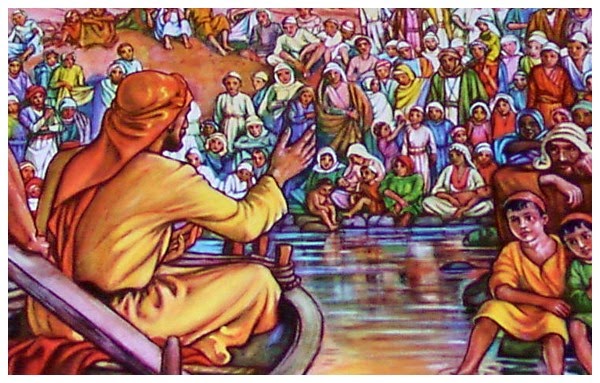
Matthew thirteen in particular opens with, “That same day Jesus went out of the house and sat beside the sea.  Such great crowds gathered around him that he got into a boat and sat there, while the whole crowd stood on the beach.” (1-2)

There is a wealth of meaning in these few lines. When it says Jesus went out of the house and entered a boat, it is preparing us for a paradigm shift. A boat is a structure that enables us to maneuver safely over great depths of water, to stay dry, to access the resources of the deep without drowning, and (especially in the days before cars and trains and planes) to travel long distances more quickly and efficiently than we could over land.

Emanuel Swedenborg tells us that boats have relation to the way our mind is structured by ideas.  Jesus sat in the boat to teach, implying a bending down or accommodation of His understanding to ours.  In this case, Jesus is established in His own Divine understanding of the Word, and then bending Himself in order to accommodate His understanding to our limited and mortal minds.

The crowd is standing on the beach. They have followed Jesus as far as they can, and cannot follow him farther.  They have hit a barrier—the sea.  They stand on the beach, at the very edge of the sea—where the land ends and past which these mortals could not travel and survive very long without specialized equipment and/or extensive swimming lessons.

Swedenborg tells us that water means knowledge, and that seas represent a large body of knowledge (a gathering together of many waters). This means that a sea illustrates a vast collection of knowledge available in one great mass; in this setting, it represents revelation.  We need Divine aid in navigating revelation effectively and safely.  We might find revelation (the sea) beautifully supportive or wildly threatening, full of bounty or ready to tear our life apart, all depending on our equipment, our training, and especially the weather.

This story in Matthew is a particular discussion of how the Divine message within revelation finds accommodation to our mortal condition.  We stand on the shore, longing to hear it.  A few of us might have boats too, but if we are honest, Jesus doesn’t even need a boat. He can walk on water.  Even in our most optimistic and beautifully confident moments of faith (Peter), we can imitate the ability to walk on water only temporarily.  Our understanding is too limited—our comprehension too hopelessly mortal—and we are quickly swamped. We sink too easily. Only Jesus has the ability to navigate the depths without assistance—He is the Word incarnate.  His being in a boat is an accommodation to our human condition, because the crowd couldn’t have handled it if he had simply walked out and sat on the water.

As for us, “standing on the shore” at least says that we are on our feet; we are ready to move.  We have come as close as we can.  In this verse it says “beach,” which gives us the image of small rocks or sand beneath our feet.  Water is knowledge that is so abstract that it takes special mental constructs to navigate.  Sand is also knowledge, but it is more “grounded” or solid than water. Anybody can access “sand” knowledge and “walk” on it.  It is relatively solid, though it shifts and blows. It is less solid than rock, but solid enough for many purposes. It has been ground down by wind and water action.  However, notice that it is about as loose and shifting as a substance can be “under our standing” before we need special equipment.

In the story, Jesus moves from solid ground to water, and we follow as far as we can.  From the vast sea of wisdom, God bends himself to teach us.

Matthew thirteen is packed with parables.  Indeed, almost right away in thirteen do we find the disciples asking, “Why do you speak to them in parables?” indicating that this chapter may address that very question. The word parable comes to us from the Greek word “paraballo,” meaning “to throw alongside” or “to compare.”  A parable by definition then, holds a parallel or symbolic meaning.  It reveals more than our first glance might assume. The listener is asked to make a mental leap in order to follow the deeper line of thought.  A parable invites us to stretch our minds, to think about things in a new way: a parable is a kind of puzzle that teases our minds into new insight.  It can be seen at face value, or interpreted for a deeper meaning.

At face value, today’s passage seems to say that God speaks in parables to prevent some of us from “hearing and seeing”.  Why on earth would the Word say this, and why would Jesus emphasize it?  We find a possible answer in Swedenborg’s work The Divine Providence: The Lord provides that no one should interiorly acknowledge truths and then afterwards depart from them and make them profane. (231:9)

According to Swedenborg, this strange story is internally about how the Lord protects us from profaning the Word. It is imperative that when we receive Divine truth it is with respect and spiritual maturity, because without respect and spiritual maturity we can do great harm to ourselves and each other.  And so the Lord speaks to us in parables.  We are kept from understanding deeper truths until we are spiritually ready.

Swedenborg says in The Doctrine of the Sacred Scripture number 97:

The literal meaning of the Word is a guard for the genuine truths lying within it. It may be turned this way and that, and interpreted to one’s own understanding, without its interior content being injured or violated. It does no harm that the meaning of the letter of the Word is understood differently by different persons: but harm results when Divine truths, lying concealed within, are twisted toward evil, for in this way violence is inflicted on the Word. To prevent this, the sense of the letter is a guard; and it acts as a guard with those who are in false thinking from their religion.

Or as translator Michael David words The Doctrine of the Sacred Scripture number 26:

“So, to prevent anyone from coming upon the spiritual meaning of the Word, and screwing up what is really true there, the Lord has posted security guards, who are meant by the ‘cherubim’ mentioned in the Word.”  (SS David 2004 26:2)

The Word exists among a humanity full of mixtures of goodness and not-so-goodness.  Some people (and some of our own inner states) are more arrogant and controlling, and some are gentler and seeking mutual well-being.  Churches also come in all sorts of mixtures of good intentions and a desire to control, ignorance or deep scholarship, sometimes doing good and sometimes doing harm. The innocent parts of us that are open to learning are represented by the sheep, the lost sheep, and the gentiles in the Word as well as by the disciples.  Those who wish to use the Bible to control others and control the church are represented by the “Pharisees.”  It is important to remember that the Pharisees aren’t so much a group “out there,” but a part of your inner world and mine.  They represent a phase or mind-set when we are sure we know what is right, and are putting our energies and attention into religious rules and enforcement.  In this mindset, we have fallen away from the “Spirit” of revelation and sunk into legalism.  We have made the Letter of the Word the Law.

When we are needing to use the Word to control other people (“Pharisees”), our eyes are blinded and our ears stopped up. We are not open to the spirit. We don’t even recognize it when it is staring us in the face. The survival of this mindset depends on silencing the voice of the spirit. This mindset is also represented by Herod who tried to slay the infant Jesus.  It is imperative that the Lord protects and prevents that part of our inner nature from accessing the tender inner truths of the Word until we are spiritually ready to treat them with respect. God hides away this precious inner meaning and keeps it (and us) safe. In fact, in his work The Divine Providence, Swedenborg tells us:  “We are not granted inner access to the truths of faith nor the goodness of mutual love except so far as we can be kept in them with integrity right on to the end of life.” (DP Longstaff 2005 21)

And so it is not so much that the Lord prevents us from seeing, but our own spiritual immaturity closes our hearts and eyes.  Revelation is presented to us in parables for our own protection.  The image of child-locks on kitchen cupboards comes to mind.  It is not good for us to have access to the knives, electrical appliances, or cleaning detergents until we are mature enough to use them responsibly.  Isaiah 6:9-10 and Matthew 10-15 can be read as, “I have put locks on the cupboards.  Those of you who reach sufficient maturity will be allowed access to the things inside.  When you are ready, these tools will add tremendously to your ability to work and serve.  If you are not ready, I will need to take away any of those things if you get a hold of them, for your own protection.”  For me, this reading of today’s story fits with the God that is being revealed in the Word—a God that comes as close as possible to those who are ready to receive, and a God who guides our spiritual advancement carefully, only presenting things as we are ready to handle them. 

Salvation is not a one-time event but a series of lifelong choices. You and I are on a path of spiritual evolution. And until we are ready for deeper concepts, we are not ready.  God guides and protects each one of us, every step of the way.

For when we are ready, the Word holds hidden vast stores of treasures in great abundance. But we need to desire this treasure, like the widow of the parable sweeping to find the coin or the man selling all he has for the field with the buried treasure.  Our part is to come to the shore—as close as we can—and stand eager to receive.  If we come with reverence and humility, and the awareness of the deep Divinity of the inner message, the Word sits ready to teach.

But if we see the Word as a tool for controlling the lives of others, it will soon become a hard and lifeless thing in our hands.  If we see instead that it is like dough with hidden leaven, prepared for our own daily bread, we will handle it with care so that the leaven can do its work.  The God revealed in the Word longs for lasting growth and strong roots in his disciples.  Such a sower exercises great patience, for strong growth takes time, even as the raising of bread dough must not be rushed.

With its appearance of impatience and harshness, perhaps Matthew 13:10-15 actually hides words of great gentleness and patience.  God has plans for our well-being and not for harm.

We do not need to worry and be afraid.  We simply need to grow in our hearts and soften our need to control, and seek diligently for readiness and wisdom.  God does all the rest.

Therefore the Lord waits to be gracious to you; therefore he will rise up to show mercy to you. For the Lord is a God of justice; blessed are all those who wait for him. (Isaiah 30:18)

Do not be afraid.  Seek and you will find.

Amen

The Readings
Isaiah 6:6-10 (NAS)
Then one of the seraphim flew to me with a burning coal in his hand, which he had taken from the altar with tongs. He touched my mouth with it and said, “Behold, this has touched your lips; and your iniquity is taken away and your sin is forgiven.”
Then I heard the voice of the Lord, saying, “Whom shall I send, and who will go for Us?” Then I said, “Here am I. Send me!” 
He said, “Go, and tell this people: ‘Keep on listening, but do not perceive; Keep on looking, but do not understand.’ “Render the hearts of this people insensitive, Their ears dull, And their eyes dim, Otherwise they might see with their eyes, Hear with their ears, Understand with their hearts, And return and be healed.”

Matthew 13: 10-15 (TNIV)
The disciples came to him and asked, “Why do you speak to the people in parables?” 
He replied, “The knowledge of the secrets of the kingdom of heaven has been given to you, but not to them. Those who have will be given more, and they will have an abundance. As for those who do not have, even what they have will be taken from them. This is why I speak to them in parables: “Though seeing, they do not see; though hearing, they do not hear or understand. In them is fulfilled the prophecy of Isaiah: “‘You will be ever hearing but never understanding; you will be ever seeing but never perceiving. For this people’s heart has become calloused; they hardly hear with their ears, and they have closed their eyes. Otherwise they might see with their eyes, hear with their ears, understand with their hearts and turn, and I would heal them.’

SS 97
The literal meaning of the Word is a guard for the genuine truths lying within it. It may be turned this way and that, and interpreted to one’s own understanding, without its interior content being injured or violated. It does no harm that the meaning of the letter of the Word is understood differently by different persons: but harm results when Divine truths, lying concealed within, are twisted toward evil, for in this way violence is inflicted on the Word. To prevent this, the sense of the letter is a guard; and it acts as a guard with those who are in false thinking from their religion.

Sunday, July 5, 2015

Love Wins - sermon July 5th

Opening Prayer 
Lord, you love us into existence, and wish only that we are free to love you in return.  We are here on this weekend of celebration, grateful for freedom. We are grateful for the sacrifices of all those who have struggled to establish and protect this freedom.  God of love, even so, somehow so many of us are still not free.  We are enslaved by debt, or trapped in hurtful relationships; we are oppressed by prejudice and injustice and the abuse of power; and we are so often imprisoned by our own bad habits.  In every way that we are blocked from experiencing and living in wise love, we are not free.  Our prisons are sometimes of our making, but often from an unjust world too.

And so today we meditate on all the ways we as a country and as members of the human race have yet to become free. We set our hope on the unstoppable mercy of your great Love—Your Love that seeks only to set us free and teach us the ways of peace.  Including the whole world as one community, hear the prayers of our hearts.

Love Wins
Rev. Alison Longstaff, July 5, 2015
Bath Church of the New Jerusalem
Isaiah 55:10-13; Matthew 13:1-9; Heaven and Hell 57
These readings are included at the end of this document.

“As the rain and the snow come down from heaven, and do not return to it without watering the earth and making it bud and flourish, so that it yields seed for the sower and bread for the eater, so is my word that goes out from my mouth: It will not return to me empty, but will accomplish what I desire and achieve the purpose for which I sent it.” Isaiah 55: 10-11

When I sat down with today’s text, a bounty of meaning spilled out like so many jewels scattering across the floor.  I had to work to select only one or two gems to lift up and display, or we would be here for days. Still, I hope that somehow through this talk you will get a sense of the tremendous storehouse of beauty that lies hidden in the words. 

For a start, today’s text raises the age-old question about God’s power.  Just how powerful is God?  Since God is Love, the question becomes also, “Just how powerful is Love?”

The short answer?  “Pretty darn powerful!”

In a now, somewhat infamous incident, the Rev. Rob Bell, then pastor of the Mars Hill mega-church on the outskirts of Grand Rapids, Michigan, found that a quote by Gandhi displayed in his church had a note pinned over it.  The notice blocking the Gandhi quote said, “Reality check: He's in hell.”

This incident threw Bell into a crisis of faith.  On the one hand he well knew the traditional Christian teaching that only those who confess belief in Jesus Christ “go to heaven.” On the other hand, he had his own inner conviction that the God of love, the creator of every human soul, could not be so simplistic and exclusive. 

So, what was the truth?  Do only confessing Jesus-believers go to heaven, or do all good souls?  After much meditation, questioning, and research, Bell published his conclusion in what would be the controversial best seller, Love Wins

Bell’s book outraged many Christian conservatives, because in it he concludes that the God of Love opens heaven to every one of all faiths.  There is a reason he called his book “Love Wins.” According to all his best research and the voice of his heart, Love triumphs in the end, not ideology.

I think he’s on to something.

“So is my word that goes out from my mouth: It will not return to me empty, it will accomplish what I desire and achieve the purpose for which I sent it.”

This small verse from Isaiah promises big things.  It tells us that God’s word will accomplish God’s will. God’s word will accomplish God’s will.  And what is God’s will?  Well, according to Swedenborg, it is that every created soul should go to heaven.  Every created soul.  Every one.  Sit still with that a minute.

It will not return to me empty, but will accomplish what I desire and achieve the purpose for which I sent it.”  I ask again, Just how powerful is God’s love?

“You will go out in joy and be led forth in peace; the mountains and hills will burst into song before you, and all the trees of the field will clap their hands. Instead of the thorn-bush will grow the pine tree, and instead of briers the myrtle will grow.”

I love to dig into the Hebrew and Greek of the Bible.  I love to see what treasures come into view.  In today’s text, the Hebrew for “thorn-bush” sounds like “not-suits” literally meaning “the thing that pricks.”  Since everything in the Bible is speaking about our own lives and our own spiritual journeys, this “thorn-bush” then is anything in our life that scratches, stabs, and sticks into the spirit like a thorn.  “Pine” in the Hebrew here sounds like bear-oash, and means any noble, stately evergreen tree indigenous to the holy land.  Not only are these trees good for shade, they were the sort used to build their houses of worship. 

Instead of the thorn-bush will grow the pine tree, and instead of briers the myrtle will grow.”

“Brier” or "sar-pad" is some unknown desert plant, something like a nettle.  It is something low and stinging, similar to a thorn-bush, but not the same.  “Myrtle” or "hadas" however could grow up to twenty feet tall when well watered.  It produces dark, scented leaves, star-shaped flowers, and an edible berry.  The myrtle signifies God’s blessings.  Which would you rather have in your spiritual life?  Nettles or these amazing myrtle trees?

What do you think this text is promising?  I believe it the promise of what happens when God’s will is done in our lives.  Tangles and prickers become shelter and sweetness.  Stinging nettles become lush fruit trees.  This isn’t an old promise about a long ago and far away desert and some random plants, but about your life and mine, right here, right now. This is God’s promise to each of us that though we may encounter spiritual brambles in our spiritual journey—brambles which tangle and tear at our feet, and impede our way—we will eventually enter a land of giant, shady trees—trees which shelter our way, offer strength and protection, and all we could need to build spiritual homes. 

God’s word will bring about God’s will. This is what the text seems to be saying.  “So is my word that goes out from my mouth: It will not return to me empty, but will accomplish what I desire, and will achieve the purpose for which I sent it.”

Let’s look closer.  The text talks about God’s word; about God’s word from God’s mouth.  Think of the mouth.  Think of all the things it is used for.  It is the way through which we communicate—through words and songs, through smiles and laughter, through touches and kisses.  From the most sublime words, to the silliest sayings, to the most intimate gestures of love—all this is the effected by the mouth. 

Have you noticed how babies bring everything to their mouths?  This is not because they have an eating fixation, but because at that stage the mouth and the lips are the most developed area on their bodies.  They explore with their lips the way a blind person explores with their fingers.  Later, their hands will catch up in sensitivity, but at the infant age and stage, it is all about the mouth. 

The mouth.  This passage is about God’s mouth.  What a powerful image!  What is God’s mouth?  It is the means by which God speaks to us; it is the means by which God laughs with us, sings with us, and the means by which God kisses you and me and every created soul.  “God’s mouth” represents all the ways God finds to communicate love.  It is Sacred Scripture, yes!  But it is also nature, creation, great art and music, the sound of a happy child, that certain lyric running through your head, that picture, that spoken word. It is every way God finds to touch our hearts both directly and through each other—that awakens our hearts to the reality of God’s great love.

“So is my word that goes out from my mouth: It will not return to me empty, but will accomplish what I desire and will achieve the purpose for which I sent it.”

Whew!  That’s pretty intense.  God is coming to you and to me, and there is no stopping that gentle, insistent love.

Let me tell you a story.  It goes back to when I was in seminary, and I was working on one of my first sermons.  Now, I can’t speak for other seminary students, but a mood had come over me while writing this sermon.  It was as if something slowly rose up inside me, and I felt very important.  I was going to do what a good minister should do—I was going to be sure to remind everyone that they were a little bit evil and ought to worry about it.  It was my job, you see, to point out all the ways people might be being selfish in life, so they could be warned and feel bad and do something about it.  Because they might otherwise go to hell!  So my sermon had a definite warning and scolding section, because that was my duty.

I brought this terrific sermon to a meeting with a supervising pastor. I showed it to him proudly, fairly sure of his approval.  He read it through, and looked very thoughtful.  He found a few positive things to say, and then said something which stopped me in my tracks.  He said something like, “It is always good to remember that it is our job to preach the gospel, which is the good news, which is that God is Love.”

My ego went down like a house of cards. But along with the crash of my ego came an overwhelming sense of relief.  This mentor had given me permission to stop needing to be one of the world’s jail wardens and watchdogs. I had picked up a burden God had never asked me to carry and never wanted me to carry. Once I set that burden down, what emerged was an amazing, bubbling joy.

It wasn’t as though I hadn’t heard this message before, I just hadn’t really understood it.  Suddenly a huge weight was lifted from my heart.  I didn’t have to scold and warn, I could preach all about the miracle of God’s love—and I could absolutely trust God’s love to do the rest.

There is an old saying that a preacher’s job is to comfort the afflicted and to afflict the comfortable.  But in my experience, just about everybody is afflicted.  Some may hide it better than others, but there is plenty of affliction to go around.  Most hearts are heavy—just look at the state of the world!  I think a healthy dose of God’s love is just about always the best medicine.  God’s love can accomplish all that it sets out to do.

Before this, I had been trapped in a common misconception.  This misperception is that THE TRUTH is somehow not really THE TRUTH unless it hurts.  Haven’t we all encountered that idea at some time or other?  “Tell me the truth” so often means “tell me the harsh, uncomfortable bit that I don’t want to hear,” eh?  In fact, one pastor I know, in another denomination, made his lead article in a church newsletter about telling visitors “THE TRUTH."  His message was about how we so often want to be nice to visitors who come to the church, but that eventually our job is to tell them “the truth,” which is that they are full of sin and need to repent and to work relentlessly not to be evil.  His main question in the article was how one might navigate that bait and switch.  He knew we wanted to be nice, and that niceness attracts people, but deep down he believed that the main “truth” people needed to hear is that they are full of evil and must remain vigilant to fight the dreadful darkness within.  That was essentially his message. 

I would say he was thoroughly trapped in the false belief that truth has to hurt.  Where is the gospel?  Where is the good news?  I have to say, I am helped by remembering that God’s love is far more powerful than the darkness any day. Please don't point at the darkness and tell me to be afraid; point at the light and offer me hope.

That notion—that the way to heaven must be hard and full of struggle, and that we haven’t had a spiritual experience unless we’ve been made to feel bad about ourselves—is rampant throughout the Christian world.  But it is a false notion. 

Suffering and feeling bad about ourselves is an inevitable part of our human condition. But it isn’t innately spiritual. Suffering is just suffering.  It can help deepen our spiritual experience, but it isn’t necessary in order for us to become deeply spiritual.  Neither is deprivation of comfort somehow spiritual, nor is poverty, nor is celibacy. And self-loathing blocks us from feeling God's love unless it can be healed back to neutrality. Every experience life brings us can teach us, but negative experiences and suffering do not need to be sought to prove we are spiritual.  They will find us, regardless!


This is the same false principle that says that a “real truth,” like a “real man,” must be battling something or conquering something or punishing something to be REAL truth, just like the (senseless and hurtful) idea that a man must be rough and hard and a bit of a bully to be a real man. 

Boys of all ages continue to tease and bully other boys if they show any signs of softness in our culture. This is a practice so deeply ingrained in our male culture that it is hardly even questioned, yet it is pervasive and deeply damaging to the male psyche. I believe that this is a reflection of our false idea about what truth is supposed to be. If you asked, “What would Jesus teach our boys?  I’m guessing “Turn the other cheek” would be a lot more like it, not “Have bigger guns than anybody else.”

It is love, not harshness that conquers all.  Listen to our text: “[The] word that goes out from my mouth…will not return to me empty, but will accomplish what I desire and achieve the purpose for which I sent it.”

Those are phrases of absolute power, yet they are devoid of intimidation or coercion. 

Love and wisdom together accomplish God’s purpose.  The Word, proceeding from Gods mouth, which is everything and every way God communicates love and wisdom with us, will accomplish all it sets out to do, with gentleness, persistence. 

I hope you collected even a few gems from the bounty in today’s text.  The more time I spend with God’s Word, the more I see that the Bible is one big love letter from God. Every single phrase in today’s passage overflowed with the story of the God’s great love for us, and of that love’s infinite power to effect God’s will. 

Without bullying or force, without harshness or brutality, Love will do what it sets out to do.  However you understand that, it is the gospel. 

Love wins indeed!  : D

Amen
Originally preached July 10, 2011, Kitchener, Ontario. Revised

Closing Prayer
We have gathered together in the spirit of love and freedom. We have rested our cares in God’s strong and powerful hands.  We have reflected on the way God’s Love sweeps us all towards heaven as gently and relentlessly as the sun calls the seeds to grow. May we remember this as we go forward into our week ahead, that though life may wrap brambles around our feet, God is working powerfully to turn them into shade trees and shelter.  May we remember that every prickly person and stinging word we encounter can some day be transformed into compassionate angels and warm encouragements.  May we seek to see the ways we sting and ensnare others, that we might be healed, and instead give smiles of encouragement and a helping hand.   For what we give we will receive, and what we would receive we must give.  In gratitude for all that You give us, Lord—for freedom, for love—may we learn to give freely in return.

The Readings
Heaven and Hell 57
You were created that you might come into heaven and become an angel. Anyone who has goodness from the Lord within is a kind of angel-on-earth.  What you have in common with an angel is that your inner nature is designed in the image of heaven, and so far as you are living from good will guided by a faith in God, you become an image of heaven. Mortals on earth also have an outer nature shaped by the culture of the world around you; yet so far as you are living from genuine good will toward others, your outer nature will be subordinate to heaven and will serve heaven. When this happens, the Lord is present with you in both worlds, just as if you were in heaven. 

Isaiah 55:10-13
As the rain and the snow come down from heaven, and do not return to it without watering the earth and making it bud and flourish, so that it yields seed for the sower and bread for the eater, so is my word that goes out from my mouth: It will not return to me empty, but will accomplish what I desire and achieve the purpose for which I sent it. You will go out in joy and be led forth in peace; the mountains and hills will burst into song before you, and all the trees of the field will clap their hands. Instead of the thorn-bush will grow the pine tree, and instead of briers the myrtle will grow. This will be for the LORD's renown, for an everlasting sign, which will not be destroyed.

Matthew 13: 1-9
That same day Jesus went out of the house and sat by the lake. Such large crowds gathered around him that he got into a boat and sat in it, while all the people stood on the shore. Then he told them many things in parables, saying: “A farmer went out to sow his seed. As he was scattering the seed, some fell along the path, and the birds came and ate it up. Some fell on rocky places, where it did not have much soil. It sprang up quickly, because the soil was shallow. But when the sun came up, the plants were scorched, and they withered because they had no root. Other seed fell among thorns, which grew up and choked the plants. Still other seed fell on good soil, where it produced a crop--a hundred, sixty or thirty times what was sown. He who has ears, let him hear.”