Showing posts with label water. Show all posts

Tuesday, May 16, 2017

Why Does God Speak in Parables? -sermon


Why Does God Speak In Parables?
Rev. Alison Longstaff, July 19, 2015
Bath Church of the New Jerusalem
Isaiah 6:6-10; Matthew 13:10-15; Sacred Scripture 97

You will indeed listen, but never understand, and you will indeed look, but never perceive.  For this people’s heart has grown dull, and their ears are hard of hearing, and they have shut their eyes; so that they might not look with their eyes, and listen with their ears, and understand with their heart and turn—and I would heal them.’ (Matthew 13:10-15 NRS)

At first glance, today’s Bible passages imply that God stops some people from understanding the Word. They imply that those who do somehow understand the inner message within the Word are given to understand and receive more and more wisdom, while those who don’t understand not only miss out on the inner meaning, but will be stripped of what understanding they do have.  Jesus says: “The reason I speak to them in parables is so that ‘seeing they do not perceive, and hearing they do not listen, nor do they understand.’  He then quotes a passage from Isaiah to emphasize his point.  In it the wording is even more harsh:

Go and say to this people: “Keep listening, but do not comprehend; keep looking, but do not understand.” Make the mind of this people dull, and stop their ears, and shut their eyes, so that they may not look with their eyes, and listen with their ears, and comprehend with their minds, and turn and be healed.  (Isaiah 6:9-10)

Today’s passages say that if the people understood, they would turn and be healed. Does this mean that God prevents some people from hearing and seeing?

These passages imply that to “be healed,” we must first manage to figure out the secret inner message to the “parables” and then we get the “abundance.”  But what if I’m not smart enough?  If my spiritual IQ is less than stellar, am I doomed to be stripped of my little rather than granted abundance?  Am I doomed to miss out on the “healing?”  Why would God prevent some of us from seeing and hearing the truths of the Word?

This picture of God isn’t fitting with a God who loved us so much that He came to earth and suffered and died for our eternal salvation.  So let’s look in deeper.

It always helps to look at the context of a saying.  The setting for our main quote is the gospel of Matthew.  Matthew begins with the promise of “God with us” (1:23) and ends with “I am with you always.” (28:20) The middle of Matthew is chock full of parables, one after another, many of them about the kingdom of heaven as something to be sought.  So this gospel’s overarching message is “God is with us,” and with us always, as well as the strong implication that we must seek the kingdom of heaven if we want to find it.  We need to want the kingdom of heaven to find it.  Today’s story is found within this bigger message: “God desires to be with us forever, but there is a process involved for us to achieve this.”

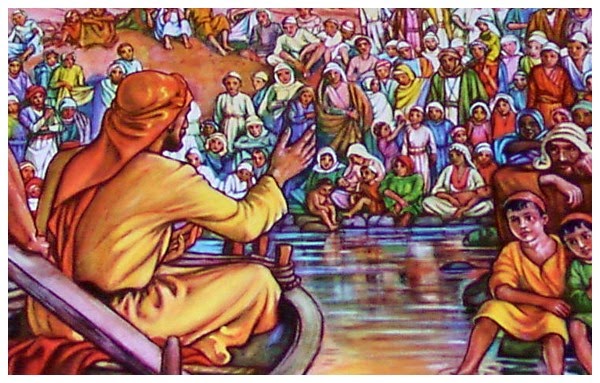
Matthew thirteen in particular opens with, “That same day Jesus went out of the house and sat beside the sea.  Such great crowds gathered around him that he got into a boat and sat there, while the whole crowd stood on the beach.” (1-2)

There is a wealth of meaning in these few lines. When it says Jesus went out of the house and entered a boat, it is preparing us for a paradigm shift. A boat is a structure that enables us to maneuver safely over great depths of water, to stay dry, to access the resources of the deep without drowning, and (especially in the days before cars and trains and planes) to travel long distances more quickly and efficiently than we could over land.

Emanuel Swedenborg tells us that boats have relation to the way our mind is structured by ideas.  Jesus sat in the boat to teach, implying a bending down or accommodation of His understanding to ours.  In this case, Jesus is established in His own Divine understanding of the Word, and then bending Himself in order to accommodate His understanding to our limited and mortal minds.

The crowd is standing on the beach. They have followed Jesus as far as they can, and cannot follow him farther.  They have hit a barrier—the sea.  They stand on the beach, at the very edge of the sea—where the land ends and past which these mortals could not travel and survive very long without specialized equipment and/or extensive swimming lessons.

Swedenborg tells us that water means knowledge, and that seas represent a large body of knowledge (a gathering together of many waters). This means that a sea illustrates a vast collection of knowledge available in one great mass; in this setting, it represents revelation.  We need Divine aid in navigating revelation effectively and safely.  We might find revelation (the sea) beautifully supportive or wildly threatening, full of bounty or ready to tear our life apart, all depending on our equipment, our training, and especially the weather.

This story in Matthew is a particular discussion of how the Divine message within revelation finds accommodation to our mortal condition.  We stand on the shore, longing to hear it.  A few of us might have boats too, but if we are honest, Jesus doesn’t even need a boat. He can walk on water.  Even in our most optimistic and beautifully confident moments of faith (Peter), we can imitate the ability to walk on water only temporarily.  Our understanding is too limited—our comprehension too hopelessly mortal—and we are quickly swamped. We sink too easily. Only Jesus has the ability to navigate the depths without assistance—He is the Word incarnate.  His being in a boat is an accommodation to our human condition, because the crowd couldn’t have handled it if he had simply walked out and sat on the water.

As for us, “standing on the shore” at least says that we are on our feet; we are ready to move.  We have come as close as we can.  In this verse it says “beach,” which gives us the image of small rocks or sand beneath our feet.  Water is knowledge that is so abstract that it takes special mental constructs to navigate.  Sand is also knowledge, but it is more “grounded” or solid than water. Anybody can access “sand” knowledge and “walk” on it.  It is relatively solid, though it shifts and blows. It is less solid than rock, but solid enough for many purposes. It has been ground down by wind and water action.  However, notice that it is about as loose and shifting as a substance can be “under our standing” before we need special equipment.

In the story, Jesus moves from solid ground to water, and we follow as far as we can.  From the vast sea of wisdom, God bends himself to teach us.

Matthew thirteen is packed with parables.  Indeed, almost right away in thirteen do we find the disciples asking, “Why do you speak to them in parables?” indicating that this chapter may address that very question. The word parable comes to us from the Greek word “paraballo,” meaning “to throw alongside” or “to compare.”  A parable by definition then, holds a parallel or symbolic meaning.  It reveals more than our first glance might assume. The listener is asked to make a mental leap in order to follow the deeper line of thought.  A parable invites us to stretch our minds, to think about things in a new way: a parable is a kind of puzzle that teases our minds into new insight.  It can be seen at face value, or interpreted for a deeper meaning.

At face value, today’s passage seems to say that God speaks in parables to prevent some of us from “hearing and seeing”.  Why on earth would the Word say this, and why would Jesus emphasize it?  We find a possible answer in Swedenborg’s work The Divine Providence: The Lord provides that no one should interiorly acknowledge truths and then afterwards depart from them and make them profane. (231:9)

According to Swedenborg, this strange story is internally about how the Lord protects us from profaning the Word. It is imperative that when we receive Divine truth it is with respect and spiritual maturity, because without respect and spiritual maturity we can do great harm to ourselves and each other.  And so the Lord speaks to us in parables.  We are kept from understanding deeper truths until we are spiritually ready.

Swedenborg says in The Doctrine of the Sacred Scripture number 97:

The literal meaning of the Word is a guard for the genuine truths lying within it. It may be turned this way and that, and interpreted to one’s own understanding, without its interior content being injured or violated. It does no harm that the meaning of the letter of the Word is understood differently by different persons: but harm results when Divine truths, lying concealed within, are twisted toward evil, for in this way violence is inflicted on the Word. To prevent this, the sense of the letter is a guard; and it acts as a guard with those who are in false thinking from their religion.

Or as translator Michael David words The Doctrine of the Sacred Scripture number 26:

“So, to prevent anyone from coming upon the spiritual meaning of the Word, and screwing up what is really true there, the Lord has posted security guards, who are meant by the ‘cherubim’ mentioned in the Word.”  (SS David 2004 26:2)

The Word exists among a humanity full of mixtures of goodness and not-so-goodness.  Some people (and some of our own inner states) are more arrogant and controlling, and some are gentler and seeking mutual well-being.  Churches also come in all sorts of mixtures of good intentions and a desire to control, ignorance or deep scholarship, sometimes doing good and sometimes doing harm. The innocent parts of us that are open to learning are represented by the sheep, the lost sheep, and the gentiles in the Word as well as by the disciples.  Those who wish to use the Bible to control others and control the church are represented by the “Pharisees.”  It is important to remember that the Pharisees aren’t so much a group “out there,” but a part of your inner world and mine.  They represent a phase or mind-set when we are sure we know what is right, and are putting our energies and attention into religious rules and enforcement.  In this mindset, we have fallen away from the “Spirit” of revelation and sunk into legalism.  We have made the Letter of the Word the Law.

When we are needing to use the Word to control other people (“Pharisees”), our eyes are blinded and our ears stopped up. We are not open to the spirit. We don’t even recognize it when it is staring us in the face. The survival of this mindset depends on silencing the voice of the spirit. This mindset is also represented by Herod who tried to slay the infant Jesus.  It is imperative that the Lord protects and prevents that part of our inner nature from accessing the tender inner truths of the Word until we are spiritually ready to treat them with respect. God hides away this precious inner meaning and keeps it (and us) safe. In fact, in his work The Divine Providence, Swedenborg tells us:  “We are not granted inner access to the truths of faith nor the goodness of mutual love except so far as we can be kept in them with integrity right on to the end of life.” (DP Longstaff 2005 21)

And so it is not so much that the Lord prevents us from seeing, but our own spiritual immaturity closes our hearts and eyes.  Revelation is presented to us in parables for our own protection.  The image of child-locks on kitchen cupboards comes to mind.  It is not good for us to have access to the knives, electrical appliances, or cleaning detergents until we are mature enough to use them responsibly.  Isaiah 6:9-10 and Matthew 10-15 can be read as, “I have put locks on the cupboards.  Those of you who reach sufficient maturity will be allowed access to the things inside.  When you are ready, these tools will add tremendously to your ability to work and serve.  If you are not ready, I will need to take away any of those things if you get a hold of them, for your own protection.”  For me, this reading of today’s story fits with the God that is being revealed in the Word—a God that comes as close as possible to those who are ready to receive, and a God who guides our spiritual advancement carefully, only presenting things as we are ready to handle them. 

Salvation is not a one-time event but a series of lifelong choices. You and I are on a path of spiritual evolution. And until we are ready for deeper concepts, we are not ready.  God guides and protects each one of us, every step of the way.

For when we are ready, the Word holds hidden vast stores of treasures in great abundance. But we need to desire this treasure, like the widow of the parable sweeping to find the coin or the man selling all he has for the field with the buried treasure.  Our part is to come to the shore—as close as we can—and stand eager to receive.  If we come with reverence and humility, and the awareness of the deep Divinity of the inner message, the Word sits ready to teach.

But if we see the Word as a tool for controlling the lives of others, it will soon become a hard and lifeless thing in our hands.  If we see instead that it is like dough with hidden leaven, prepared for our own daily bread, we will handle it with care so that the leaven can do its work.  The God revealed in the Word longs for lasting growth and strong roots in his disciples.  Such a sower exercises great patience, for strong growth takes time, even as the raising of bread dough must not be rushed.

With its appearance of impatience and harshness, perhaps Matthew 13:10-15 actually hides words of great gentleness and patience.  God has plans for our well-being and not for harm.

We do not need to worry and be afraid.  We simply need to grow in our hearts and soften our need to control, and seek diligently for readiness and wisdom.  God does all the rest.

Therefore the Lord waits to be gracious to you; therefore he will rise up to show mercy to you. For the Lord is a God of justice; blessed are all those who wait for him. (Isaiah 30:18)

Do not be afraid.  Seek and you will find.

Amen

The Readings
Isaiah 6:6-10 (NAS)
Then one of the seraphim flew to me with a burning coal in his hand, which he had taken from the altar with tongs. He touched my mouth with it and said, “Behold, this has touched your lips; and your iniquity is taken away and your sin is forgiven.”
Then I heard the voice of the Lord, saying, “Whom shall I send, and who will go for Us?” Then I said, “Here am I. Send me!” 
He said, “Go, and tell this people: ‘Keep on listening, but do not perceive; Keep on looking, but do not understand.’ “Render the hearts of this people insensitive, Their ears dull, And their eyes dim, Otherwise they might see with their eyes, Hear with their ears, Understand with their hearts, And return and be healed.”

Matthew 13: 10-15 (TNIV)
The disciples came to him and asked, “Why do you speak to the people in parables?” 
He replied, “The knowledge of the secrets of the kingdom of heaven has been given to you, but not to them. Those who have will be given more, and they will have an abundance. As for those who do not have, even what they have will be taken from them. This is why I speak to them in parables: “Though seeing, they do not see; though hearing, they do not hear or understand. In them is fulfilled the prophecy of Isaiah: “‘You will be ever hearing but never understanding; you will be ever seeing but never perceiving. For this people’s heart has become calloused; they hardly hear with their ears, and they have closed their eyes. Otherwise they might see with their eyes, hear with their ears, understand with their hearts and turn, and I would heal them.’

SS 97
The literal meaning of the Word is a guard for the genuine truths lying within it. It may be turned this way and that, and interpreted to one’s own understanding, without its interior content being injured or violated. It does no harm that the meaning of the letter of the Word is understood differently by different persons: but harm results when Divine truths, lying concealed within, are twisted toward evil, for in this way violence is inflicted on the Word. To prevent this, the sense of the letter is a guard; and it acts as a guard with those who are in false thinking from their religion.

Sunday, March 1, 2015

The Way Through the Wilderness

“The Way Through the Wilderness”
“Streams in the Desert; Joy in the Journey”
Rev. Alison Longstaff, March 1, 2015
Bath Church of the New Jerusalem
Isaiah 43: 16-21, Matthew 4:1-11, Secrets of Heaven, Paragraph 2334

The hardest thing about writing a sermon is not “what to say” but “what NOT to say.”  There is so much bounty in God’s Word.  So many gems of wisdom!  This thing was ten pages long when I started it, but fear not, I did some relentless trimming.  I pray that the outcome is a lovely bonsai, not a… well, mangled bush.  So here we go.

“I will make a way in the wilderness and rivers in the desert.”

In 2007 I had the privilege of going to the Holy Land. I breathed in the clear, clear air and walked under the brilliant blue sky.  The air is clear and the sky so blue because there is almost no humidity—no airborne water vapor at all.  You see, most of southern Israel is a desert.  Water is a rare and precious commodity.  Unless regularly irrigated, or immediately after a rain, nothing grows.  Nothing, except the occasional most drought-resistant shrubs. Maine is a lush rain forest in comparison to southern Israel.  There is simply NO WATER.  For miles and miles there is nothing but rough, extremely rugged rock.  This isn't a soft, sandy desert, but a deeply ridged and rocky landscape. 

The craggy mountains are sliced and intersected by “wadis,” or deep gullies carved by rare flash floods.  Crossing this landscape before the advent of modern highways involved a lot of climbing and descending into steep ravines, stumbling over large boulders, or taking repeated wide detours to find a less challenging path.

  Think about it: John’s prophesy that “every valley will be lifted up and every mountain and hill made level” takes on a whole new meaning when one  considers what must have been involved in trying to navigate such a hostile geography.  This is the wilderness the Children of Israel wandered in for 40 years; this is the wilderness in which our Lord Jesus suffered his forty days of temptation.

But that’s not all.  Being a desert, not only do the temperatures rise to scorching highs in the day, they plummet to near freezing at night, because, with no suspended water vapor trapping the heat near the surface, all the accumulated heat disperses back into the atmosphere at nightfall.  The lack of water in a desert impacts every aspects of the environment, rendering it shockingly inhospitable to human life. 

You and I may never have to contend with the actual Negev wilderness, but each one of us is called to cross our own spiritual Negev.  To make our own journey from the spiritual Egypt to our personal Holy Land, you and I must traverse this spiritual wilderness.

Saying “yes” to this journey invites intense spiritual work. No amount of physical wealth or powerful technology or top-notch insurance can make any difference when we face this personal gauntlet.  Only one thing can help us on that journey, and that is the presence of God—the original local nomadic guide, with his wisdom and compassion.  God’s love and wisdom are the only things that will get us through.  These show up in the Bible as the pillar of cloud by day and the pillar of fire by night that guided the children of Israel in the wilderness. 

So where do I get me some of them?

As I've said before, Swedenborg talks a lot about love and wisdom.  He tells us that they are two distinctly different things that are in relationship inside us.  He tells us that the bread of communion represents God’s love, and the wine represents God’s wisdom.  In another place he says again the bread represents God’s wisdom, and the wine represents God’s love.  Wait….

Is the bread the love, or the wisdom?  Is the wine the wisdom or the love?  Huh?

The answer is: “Yes.”

Deeper study of Swedenborg’s material shows us the very yin/yang relationship between these two essential capacities of our nature. Wisdom holds deep within it tremendous love (or it isn't real wisdom), and genuine love is always guided by a deep inner wisdom. The two capacities mirror each other and work together in a profound and miraculous way.  This means we can always find BOTH qualities in every correspondence.  Wine or bread can represent love or wisdom, depending on the context and the emphasis.  The same is true with many other representatives in the biblical narrative.

So, I submit that though Swedenborg tells us repeatedly that water corresponds to truth, when we are looking at a rocky, sun-baked landscape, where rocks represent truth, and sunlight represents truth, the thing that is needed for survival in this case is possibly not more truth.  In considering the wilderness and surviving spiritual temptation, it is entirely possible that our need for water could represent our need for supportive, utterly essential life-giving love.

Can water represent love?  Well, think about it.  Love, feelings, and emotions—are they static and solid, or fluid and difficult to restrain? What is more likely to swamp us, ideas or feelings?  We can “drown” in emotions, be “flooded” with feelings and “filled” with love—all language that suggests a fluid nature more like water than rocks. Our bodies are 98% water, and Swedenborg tells us love is our very life.  We are gestated in water, baptized in water, and will die without water long before starvation can carry us off.  So for me at least, water and our need for water images our need for love far more than truth, and this is NOT contradictory to Swedenborg’s message.  You don’t have to agree with me, but when it comes to crossing my spiritual wilderness, nine times out of ten it is love and comfort I need to get me through.  It is the warmth of a hug, the reassuring squeeze of the hand of friendship—not a book or a quote or a lecture.  Honestly, when you are truly hurting, which is more helpful, a hug or a platitude?  A Kleenex or being told, “Don’t cry?”  A silent, sympathetic, non judging presence or a sermon?

Secrets From Heaven, Paragraph 1690:3 says, “Every temptation [which is what the “wilderness” corresponds to] is an assault upon the love in which a person is, and the temptation is in the same degree as is the love. If the love is not assaulted, there is no temptation. To destroy anyone's love is to destroy their very life; for their love is their life.” Emanuel Swedenborg

We are in temptation when our love is under attack---not our ideas, our love.  Love manifests and cloaks itself in ideas, but never let us mistake the fact that any genuine temptation is an attack on what we love, not what we think.  Confusion and deep questions and a crisis of faith will only occur in the midst of such a temptation, but they are not the real issue.  Genuine spiritual temptation means what we love is under attack.  And love is always good.  

Even twisted love, otherwise known as evil, derives any power it has from the kernel of goodness at its core.  And it is the attack on that goodness that creates the suffering.  It is the attack on God-with-us that creates the pain.  Jesus suffered because this is what suffers in us.  We are not wrong when we are suffering temptation.  It means that we are spiritually alive.  It means we are responding to God’s call to live and love more deeply!  It hurts like…well, hell but please don’t waste one scrap of energy beating yourself up for being in temptation if you are.  As Winston Churchill said, “When you are going through hell, keep going.”  Don’t beat yourself up for being there, keep going!

So, knowing all that we know about spiritual temptation, what do we do to prepare ourselves?  Given our Swedenborgian-status-special-Biblical-knowledge, how do you and I prepare to be Swat-team buff and ready to face our personal wilderness crossing?  How do we become wilderness-crossing-ninjas—not only surviving but ready to rescue everyone else?

Step one, we get over ourselves.  The twelve steppers have it right: “We admitted we were powerless before our personal wilderness….”

The truth is we will probably survive about as well as anyone else does.  We may even end up whining and complaining as loudly and often as the most cantankerous of the children of Israel.  We may give up again and again on God, even having seen the miraculous provision of water and manna for our survival in every prior experience. 

Because the story of the Children of Israel in the wilderness and their repeatedly failing faith and almost ADD inability to trust in their God isn't in the Bible to shame us into doing better than they did.  It is there to say, “This is what the journey looks like.  This is what mortals do in this process.”

We are the ones who get stuck on thinking we’re supposed to be better than we are.  We are the ones who think that somehow, because we supposedly “know better,” we should be able to do better.  That’s called pride.  Honestly, looking at the whole of human history, how often has “knowing better” ever meant we chose to do better?  Our idealism is adorable, but rarely realistic.

The Lord’s miraculous love and tremendous wisdom knows that we have lousy spiritual attention spans.  God is way ahead of us.  It is kind of darling how earnest we are and how hard we try to be perfect.  But the truth is, we are two-year-olds trying to do quantum physics here.  It is important to us that we try, and it is good for us to try, but the victory ever and always belongs to God. It is probably good for our pride that we don’t realize just how powerless we are.  But the truth is, despite all their shortcomings, God brought the Children of Israel through the wilderness intact, and God will do it for you and me as well no matter how inept we might feel.  We just have to show up.  We just have to say, “Yes,” to the journey. Then the only thing that might make the journey more comfortable is letting go of doing it more perfectly than anyone else.  You won’t.  I won’t.  We are not that powerful.  And that is perfect.

God’s power.  God’s love.  The spiritual journey to which our God calls us is the journey to venture more deeply into love.  Love equals compassion, and the one who needs compassion the most from you and me is not our lousy neighbor, not the idiot from our work-place, not even Hitler.   The one who needs compassion the most from you and me is our own, broken selves.  Yourself.  Myself.

I’m going to share something with you:  My particular heredity gifted me with an inner critic so harsh as to rival the most abusive nasty parent.  It never was and probably never will be more criticism that I have needed, but more compassion, more gentleness, and far more patient loving-kindness than I would ever naturally give myself.  I have had to get over an enormous pride—pride, I tell you, that was not because I ever truly felt I deserved it, but pride that is a massive defense against the relentless, merciless, profoundly abusive inner critic (that I now know is a legacy of my particular genetic line).  A cruel personal demon.  A nasty hereditary trait that is not unusually special by the way—I don’t even get to take pride in how harshly that inner critic can abuse me.  Dang!  Because a vicious inner critic is not even as rare or special as my pride would like to think.

But the point isn't whether I'm prideful or special.  The point is that what has helped heal me—what has helped get me through that leg of my wilderness—was not stones.  Which is to say, not criticism or advice.  Not the stone of “I shouldn't be so proud.”  Not the stone of “I should love God more.” Not the stone of “I should try harder;” but the life giving, miraculous experience of being radically loved in the midst of feeling so miserably unlovable.  Immense, overwhelming, utterly delighted tenderness.  Being bathed in that cleansing benevolence when we are so utterly dry is what saves you and me, and continues to save us in the midst of the glaring sun and harsh and scraping landscape of personal temptation. 

That God loves you and me even in our profound brokenness is the saving truth of God’s love.  It is true for me, and it is true for you.  Show up. Care.  And forgive yourself for being so imperfect. Who did you think you were, God?  We are so cute.

“I will make a way in the wilderness and rivers in the desert,” says our God.

It is the Lord’s bounteous, miraculous love that lifts the valleys before us and turns the mountains into plains, not our preparedness, not our amassed store of wisdom, not how many bible quotes we have memorized or how much Swedenborg we know.  It is God’s love that does that work—the spiritual water that fills every cell of our spiritual bodies and that sustains us and operates at levels far beneath our conscious control.  That is what wins the victory and transforms the desert.  If we can just let go of thinking we have to do it perfectly—when we can stop judging ourselves so harshly and stop trying so hard, we just might open ourselves into relaxing into God’s providence.  And when we can do that, then, then we will see how the river of God’s love lifts up and softens that barren rock and causes the desert to bloom with joy and life.  Amen.

The Readings:
Isaiah 43:16-21
Thus says the Lord, who makes a way in the sea, and a path through the mighty waters,
Who brings forth the chariot and horse,
the army and the power (They shall lie down together, they shall not rise; They are extinguished, they are quenched like a wick):
“Do not remember the former things,
nor consider the things of old. Behold, I will do a new thing, now it shall spring forth; shall you not know it? I will even make a road in the wilderness and rivers in the desert.  The beast of the field will honor Me, the jackals and the ostriches, because I give waters in the wilderness and rivers in the desert, to give drink to My people, My chosen. This people I have formed for Myself; they shall declare My praise.

Matthew 4:1-11 Then Jesus was led up by the Spirit into the wilderness to be tempted by the devil. And when He had fasted forty days and forty nights, afterward He was hungry. Now when the tempter came to Him, he said, “If You are the Son of God, command that these stones become bread.”
But He answered and said, “It is written, ‘Man shall not live by bread alone, but by every word that proceeds from the mouth of God.’”
Then the devil took Him up into the holy city, set Him on the pinnacle of the temple, and said to Him, “If You are the Son of God, throw Yourself down. For it is written: ‘He shall give His angels charge over you,’ and, ‘In their hands they shall bear you up,
Lest you dash your foot against a stone.’
Jesus said to him, “It is written again, ‘You shall not tempt the Lord your God.’”
Again, the devil took Him up on an exceedingly high mountain, and showed Him all the kingdoms of the world and their glory. And he said to Him, “All these things I will give You if You will fall down and worship me.”
Then Jesus said to him, “Away with you, Satan! For it is written, ‘You shall worship the Lord your God, and Him only you shall serve.’”
Then the devil left Him, and behold, angels came and ministered to Him.


Secrets From Heaven, Paragraph 2334 “All temptation includes feelings of doubt about the Lord's presence and mercy, about salvation, and so on; for people who experience temptation suffer great emotional distress, even to the point of desperation. They are kept in this state primarily so that they may eventually be confirmed in the certainty that all things are governed by the Lord's mercy, and that they are saved through Him alone….” Emanuel Swedenborg

Sunday, September 28, 2014

Water "Communion" and summer review

“The Waters of Our Lives”
Rev. Alison Longstaff, Sept 28, 2014
Psalm 37:23-29, Luke 9: 1-6; AE 453:11

This morning we celebrated our travels and activities over the summer.  I chose readings, prayers and hymns focused on water and travel, trust and community.  Overall, the focus was a celebration of our accomplishments so far, as we gird our loins for the upcoming year. The readings reminded us to trust in the Lord’s leading.  To trust, and trust some more, and keep on trusting.  They also speak of how we travel through life in community.  We need each other to get through.  God works through us and we can be God's presence for each other sometimes, while God is also directly with each one of us.


Instead of a children's talk we celebrated a "water communion"---a lovely ritual brought to us from the Unitarian Universalist tradition.  In it, we each came up and poured water into a common container, our baptismal font, naming the places we have been and what they meant to us.  We had vessels of all shapes and sizes, and water from near and far pouring into our common bowl.  It was beautiful to hear all the stories of where we have been and what we have celebrated.  It makes a special space to hear and see each other, which helps us to feel more connected and know more of each others' lives.
Then we watched a slide show of all the various activities and events that we have been part of as church members this summer, including the many pictures of the renovations to our building.  With a musical accompaniment, it celebrated all that we as a community are doing and how we are growing and loving each other along the way.  In creating it, I worked with the pictures I was able to find. Some events are better represented than others.  Some pictures are not from this year.  But overall, the presentation tried to capture the spirit of our group and of the many individuals who contribute to making BCNJ a vibrant spiritual community.
(Click on this link for the slide show)
Our Summer, 2014
This is BCNJs story for the summer.  May we go forward from here, strengthened in courage and hope, continuing to grow in love and wisdom and service to our community.
The Readings
Psalm 37:23-29 (ESV)The steps of a person are established by the Lord, when we delight in His way;though we fall, we will not be cast headlong, for the Lord holds us up by our hands.I have been young, and now am old, yet I have not seen the righteous forsaken     or his children begging for bread.He is ever lending generously, and his children become a blessing.Turn away from evil and do good; so shall you dwell forever.For the Lord loves justice; he will not forsake his saints. They are preserved forever, while the issue of the wrongdoers shall be cut off.The upright shall inherit the land and dwell upon it forever.

Luke
When Jesus had called the Twelve together, he gave them power and authority to drive out all demons and to cure diseases,  and he sent them out to proclaim the kingdom of God and to heal the sick.  He told them: “Take nothing for the journey—no staff, no bag, no bread, no money, no extra shirt.  Whatever house you enter, stay there until you leave that town.  If people do not welcome you, leave their town and shake the dust off your feet as a testimony against them.”  So they set out and went from village to village, proclaiming the good news and healing people everywhere.


The Apocalypse Explained 453:11  [Regarding portions of Isaiah 33:15,17:] “to walk in honesty and to communicate justly,” means “to behave in all things according to loving-kindness, right-thinking and deep perception.” “To walk” means to live, “in honesty” is describing a person’s goodness, and “to communicate justly,” is describing a person’s truthfulness or thinking.  “The king in his beauty,” is describing each of us as we progress in wisdom, for a “king” means true thinking springing from compassion, and “beauty” means the consequent wisdom. The Divine truth in its most beautiful form is such wisdom.