Showing posts with label shepherds. Show all posts

Friday, May 12, 2017

Forgive Us Our Debts

“Forgive Us Our Debts”
Rev. Alison Longstaff, Oct. 13, 2015
Bath Church of the New Jerusalem
Isaiah 40:6-11; Luke 16: 19-31; Heavenly Secrets 6960 

I love researching sermons.  The deeper I delve, the bigger and broader and more amazingly interconnected the insights become.  (It doesn’t get better than being Swedenborgian in my honest opinion.)

Heavenly Secrets 6960. ‘Put your hand into your bosom’ means making truth ones own. This is evident from the meaning of ‘hand’ as power, and from the meaning of ‘bosom’ as love. The chest corresponds to love since the chest holds within it the heart.  We have a sense of ownership of or attachment to the things we love. Therefore ‘the bosom’ symbolizes the things we ‘own’ or identify with, which is the same as the things we love.  For this reason ‘putting a hand into one’s bosom’ here means making something one’s own.  And for this reason 'the bosom’ symbolizes a person’s true self, or all the things with which one identifies or one ‘owns.’ 

“Forgive us our debts.”

I have had this topic on my heart for a while, having listened to many stories of good people struggling with overwhelming debt in the past several years.  I came to Maine with no debt and will be leaving with several thousand in debt, so it is an active personal topic as well. 

According to my book-keeping program, I now have a negative net worth.  I am worth less than nothing.  It doesn’t matter what my character is or my desire to do good, or my kindness, or my life experience.  Put me next to someone who earns more than I do—who owns more than I do—and I can be seen as “worth less” or worthless.  In today’s culture it means I must be less deserving.  That it would tell Jesus the same thing were He among us today is only a little comforting.

“Forgive us our debts.”

Debt weighs heavily on our hearts.  In this culture in particular debt seems to strike at our very sense of human worth, not just material worth.

Take yourself back to a time when you realized that you owed far more than you could pay.  Surely everyone in this room has experienced that bottom-dropping-out sensation—that cold hollow in the gut when you realized you didn’t know how you would repay a debt. Remember that insurmountable bill—that frightening peek into the future that struck at your very sense of worth and capability.  It doesn’t feel good.

To have a hopeless, unpayable debt forgiven, throws us sobbing on our knees.

As I researched this topic, I kept being struck by the relationship of debt with ownership, and Swedenborg’s extensive discussion of what is “our own.”  In spiritual growth circles, phrases have emerged such as “I need to own my part of it,” and “that wasn’t mine to own”.  They are used to describe how we do or don’t take responsibility over our part in misunderstanding and conflict.  Spiritual growth work invites us into greater and greater clarity over what we do and don’t “own” in our relationships. This clarity brings healing to all areas of our lives. We develop the ability to “own” our part rather than “pass the buck” to someone else. 

Spiritual “ownership” means we take responsibility for our contributions to life situations.  We become better and better at managing what is ours and leaving alone what isn’t ours in our relationships with others. We start spending increasing energy on our own spiritual territory and stop spending so much energy on what other people “should” be doing. The metaphor holds strong all the way through.  Our debts are all the things we are refusing to take responsibility for yet which drain our ability to be of service to others.  We need help acknowledging them and learning to manage them. This is far easier than it sounds but it is essential to our happiness.

“Forgive us our debts.”

When the scripture reading from Isaiah says that God carries the lambs in His bosom, it is symbolizing the way God embraces our innocence and vulnerability.  The bosom symbolizes what someone loves most—it is the “heart place.”  The female bosom symbolizes motherly comfort and nourishment; the male bosom symbolizes fatherly protection and strength.  The Divine bosom encapsulates all of these qualities in one and transcends them as well.  Our weakness and ignorance are next to God’s heart.  He carries us tenderly even when we feel weak and unworthy.

When we pledge allegiance, we put our hand to our “bosom.” This shows our willingness to support something we hold dear.  This intuitive act of placing our hand on our heart springs from the spiritual meaning of showing commitment to the things that have the most meaning in our lives. 

Swedenborg tells us that we are what we love.  The things we draw to ourselves represent our desire to “own” or be identified with those things.  Ultimately, everything we pull close represent what we love, and what we love is who we are.  Why would we pull close those things that reflect badly on us, even if we are responsible for their existence?

 “Forgive us our debts.”

We say that phrase every time we say the Lord’s Prayer. It is a simple phase, holding within it such a world of meaning.  We are not asking that God forgive our debts when we pray this.  We are stating the reality of what God is already doing.  Our “debts” are already and continuously forgiven by God.  It is we who cannot forgive our debts.  It is we who feel the shame, and can get caught between denial and self-abuse when we realize how much we “owe” spiritually.  We struggle with all aspects of spiritual ownership. We tend to swing between wanting too much “credit” or wanting none at all even though it is due.  We notice when others “take credit” unduly and we feel the injustice of it.

Where do you lie on the spectrum of ownership of your spiritual worth?  Do you acknowledge the riches you have and use them in wise service, or do you tend to feel undeserving and bury them in the ground? Are your riches repeatedly cast before swine?  When the world wants to hand you responsibility because of your spiritual abilities, do you hide your gifts under a bushel, or do you step up and offer from your bounty?  Or are you the one most likely to give energetically more than you have only to end up needing help yourself or in debt?

Because we all tend to be out of balance in one direction or the other, there is only honor in recognizing yourself in one of these profiles.  “Owning” your tendencies is the first step toward a healthier spiritual “financial portfolio.”  As for me, I am the one who gives away too much.  I repeatedly “spend” too much on helping others, forgetting to leave enough for myself.  There is a false “Christian” cachet associated with this way of living that is not actually helpful.  Another name for an overly-sacrificing style of relationship might be “codependency.” So detrimental can codependency be to healthy relationship, it now has its own twelve step group to aid people in recovery. Far from making everything better as it likes to believe it can, codependence is often as big a part of the problem as what it is trying to help.

And this brings us back to ownership.  If I am too ashamed to “own” the ways I am codependent, but instead pass responsibility onto others, (blaming) I will never get free of my spiritual “debts.”  Only by owning my part in each problem to the best of my ability (but no more than my part) can I help restore my relationships to their rightful balance.  Even if those around me are wobbling in their balance, the more stable and healthy I am in myself, the more I make space for others to find their balance.  The only debt I can own is my own.  The only contribution I am responsible for is my own.  And because we are all so interconnected, the more stable and balanced I become, the more easily those around me can find their own balance.

“Forgive us our debts.”

My grandfather kept a little black book on each of his eight children, tallying what they were costing him as they grew up. Imagine the emotional impact that must have had on those seven little girls and one little boy.  One day my grandmother, who rarely stood up to her charismatic but often violently angry husband, threw those books in the fire.  He never raised a hand to her, they say.

A chasm of unworthiness existed in the heart of my grandfather. He could not forgive himself for whatever he thought was so completely unlovable inside himself, so he spread harsh judgment and blame onto those around him.  A terrible accuser existed inside his own consciousness, placing on him a sense of debt so great he could never get out from under it.  He could not love his children because he could not love himself.  I don’t know what wound he carried, but I don’t believe he ever forgave himself on this earth. He died of a massive heart attack at age forty eight.  My prayer is that he found the self-forgiveness he needed in the life to come.
 
“Forgive us our debts.”

God would no more keep a book of deposits and debits on our spiritual account than would any loving parent.  Imagine saying to a newborn, “Well, it will be twenty thousand for the hospital fees; another ten thousand for the prenatal visits, blood-tests, and ultrasounds; then there was the six hundred for the maternity wardrobe; two hundred for the prenatal vitamins; and we haven’t even begun to add up the costs of diapers, immunizations, clothing, school costs, university….  Will that be check or credit card?”

We can never repay our “debt” to God, but it isn’t about debt, with God.  It is we who cannot forgive our debts, not God.  We are born profoundly imperfect, frightened, and ignorant.  We then inherit whatever the family legacy might be, be it privilege and loving support or blame, abuse, and addiction, or something in between.  If we leave this life having made any progress on the spiritual family legacy, I count it as a win. Besides, no one can see our spiritual balance sheets but God anyway.

And God forgave our debts before we were born.

Amen

The Readings
Isaiah 40: 6-11
The voice said, “Cry out!”
And I said, “What shall I cry?”
“All flesh is grass, And all its loveliness is like the flower of the field. The grass withers, the flower fades, because the breath of the Lord blows upon it; surely the people are grass. The grass withers, the flower fades, but the word of our God stands forever.”
O Zion, You who bring good tidings, get up into the high mountain;
O Jerusalem, You who bring good tidings, lift up your voice with strength. Lift it up, be not afraid;
Say to the cities of Judah, “Behold your God!”
Behold, the Lord God shall come with a strong hand, and His arm shall rule for Him;
Behold, His reward is with Him, and His work before Him.
He will feed His flock like a shepherd; He will gather the lambs with His arm, and carry them in His bosom, and gently lead those who are with young.

Luke 16:19-31
“There was a rich man who was dressed in purple and fine linen and lived in luxury every day. At his gate was laid a beggar named Lazarus, covered with sores and longing to eat what fell from the rich man’s table. Even the dogs came and licked his sores.
“The time came when the beggar died and the angels carried him to Abraham’s side. The rich man also died and was buried. In Hades, where he was in torment, he looked up and saw Abraham far away, with Lazarus in his bosom. So he called to him, ‘Father Abraham, have pity on me and send Lazarus to dip the tip of his finger in water and cool my tongue, because I am in agony in this fire.’
“But Abraham replied, ‘Son, remember that in your lifetime you received your good things, while Lazarus received bad things, but now he is comforted here and you are in agony. And besides all this, between us and you a great chasm has been set in place, so that those who want to go from here to you cannot, nor can anyone cross over from there to us.’
“He answered, ‘Then I beg you, father, send Lazarus to my family, for I have five brothers. Let him warn them, so that they will not also come to this place of torment.’
“Abraham replied, ‘They have Moses and the Prophets; let them listen to them.’
“‘No, father Abraham,’ he said, ‘but if someone from the dead goes to them, they will repent.’
“He said to him, ‘If they do not listen to Moses and the Prophets, they will not be convinced even if someone rises from the dead.’”

Sunday, December 21, 2014

Peace on Earth - a sermon for fourth advent


Peace on Earth
Sermon for the Advent of Peace
Rev. Alison Longstaff, Dec 14, 2014
Bath Church of the New Jerusalem
Isaiah 9:2, 6-7; Luke 2: 8-14; Heavenly Secrets 8455


Heavenly Secrets 8455
Peace has within it confidence in the Lord, that He is in charge of everything, and is taking care of everything, and that He is leading to a good outcome.  Those who practice this confidence experience this peace; they fear nothing, and no worry about the future disturbs them.  So far as you and I grow in love to the Lord, so far do we experience this state of peace.

The angels proclaimed to the shepherds, "Peace on earth and good will toward all human kind." Some translations render this, "Peace to all whom God favors," but this implies a sort of "gonna find out who's naughty and nice," God—a God who has favorites and who leaves coal in the stockings of the rest of us. That doesn't align with a God of radical grace and love.

It is we humans who expect God to exclude some of us from His love. It is we humans who like to think that some of us are more worthy of God's favor than others. But worthy/unworthy doesn't apply to God's immense and all-encompassing love. God's love is available always and without condition, the way the sunlight shines unceasingly in the heavens. It is barriers inside and around us that make it seem as though God's favor is inconstant. Things in our life can block our ability to feel God's love just the way the clouds sometimes block the sunlight; still God's love shines perpetually and without ceasing, just waiting for our clouds to dissipate once again.

So I believe God desires "Peace on earth, and good will for all human kind," not just a few lucky ones.

But unfortunately current events show that peace and good will toward all human kind is far from the status quo in our world. Indeed it is even far from the status quo in our nation. Would you say that peace and good will exist in this state? In this town? This congregation? How about in your home? What about inside your very heart?

Because they are all connected.

When I think about the decided lack of "peace and good will toward all human kind" on earth, I can get very discouraged. Listening to the news and the choices being made by some of the world's leaders, I can get impatient and frustrated and angry. I want to shout at the idiots who are making the choices that create all the strife and cause so much harm.... Surely we know better by now! Surely we should have learned from our past mistakes and stopped doing such idiotic things to our planet and each other?

But one fact of human kind is that the more anxious we get, the less "mindful" or enlightened we behave. The more threatened we feel, the more the rational mind shuts down, and our less evolved coping strategies take over. It doesn't matter what I may know "with my whole head;" all wisdom will go out the window the minute I am under duress unless I have made an intentional practice of mindfulness and peace-keeping. Peace requires deep trust in the Lord, deep compassion for the neighbor, and intentional peace-keeping behaviors.

So as much as I might enjoy blaming the idiots "out there" for their choices, this probably isn't my most helpful response. It serves the purpose of giving vent to the hurting I feel inside over the human suffering and injustice, but it probably also just contributes to the problem. To quote loosely a Canadian radio comedy, "Tom, Tom, Tom. Do you really think you're going to get greedy, short-sighted, and arrogant people to amend their ways by calling them 'greedy, short-sighted, and arrogant'?" (Dead Dog Cafe) In other words, accusations and name-calling rarely evokes the response we desire. Shouting indignant accusations is often our most immediate response to injustice, but it just makes people defensive, and defensive people are not good listeners.

Now, before I proceed further, I want to talk about true peace and fake peace. True peace comes from a heart at rest—one without malice, that trusts completely in God's providence. There is a reason we call peace "resting in the Lord."

Smiling and saying things are fine when they are not is not true peace. Not allowing dissenting voices does not allow true peace. Covering up unhappiness and silencing complaints creates only a false peace.

True peace requires that all sides have the courage to address the conflict. True peace can be found when all sides probe with compassion the deep sources of the pain and then work to resolve them. True peace can only be found when we become willing to see our own part in the conflict and to make the necessary changes in our response. It requires that we be trustworthy, even when we are not sure the other parties will also be trustworthy.

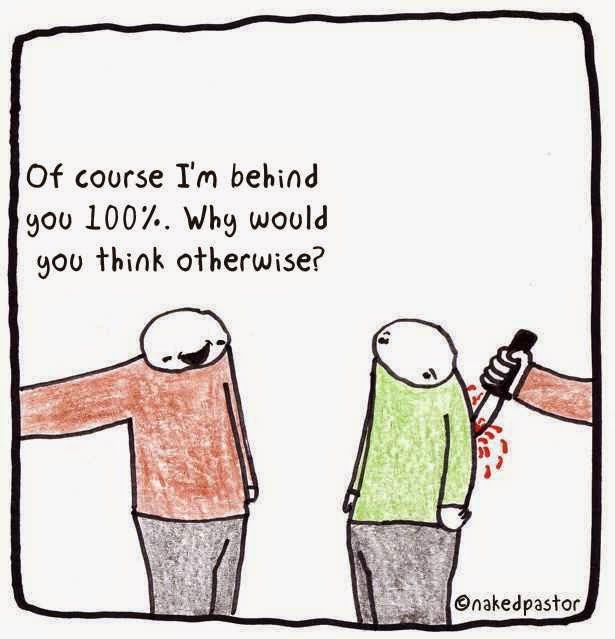
I am sure we have all had encounters with the person who smiles to our face and then complains to everyone else behind our backs. Perhaps we have even been this person?

It is the default human response to discuss our outrage with anybody but the offender, to lick our wounds and bolster support. It feels much safer to do this. But it is a problem. It takes real courage to address the issue with the one who offended us and try to work it out before we start recruiting others to fortify our side. Taking our problem to a third party and recruiting them against the other "side" is called "triangulation," in counseling circles. This behavior is common, but it is rather unenlightened. Triangulation is by definition a conflict-escalating behavior because it reinforces the impression of opposition. It asks for loyalty to one's own story against the other side's story sometimes before the other party even knows there is a problem.

When you or I are the one who is being whispered about, we may have no idea there has been a problem until a whole army shows up on our doorstep, so to speak. By that time the triangulator may have such an investment in being the injured party that it is often too late to defuse the misunderstanding or make easy amends. By that time we already have a sort of war on our hands whether we like it or not. Poorly chosen words have become a cherished wound, the defenses are up, and the injured party is taking no prisoners.

Does this dynamic sound familiar? Has this happened to you? I know I have experienced both sides of this dynamic. I have been the outraged triangulator (I hope I have learned since then!) and I have been the one who has had no idea there was a problem until it was far too late and the grudge was well and truly entrenched.

What versions of this scenario have you experienced? How did you like it? Were you the triangulating injured party or the oblivious offender? Or perhaps you have been sucked into the conflict of one triangulator against another triangulator and you didn't know how to get out of the middle. In any case, triangulation creates a mini war. It is different from big war only in scale. It is not the way of peace.

The hardest part of divorce on children is not the divorce itself, but the ways the parents can try to recruit the children against the other parent. This is deeply unfair to the children and creates a terrible inner conflict for them. In some cases, it is a form of abuse. Yet until we discipline ourselves into more enlightened behaviors, triangulation is our first go-to coping mechanism when we are hurt or threatened. We humans tend to "go to war" as a default, and in war innocents get killed. They are the first and worst casualty of every war whether global or personal.

Sometimes our wars are cold or silent. We may be so conflict-avoidant that we choose to dodge all interaction with the "problem" person. Perhaps we harbor resentment towards that person, holding arguments with them in our heads, though we would never actually attempt the imagined conversation in reality. Resentment feels like we are getting back at the other person, but it actually only harms us. "Resentment is like eating rat poison and expecting a rat to die," they say. It eats us up inside, not the one we are mad at.

Bearing a grudge, holding resentment, pretending everything is fine, and simply avoiding the problem all create a false peace, because the conflict remains inside us. There is a knot of unresolved negative energy that stays with us wherever we go, affecting us, and not the one with whom we are in conflict. And it will not go away until we change ourselves—not the other, ourselves. Passive aggression is still aggression. It is just pretending to be nice. It is fake peace.

To quote Jeremiah 6:14: "They dress the wound of my people as though it were not serious. 'Peace, peace,' they say, when there is no peace."

So how do we change our default response of attack and defense to something entirely other—to something that transcends the war impulse and taps a deeper wisdom?

Today's reading from Swedenborg says that peace comes from trusting God. We must cultivate a deep confidence in God's all-powerful and benevolent providence that is so strong we cannot be shaken "though the earth be removed, and the mountains be swept into the midst of the sea" (Psalm 42:6). In fact, I believe today's verse from Luke is also showing us the way to peace. When it says, "Glory to God in the highest, and on earth peace, good will to all humankind," I believe we can read it as when we "glorify" God in the highest (which is to adore and put our absolute trust in the most-powerful and most-high God) the result is peace in our natural lives ("on earth") which comes from a cessation of ill-will. When we deeply trust that God has everything under control, we realize we have nothing to fear. When our soul is at peace and we have nothing to fear, we truly do begin to wish well to all of God's created children, not just the ones who have pleased us. This is the Prince of Peace born in us indeed.

It is the nature of our earth-bound mind to be attached to temporal outcomes and worry about short-term goals. It can't help it. It can't help but think it is alone, and that every outcome is its responsibility. It is run most often by the ego. Resistance and struggle and "victim" are its default.

But according to the 'Borg, (Swedenborg) "Resistance is futile." We can fight the flow of Providence or relax into it. It will carry us toward the happiest outcome that we will allow, regardless.

When you go from this place today, I ask you to cultivate an attitude of peace. I ask you to work on an ever-deepening trust in providence, no matter how much the ego-mind scoffs.

Yes, this life may sometimes give us very scary situations. Trusting Providence does not mean this life will be easy. Rather, trusting in providence changes what we pay attention to. It shifts our attachments from earthly values to spiritual ones. It makes earthly disappointments much easier to bear, and opens our eyes to coming joys we never even imagined before. So, no matter what comes our way in this life, we are at ease, because we know that God is always turning everything into the best possible spiritual outcome, no matter how things look temporarily in this life.

To quote the mystic Julian of Norwich, "And all will be well, and all will be well, and all manner of things will be well. Trust in God, and all indeed will be well.

Let the Prince of Peace be born in your heart, and then you will find "peace on earth and good will toward all human kind." Amen.

The Readings
Isaiah 9:2, 6-7
The people walking in darkness have seen a great light;
on those living in the land of deep darkness a light has dawned
 For unto us a child is born, unto us a son is given, and the government will be on his shoulders.
And he will be called Wonderful Counselor, Mighty God,
    Everlasting Father, Prince of Peace.
Of the greatness of his government and peace there will be no end.
He will reign on David’s throne and over his kingdom, establishing and upholding it
    with justice and righteousness from that time on and forever.
The zeal of the Lord Almighty will accomplish this.
Luke 2: 8-14   Now there were in the same country shepherds living out in the fields, keeping watch over their flock by night. And behold, an angel of the Lord stood before them, and the glory of the Lord shone around them, and they were greatly afraid. Then the angel said to them, “Do not be afraid, for behold, I bring you good tidings of great joy which will be to all people. For there is born to you this day in the city of David a Savior, who is Christ the Lord.  And this will be the sign to you: You will find a Babe wrapped in swaddling cloths, lying in a manger.”
And suddenly there was with the angel a multitude of the heavenly host praising God and saying:
“Glory to God in the highest, And on earth peace, goodwill toward all humankind!”


Tuesday, December 11, 2012

What the Heart Knows


“What the Heart Knows”
Rev. Alison Longstaff, Dec 11th, 2012
New Church Live Christmas Vespers
Bryn Athyn, Pennsylvania
Arcana Caelestia 30; Luke 1:39-47

Luke 1:39-47 At that time Mary got ready and hurried to a town in the hill country of Judea,  where she entered Zechariah’s home and greeted Elizabeth.  When Elizabeth heard Mary’s greeting, the baby leaped in her womb, and Elizabeth was filled with the Holy Spirit.  In a loud voice she exclaimed: “Blessed are you among women, and blessed is the child you will bear!  But why am I so favored, that the mother of my Lord should come to me?  As soon as the sound of your greeting reached my ears, the baby in my womb leaped for joy. Blessed is she who has believed that the Lord would fulfill his promises to her!”
 And Mary said: “My soul glorifies the Lord   and my spirit rejoices in God my Savior

Arcana Caelestia 30. When someone is being regenerated, their spirituality develops as follows: First they start to learn about spiritual things, which they have then in their memory. This is “fact-based” or “rules-based” spirituality. Then, after they have thought about things for awhile and have lived with the ideas for awhile they develop a deeper understanding, which is theory-based spirituality. Finally, a true spirituality comes from the heart, which is genuinely loving.

Our text tonight is from Mary’s Song of Praise, also known as “The Magnificat.”  We find it in the Gospel of Luke right after Elizabeth greets Mary.  The gospel of Luke is a gospel of contrasts, of rich and poor, of priests and peasants, of men and women, of the educated and the working class.  Tonight I wish to focus in particular on what Mary represents.  Mary, the young, poor, peasant woman, yet in whom the son of God is conceived and to whom God incarnate can be born.
            Mary represents the feminine, or heart side of our inner nature.  Mary is the side of life that is typically discounted, pushed aside, and silenced in our culture.  Mary is the quiet whisper of our heart, especially when it challenges the status quo. Mary represents the stuff we just know without being able to explain.   Mary is the mystical, the unscientific, the stuff that we are afraid to trust, yet the part of us that somehow knows what is going on well before it makes sense.           
Let’s look once more at the gospel story.  Again and again it is the unsophisticated, marginalized characters that accept the angels’ wonderful news and welcome the divine immediately, while the privileged and educated and powerful come around much more slowly.  Zacharias –as an old man and a priest--- represents our intellectual side.  He struggles to accept the news of John’s birth.  In fact, he asks the angel for proof.  He wants evidence.  His proof comes in his being rendered speechless until after the miracle is accomplished.  In contrast, young, uneducated Mary simply asks for reassurance from the angel. She then moves right into acceptance and ultimately sings the song of praise which contains tonight’s text.  
Then, when Jesus is born, it is the shepherds who first see the angels and hear the good news.  Shepherds at that time in Judean culture were the bottom of the pecking order: poor, uneducated, and the least respected among the working class. Yet the good news comes first to them!  Something about them makes them ready to receive it before any other group.  And they respond instantly and with full acceptance, rushing to see the newborn baby. In contrast, the Wise Men---representing our intellectual side---see a remote star, and have to figure out how to travel the tremendous distance required to find the newborn.  They even have to stop and ask for directions---it takes a Wise Man to have the humility to stop and ask for directions….  In any case, the Wise Men do finally arrive, bearing tremendous gifts, but not until LONG after the shepherds do.   And isn't it interesting that the shepherds brought only the gift of their presence, and it was enough?
Later, when Jesus rises, who comes first to the tomb?  It is the women of the story, with courage and tears.  The men---remember, that means the intellectual side of you and me, not men ---that side of us takes longer to figure out and accept what has happened.  Doubting Thomas represents the last hold-out in you and me against trusting anything not evidence-based.  He is not wrong.  He is still one of the disciples!  He is part of the story.  But yes, we are blessed when we can trust and see and follow more quickly than fearful, doubting Thomas.
Please remember, I am not saying that women are better or smarter than men.  Each gender has strengths and gifts, and each gender has weaknesses, the same way the two hemispheres of our brain have strengths and weaknesses, and the two sides of our human nature has strengths and weaknesses.   Besides, not all women fit the classic female stereotype, nor do all men fit the classic male stereotype.  Praise the Lord! We need these boundary-bending examples to keep us from getting too comfortable with easy categories. 
It is not our fault that we struggle to find balance between our thinking side and our feeling side.  And it certainly doesn't help if we make one side bad and the other side good, or one side better and the other side worse.  Both are good.  Both are gifts.  Both are beautiful and necessary for our regeneration.  Even the parts of our nature that won’t fit easily into head or heart categories are gifts too.  Never forget it.
I can easily find stories from my personal life when my heart rushed ahead and left my intellect struggling along behind, just like we see in so much of the Christmas narrative.  An example: When I go to my alternative health care provider---my naturopath or my energy worker---I leave my intellect in the car.   The scientific, logical side of my nature can’t make sense of the flakey, illogical “unscientific” stuff that happens in those offices.  “What do you mean, ‘energy work?’” my inner Spock wants to know.  The intuitive, experiential, or the “Mary” half of my nature knows that these forms of care make a difference---often a profound difference---to my health whether or not there are scientific explanations of “how” that satisfy my left brain.  So my intellect stays in the car, or it goes in a closet and puts on loud music.  My intellect just doesn't understand that flakey stuff and can't watch.  Do you have similar examples from your life?
But before we believe that this scenario is the only legitimate one, I can tell stories of my intellect being super clear on something while my heart is still struggling along behind.  An example might be how I feel terrified of spiders despite knowing with my whole head that they are much tinier than me and not even poisonous in this area of the world.  They are completely benign!  But my emotions when I encounter a spider remain fairly primitive.  Because it isn't about what I believe.  Pre-rational emotion just takes over. It is all kind of funny --- once I’m done shrieking and can come down off the chair.
The point is that this imbalance between our intellect and feeling-side is normal.  It is how we are made.  It is not our fault.  It really is rather funny, one we get over stressing about it.  And it is God’s promise to us that one day these two very different sides of our natures will be united.  One day we will become so integrated in our loving and our thinking that we scarcely notice the negotiations between the two sides, let alone find the discrepancies so comically wide.
For tonight, it might just help us to remember that when God comes to us be born anew, there will probably be a big part of us that has no idea what is going on and wouldn't believe it if it knew.  The same way our science-loving culture tends to discount or invalidate the mystical and intuitive, the seemingly impossible and miraculous occurrences in our lives, you and I individually may easily doubt and question any evidence that God is indeed being born into your individual heart and life.   Yes; into yours.  Into mine.
But shifts do happen in our spirits as we grow closer to God.  The same as in the Christmas story, our spiritual growth is lead first by intuition and innocence.  “Why did you decide to stop in at that particular church, or pick up that particular book?”  But our intellect quickly takes the lead as facts and information accumulate.  Unfortunately, the intellect can be kind of clueless when it comes to feelings and intuition.  Sadly, once in charge, the intellect often invalidates feelings and intuition because it isn’t well designed to understand them and can feel a little threatened by them.  It happens all the time, and isn’t very helpful.  Intuition guides the intellect to what it needs, and then the intellect acts like it was in charge all the time and intuition is dumb.  Oh well.
In any case, for much of our spiritual journey we are more likely to be lead by ideas and concepts than by gut feelings and instinct.  That is okay.  That is how God designed the process of learning to happen for most of us.  This shows up in the Bible as Jacob taking pre-eminence over Esau, and as the stone temple replacing the soft, tent-like tabernacle.
But the same way Jacob wasn’t supposed to have contempt for or fear of Esau, we need to do our best to remember the strengths and gifts that our intuitive side brings to our life.  Our intellect can have a tendency to want to hoard and hold on to power, and to fear and invalidate the mystical, fluid, hard-to-box-up-and-measure qualities of our emotional side.  In the end, Esau will take his rightful place, but in the bulk of the Bible, Jacob’s story gets the limelight.
Our culture here in the West still remains pretty uncomfortable with feelings.  We have been told there are good feelings and bad feelings, excessive feelings, and inappropriate feelings.  But in the realm of psychology and therapy it has been known for a long time that there are no wrong feelings.  There can be hurtful behaviors, but all feelings are appropriate and make sense when we understand what drives them.  Our feelings can be amazingly wise teachers when we listen to them.  They point directly to the wounded parts and invite healing.  But for tonight just remember: feelings are never wrong.  They simply are.  Even if that concept drives the intellect crazy.  Accepting emotions and working with them works much better than judging and controlling them.
Your heart knows what it knows.  It is incredibly wise.  It doesn’t have to explain.  What it knows may not be easy to understand, rather like a virgin birth; but without our hearts, Jesus cannot be born.  By means of Mary, into a simple, mucky stable, full of humble, smelly animals, our God rushes with new life and light.  Birth is messy and perfect. Let us sing for joy.  Amen
Guided meditation 
Welcome to this holy and sacred and safe space.  I ask you to be still for these next few moments.  To pull up a stool and to sit by the manger, and to gaze into the eyes of the newborn God of the whole universe. This, our God, has come down right here, right now, into our tender and insecure lives.
Like the stable animals, all feelings are welcome here.  No one said, “the donkey isn't good enough or clean enough to be here,” no one said, “The camel is too noisy and grumpy to be here.”  God comes to us exactly as we are, how we are, and doesn't reject any parts of us as too unworthy to be present right where he is born. 
Just be here, no matter how you are feeling, or what you are thinking.  You are welcome here.  Perhaps this Christmas you are full of wonder and joy---the “right” feelings to be having this time of year.  But perhaps, like so many, you are feeling loss or deep sadness; you may be dealing with fresh and new grief, or perhaps old and aching losses from years past.  There is no wrong story to bring to the manger.  Whatever feelings press forward are the ones that most need the healing love that this infant brings.  Do not forbid them.  And no matter what feelings come, remember that you are not alone.  You are surrounded by love.  Tears are welcome here. 
As we sit and soak up the peace and the love and the complete acceptance that this new infant brings to our world, be accepting of every feeling.  Perhaps you are feeling anxious about time, or about money, or about choices that loved-ones are making.  You are normal, especially for this time of year, in this culture and economy.   I ask you just to be here.  Be here, and release self-judgment if you can.  Let’s all of us take a breath together. 
Sheep, goats, camels, chickens, angels….  Just for now, set your worries, judgments and distractions aside.  Put them down, in a box.  They will wait.  Just be here. Right here, right now, with people who love you, and want the best for you, and who are committed to walking beside you no matter what.  This community is where Jesus can be born.  Our Lord Jesus, Emanuel, God with us, is here, now.  Breathe this in. 
Glory to God in the highest, and deep peace to every human heart on earth.  Amen